

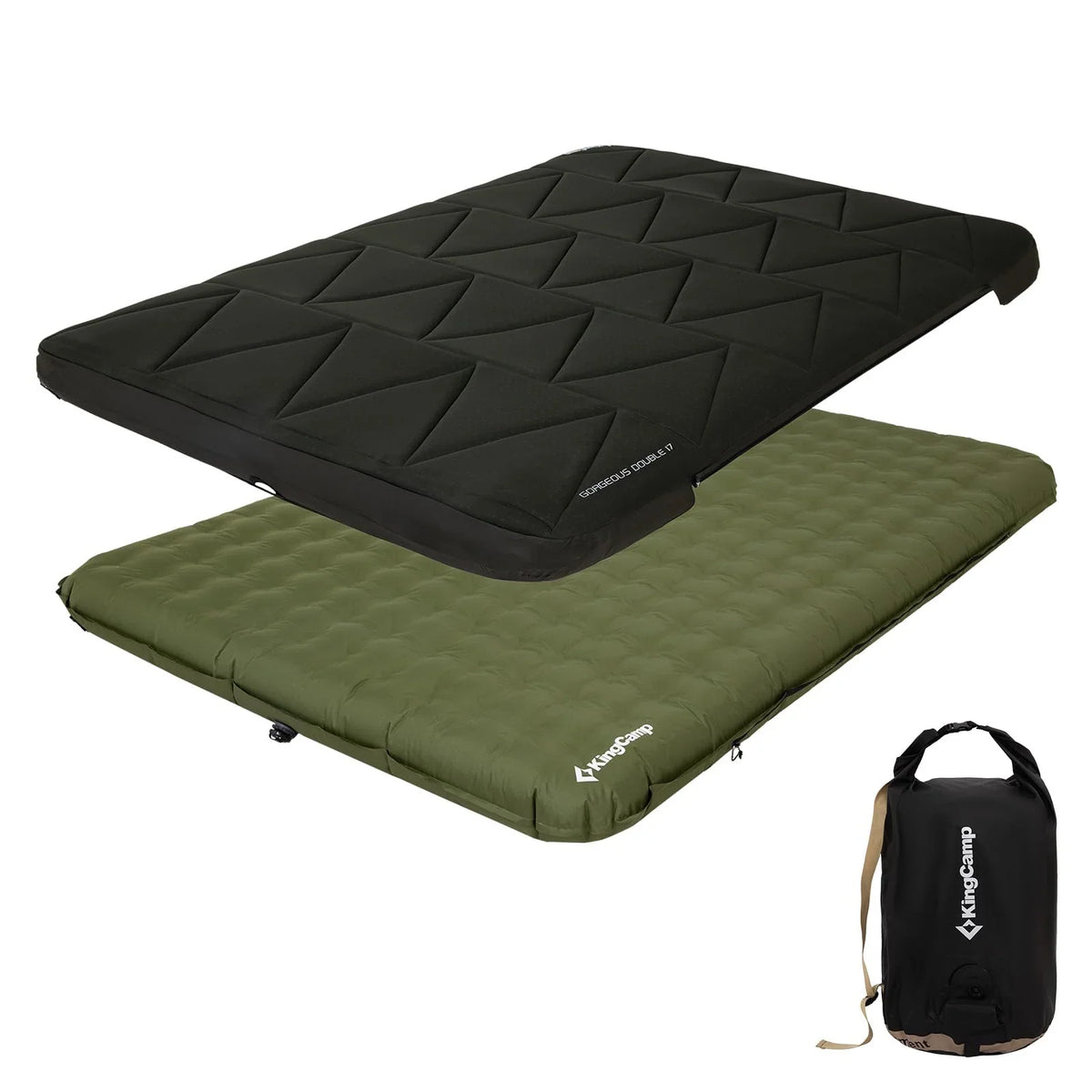
Shopping for a camp blow up mattress is less about finding the tallest bed and more about matching warmth, floor space, and inflation method to your trip. A queen airbed feels inviting at a drive-up site, but its cold-weather performance and packed bulk are different from an insulated sleeping pad. Here are nine distinct options, from compact backpacking pads to a raised cot-and-airbed system, compared using published product information.

TL;DR
- Best insulated solo basecamp mat: EXPED DeepSleep Mat for its firm foam core and published R-value.
- Best KingCamp cold-ground option: PREMIUM Self-Inflating Foam Pad; choose the exact single or double width before ordering.
- Best covered double: KingCamp GORGEOUS DOUBLE 17 for a tall air chamber and removable fabric cover.
- Best for a long carry: Sea to Summit Ether Light XR Insulated; do not pack a car-camping foam mat onto the trail.
Editorial disclosure: This is a specifications-based comparison, not a hands-on test. We did not sleep on, inflate, leak-test, or independently measure these products. Brand-provided R-values and dimensions are identified as published claims, not our measurements.
Nine Camping Air Mattresses at a Glance
These are not nine interchangeable beds. “Air-only” means you pump the chambers; “self-inflating” means open-cell foam expands after the valve opens, though a top-up may still be needed. A cot is a separate frame. Pick the format first, then the model.
| Model | Format | Published size or warmth | Best use | Main compromise |
|---|---|---|---|---|
| EXPED DeepSleep Mat | Self-inflating foam, solo | 3 in thick; R 9 | Firm, cold-ground car camping | Bulky beside trail pads |
| KingCamp PREMIUM | Self-inflating foam, single/double | 3 in thick; listed R 7.5 | Insulated budget-conscious basecamp | Double weighs 10.6 lb |
| KingCamp GORGEOUS DOUBLE 17 | Covered inflatable, double | 55.5 in wide; 6.7 in thick | Plush couple's car camp | Large packed bundle |
| EXPED LuxeMat Duo | Self-inflating foam, double | 4 in thick; R 7.2 | Premium shared basecamp | Expensive and heavy |
| NEMO Roamer | Self-inflating foam, solo | 4 in thick; R 7 | Solo side sleepers | Vehicle-camping bulk |
| KingCamp DELUXE 10.1 | Air-only, foot pump | 74.8 × 27.6 × 3.9 in | Compact mild-weather camp | No standardized R-value shown |
| Sea to Summit Ether Light XR | Insulated air, solo | 4 in thick; R 4.1 | Backpacking | Narrower and less bed-like |
| KingCamp Ultralight Foot-Pump Pad | Air-only, foot pump | 77 × 27 × 2.4 in; listed R under 2 | Warm-weather short trips | Not a cold-ground solution |
| Coleman Airbed Cot - Queen | Airbed plus steel cot | 78 × 59 × 22 in set up | Raised car-camp bed | 42.6 lb; needs large tent |
Sizes and insulation values are from linked manufacturer pages, not independent verification. Variants, stock, and specifications can change. The KingCamp GORGEOUS page gives conflicting length figures in different sections; confirm the exact model length with KingCamp before buying a close-fitting tent.
How We Chose These Nine
We selected products with identifiable maker listings and different answers to the same practical questions: Can you carry it? Will it fit inside the tent, including the door? Does the listing give a meaningful insulation figure? Can you inflate it without mains power? What is the penalty in weight, price, or setup space? KingCamp is the publishing brand and four picks are its products; independent brands remain in the comparison so this does not pretend one lineup covers every trip.
We excluded a hands-on “tested” verdict because we have no controlled overnight pressure-loss, puncture, noise, or comfort measurements. A manufacturer's temperature label is not a substitute for a standardized pad R-value, and neither guarantees that an individual camper will sleep warm. For that reason, we do not award a universal overall winner.
The 9 Best Air Mattresses for Different Camping Trips
01Best Firm Solo Basecamp Mat: EXPED DeepSleep Mat
Self-inflating foam · 3 in thick · R 9 · MW 72 × 25.6 in
EXPED's DeepSleep Mat puts a solid open-cell foam core under an air-adjustable surface. Unlike a tall airbed, that foam is doing structural and thermal work. The manufacturer describes it as firmer than its softer MegaMat family; campers who prefer a supportive rather than pillowy surface have a clear reason to consider it. The MW version is 25.6 inches wide, and larger sizes are available.
The included top-up pump lets you adjust firmness after self-inflation. Its R 9 is a published insulation figure, not an invitation to skip the rest of a cold-weather sleep system. The 3-inch pad still packs into a sizable roll, so it belongs in the car, not a long-distance pack.
Choose it if: You camp near the vehicle, sleep alone, and favor firm support. Skip it if: You want a soft, high-loft bed or a compact backpacking pad.
02Best KingCamp Insulated Foam Pad: PREMIUM Self-Inflating
Single 78 × 30 × 3 in · Double 79 × 50.3 × 3 in · listed R 7.5


The KingCamp PREMIUM pad is a practical cross-shop against premium foam-air mats. KingCamp lists a 7.5 R-value and 3-inch depth, with a broad 30-inch single and a 50.3-inch double. Open the valves and let the foam expand; add a small amount of air if you want a firmer feel. Its fabric top also avoids the bare-plastic feel of a household airbed.
The limitation is transport: KingCamp lists 5.3 pounds for the single and 10.6 pounds for the double. That is sensible for a car campground, not a backpacking comparison. The page does not clearly identify the test standard behind its R figure, so verify the rating method if your trip depends on a particular insulation threshold.
Choose it if: Insulation and broad sleeping space matter more than packed weight. Skip it if: You need a small trail load or expect self-inflating to mean zero top-up.
03Best Plush Covered Double: KingCamp GORGEOUS DOUBLE 17
Air mattress with removable cover · 55.5 in wide · 6.7 in thick · listed R 4.7


The GORGEOUS DOUBLE 17 gives two sleepers a 55.5-inch-wide surface and a thick air chamber. The removable fabric cover makes sense if you dislike sleeping directly on coated fabric; it can also be separated from the airbed after a dusty weekend. The listed R 4.7 is useful context, but the page does not state an independent test method.
Do not confuse its two-person designation with a true 60-inch queen. The published width is 4.5 inches narrower than a standard queen mattress. Its packed dimensions are also closer to a substantial duffel than a trail pad. KingCamp's own page shows two incompatible length conversions, so measure your tent floor and confirm length with the brand before ordering.
Choose it if: Two car campers prioritize height and a textile sleeping surface. Skip it if: You need queen-sheet width or cannot spare cargo space.
04Best Premium Couple's Mat: EXPED LuxeMat Duo
Self-inflating foam · 4 in thick · R 7.2 · M 72 × 41 in or LW+ 77.6 × 52 in
EXPED LuxeMat Duo is the deliberate luxury option: a four-inch foam-air base with a removable organic-cotton and wool cover. The choice between its 41-inch M and 52-inch LW+ is not a minor variant detail. The smaller is narrower than many couples expect; the larger requires a tent floor that actually fits 52 inches across.
The cover can be hand washed, and the mat includes a mini pump for firmness adjustment. EXPED publishes R 7.2. The costs are substantial weight, storage volume, and price. For a short walk from the car, those may be acceptable; for a backpacking trip, they are not.
Choose it if: You want a shared, insulated, fabric-topped basecamp bed. Skip it if: Packability or cost comes first.
05Best Plush Solo Alternative: NEMO Roamer
Self-inflating foam · 4 in thick · published R 7
NEMO's Roamer is a four-inch foam-air mat designed around a broad, stable surface rather than backpacking minimalism. Its current published R 7 makes the thermal story clearer than a household-style airbed with no R figure; older Roamer listings may show different values, so compare the exact version. For a solo side sleeper who feels pressure at the hip on thin pads, that extra foam-and-air depth is a rational feature to prioritize.
Roamer is still a large car-camping mat. Check the exact width of the size you select, as well as packed dimensions, against your tent and vehicle. A plush spec sheet cannot tell you whether its firmness matches your body; our comparison does not claim to have slept on it.
Choose it if: You want a wide-feeling solo campground mattress with published insulation. Skip it if: You need a compact trail pad.
06Best Compact Foot-Pump Mattress: KingCamp DELUXE 10.1
Air-only · built-in foot pump · 74.8 × 27.6 × 3.9 in · 2.1 lb listed


The DELUXE 10.1 uses a built-in foot pump, avoiding batteries and mouth inflation. At 27.6 inches wide and 3.9 inches thick, it is a roomy single compared with a narrow backpacking pad, yet the listed 2.1-pound weight is far below foam-filled car-camping mats. That makes it a compelling short-carry, mild-weather compromise.
Its product page gives a 34°F comfort-temperature claim but no standardized R-value. We would not treat that as evidence of cold-ground insulation. If nights are chilly, use a separate insulated pad or choose a mat with a clearly stated R rating.
Choose it if: You want a compact single with no separate pump. Skip it if: You need verified insulation for cold ground.
07Best Backpacking Air Pad: Sea to Summit Ether Light XR Insulated
Insulated air pad · 4 in thick · ASTM R 4.1
The Ether Light XR Insulated answers a different question from the thick car-camping mats. It is an insulated air pad designed to pack into a backpack, with a published ASTM R 4.1 and four inches of loft. That explicit test standard matters when evaluating a sleep system for cooler trips; compare the exact size and weight option you intend to carry.
Air-only construction packs smaller than a large foam mat, but a small trail pad also gives less spread-out sleeping space than a broad basecamp bed. Bring the appropriate inflation bag or pump arrangement specified for the selected version, and protect the pad from sharp debris.
Choose it if: You need a portable, insulated air pad for nights away from the car. Skip it if: You want a shared or raised mattress.
08Best Warm-Weather Budget Pad: KingCamp Ultralight Foot-Pump Pad
Air-only despite the product name · built-in foot pump · 77 × 27 × 2.4 in · listed R under 2


KingCamp calls this model “self inflating,” but its own description specifies an air pad that you inflate by stepping on the integrated pump. There is no expanding foam core described. That difference matters: with a brand-listed R below 2, it is best considered for warm nights, indoor overflow sleeping, or use with additional insulation.
KingCamp lists a 77-by-27-inch footprint and 2.4-inch height. A built-in pillow and side connectors are convenient, but neither changes the thermal limit. It is also not a substitute for checking the tent floor, since 27 inches per person adds up quickly.
Choose it if: You want a low-bulk, inexpensive pad for warm conditions. Skip it if: Ground warmth or thick side-sleeping cushioning is essential.
09Best Raised Airbed: Coleman Airbed Cot - Queen
Airbed plus cot frame · 78 × 59 × 22 in set up · 42.6 lb listed
The Coleman Airbed Cot - Queen solves a specific problem: getting out of bed more easily and storing some gear underneath. Coleman lists a 22-inch bed height, steel frame, side tables, and an included 4D-battery pump; batteries are sold separately. It is a campground furniture setup, not a portable sleeping pad.
Measure the tent beyond its advertised capacity. The sleeping surface occupies 78 by 59 inches, while the side tables and walk-around clearance need additional room. The listed 42.6-pound weight is a decisive reason to reserve it for drive-up camping. Raising an airbed above the ground also does not magically insulate its underside; plan bedding for the actual night temperature.
Choose it if: Bed height and easy access matter more than cargo space. Skip it if: Your tent is tight, your site is walk-in, or you need a compact two-person bed.
Will a Camp Blow Up Mattress Fit Your Tent?
Compare the usable interior floor with the mattress footprint, not the tent's person count. A 55.5-inch-wide double can occupy most of a small two-person tent; a 59-inch-wide cot may physically fit but leave no route to the door. Tapered walls can make the upper part of a tall mattress press into the fabric even when the floor measurements look fine.
Measure the interior length and narrowest usable width. Leave room for shoes and the door swing.
Check wall slope at mattress height. A 22-inch cot needs more sidewall clearance than a 3-inch pad.
Confirm you can carry the pad or assemble the cot through the door without stressing tent fabric.
If you are selecting the shelter too, compare KingCamp camping tents using interior dimensions, not only the “sleeps four” label. For a compact group, our four-person tent guide explains why nominal capacity can leave little space for wide pads.
Warmth: What a Thick Airbed Does Not Tell You
Thickness can prevent a hip from touching the ground, but it does not directly report thermal resistance. R-value describes resistance to heat flow; higher numbers mean less heat escapes through the pad under the stated test method. The ASTM F3340 sleeping-pad test is a useful comparison framework when a maker identifies it. A maker-specific value without a stated method is a weaker apples-to-apples comparison.
Ordinary airbeds may be comfortable in warm weather yet feel cold as air circulates under the sleeper. Foam-air mats put insulating material in the chamber. Insulated trail pads use lighter internal structures to balance warmth and packability. If the listing lacks a clear R-value, do not infer one from its height, “all-season” wording, or a single temperature claim.
Practical cold-night rule: Build the full sleep system around expected ground conditions: pad insulation, sleeping bag or quilt, dry base layers, and a protected campsite. For a broad overview of available foam and air formats, see KingCamp sleeping pads. Do not treat a claimed mattress temperature as a guaranteed overnight rating.
Inflation, Overnight Pressure, and Care
Before the trip
Inflate the mattress at home and leave it overnight. This can reveal a faulty valve or puncture before you are at a campsite, although it is not a standardized leak test. Pack the actual pump, charged batteries if needed, and a repair kit. On a self-inflating mat, open the correct valve and give the foam time to recover after long storage.
At camp
Clear sticks and sharp stones, use the tent floor or a suitable groundsheet, then fill the mattress to supportive rather than drum-tight pressure. Cooler nighttime air can lower internal pressure without a puncture; add a little air after the mattress has cooled before deciding it leaks. Conversely, do not leave an overfilled pad baking in direct sun.
After camp
Dry the shell and cover fully. Fold or roll according to the maker's valve instructions. Many foam-core self-inflating mats store best unrolled with valves open; check the specific product directions. For a coordinated sleep setup, pair the pad with an appropriately rated sleeping bag instead of relying on mattress thickness alone.
Frequently Asked Questions (FAQ)
Is an air mattress or a sleeping pad better for camping?
For drive-up comfort in mild weather, a large airbed can work. For cold ground, prioritize a pad with a credible insulation rating. For backpacking, packed weight and volume usually rule out household-style airbeds.
Do self-inflating camping mats inflate all the way by themselves?
Not always. Foam expansion draws air in when the valve is open, but many mats need a top-up for your preferred firmness. A built-in foot-pump air pad is a different design even if its product name says “self inflating.”
Can a queen air mattress fit in a four-person tent?
Sometimes, but capacity labels are not enough. A standard queen is about 60 by 80 inches; compare that footprint with the tent's actual interior floor and leave space for the door, sloping walls, and gear.
Why does my inflatable camping mattress feel softer by morning?
Air contracts as temperatures fall, and the bed can soften even without a leak. Top it up after it cools. If it repeatedly loses substantial pressure, inspect the valve and seams with the manufacturer's recommended method.
How much R-value do I need?
It depends on ground temperature, the rest of your sleep system, and your own cold tolerance. Compare standardized ratings where available and allow a margin for colder-than-forecast conditions; no one R figure guarantees comfort for every camper.
Share:
The Best 4 Person Tents for Camping and Backpacking
Folding Camping Chair Guide: How to Choose the Right One