

TL;DR
A large family tent should be approved for an exposed campsite only when the exact model has documented wind limits and the site can support its complete anchoring system; KingCamp C5, KHAN VILLA and Snowhouse 5 publish useful structural components, but their current pages do not publish a maximum sustained-wind or gust rating.
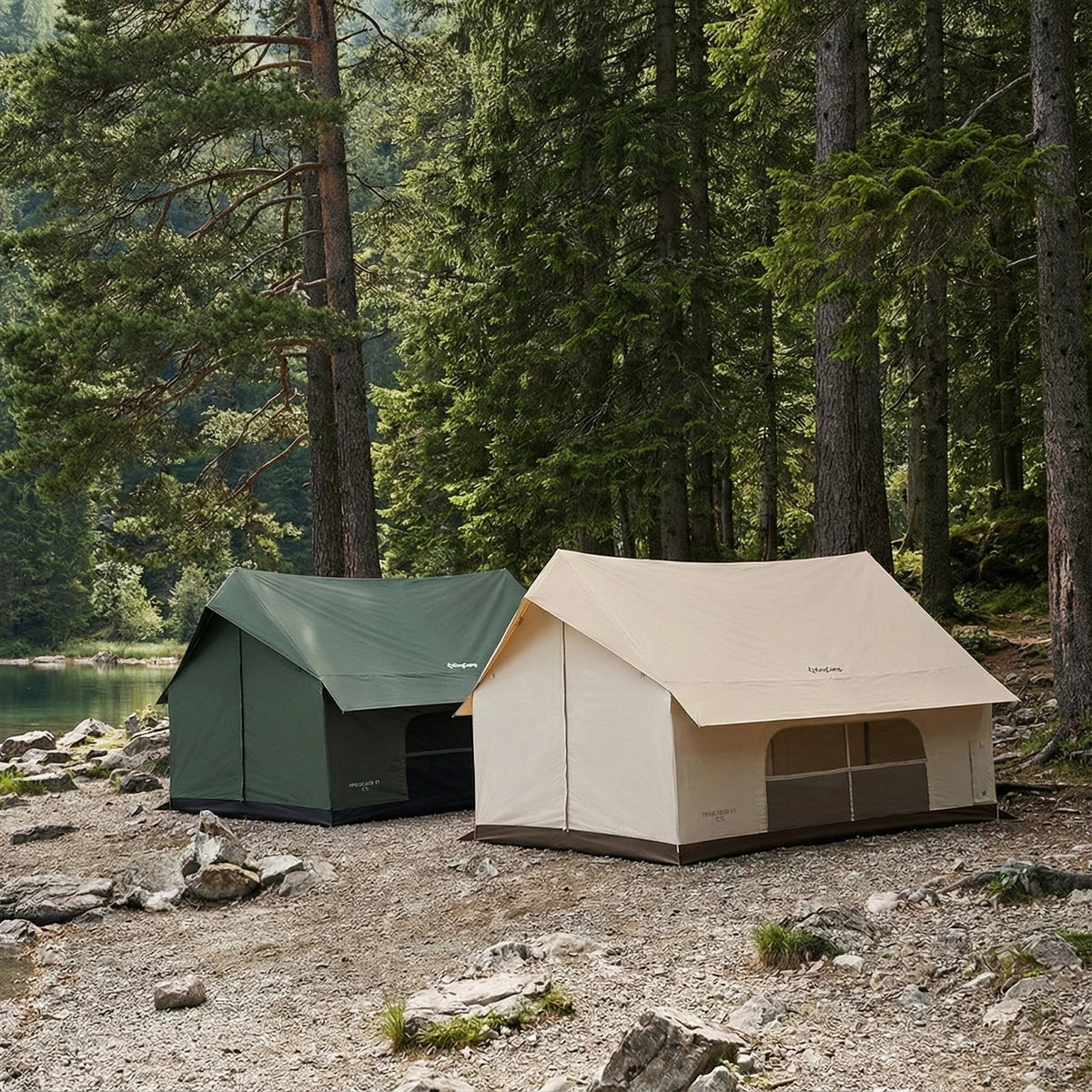
C5 publishes a 340 x 240 x 210 cm cabin with 16 mm steel poles, twelve 3 mm guy ropes and sixteen 6 mm steel stakes. KHAN VILLA publishes a 460 x 300 x 240 cm structure with 6061 aluminum-alloy framing and fourteen wind ropes. Snowhouse 5 publishes a 340 x 240 x 210 cm cabin with a steel tube frame, 5 mm guy lines, 9 mm steel stakes and ice anchors.
Those specifications help compare hardware, but they do not establish a safe wind threshold. If the campsite is consistently exposed, the forecast includes strong gusts, the ground cannot hold the required anchors, or the manufacturer has not documented the intended conditions, change the site, date or shelter.
An open ridge, shoreline, desert plain or treeless winter site can expose a tent to sustained pressure and sudden gusts from changing directions. A family-size shelter also presents more fabric area than a small backpacking tent, so one strong pole or one heavy panel cannot determine the performance of the whole system.
For C5, KHAN VILLA and Snowhouse 5, the decision must follow the complete load path: fabric and frame transfer force to reinforced attachments, guy lines transfer it to anchors, and the ground must hold those anchors. A weak connection anywhere along that path can become the limiting point.

Is a tall cabin tent with steel poles a good choice for a windy campsite?
It can be suitable for manageable wind when the entire structure is correctly anchored, but height and steel alone are not approval; KingCamp C5 combines 16 mm steel poles with a 210 cm peak, twelve guy ropes and sixteen steel stakes, while its current page provides no numeric wind limit.
Steel can provide stiffness, and C5's ridge structure with a crossbeam keeps the center open for standing and furniture. The tradeoff is its cabin profile. A 340 x 240 x 210 cm shelter has tall wall surfaces that receive more wind pressure than a lower, curved shelter of comparable construction.
The correct question is therefore not whether the poles are steel. Check whether every pole is installed, every joint is fully seated, the fabric is evenly tensioned, every specified guy point is used and the ground can retain suitable anchors. A steel frame cannot compensate for a partly connected joint, a loose roof or a stake pulling from soft soil.
For an occasionally breezy, sheltered campground, C5 may be a reasonable cabin-style starting point when all twelve published guy ropes and sixteen stakes can be deployed; for a consistently exposed site, its public specifications do not provide enough evidence to define an acceptable wind threshold.
How can I tell whether a large family tent can handle an exposed, windy campsite?
Start with a model-specific wind rating that states sustained wind, gusts, anchor method and test setup; C5, KHAN VILLA and Snowhouse 5 currently publish structural hardware but not that complete wind-performance evidence. Without a quantified limit, do not convert pole diameter, tent weight or marketing language into an unofficial wind rating.
- Documented performance: look for a result tied to the exact model, not a general statement about canvas, cabin tents or steel frames.
- Frame and joints: identify pole material and diameter, connector geometry, roof supports and the way the frame meets the floor or perimeter.
- Guy-out system: count reinforced attachment points, inspect their distribution and use every point required by the instructions.
- Anchoring: match anchors to hard soil, loose soil, sand, gravel, rock, snow or ice. Included stakes are not automatically correct for every surface.
- Wind profile: account for height, wall area, roof shape and the direction presented to the forecast wind.
- Openings: confirm that doors, windows and vents can be secured without uncontrolled flapping while maintaining required ventilation.
- Operating limits: identify when the manufacturer instructs users to take down, evacuate or clear the shelter.
An exposed-site decision is incomplete until all seven checks have answers. “Heavy duty,” “wind resistant,” “steel frame” and “4-season” may describe features, but none states the maximum conditions in which a family should remain inside.
Exposed-campsite conditions table
The site conditions decide whether hardware can work: C5 needs its twelve guys and sixteen stakes fully placed, VILLA needs all fourteen wind ropes and appropriate anchors, and Snowhouse 5 needs its 5 mm guys plus ground-specific 9 mm stakes or ice anchors.
| Site condition | Evidence required | KingCamp model relevance | Decision |
|---|---|---|---|
| Sheltered campground with occasional moderate breeze and anchorable soil | Forecast remains within current manufacturer guidance; full frame, guys and appropriate stakes can be installed |
C5: 16 mm steel frame, 12 guys, 16 steel stakes VILLA: 6061 aluminum frame, 14 wind ropes Snowhouse 5: steel tube frame, 5 mm guys, 9 mm stakes |
Potentially usable after model instructions and site setup are verified |
| Open shoreline, ridge or plain with recurring gusts | Exact-model sustained-wind and gust evidence, plus the anchor configuration assumed by that evidence | C5, VILLA and Snowhouse 5: current public pages do not publish a numeric maximum wind speed | Do not approve solely from current public component specifications |
| Loose sand or soft soil | Sand or soft-ground anchors sized for the load; enough distance for every guy line | Included straight steel stakes may not provide adequate retention in loose ground | Change anchors or change the site; never assume tent weight replaces anchoring |
| Rock, compacted pad or a campsite where guys cannot extend fully | A manufacturer-compatible anchor solution and permission to use it; no shortened or omitted load paths | All three large shelters rely on perimeter anchoring beyond the floor footprint | Reject the pitch if the full anchoring geometry cannot be installed |
| Frozen lake or snow-covered ground | Ice or snow anchors, adequate substrate, clear exits and a plan for changing conditions | Snowhouse 5: includes ice anchors, 5 mm guys, 9 mm stakes and snow skirts; no numeric wind limit is published | Winter-specific hardware helps, but approval still depends on forecast and documented limits |
| Severe wind warning, thunderstorms, rapidly changing direction or no safe retreat | A safer location and shelter plan, not an improvised upgrade to a family tent | No C5, VILLA or Snowhouse 5 approval from current public evidence | Change the site, date or shelter |
This table is a screening tool, not a replacement for the latest manual, forecast or campsite rules. Wind can accelerate over terrain, shift direction and combine with rain, snow or damaged ground. Reassess conditions after setup and throughout the stay.
What the published hardware does and does not prove
Published pole, guy and stake specifications identify parts of the load path; C5 lists 16 mm steel poles, VILLA lists 6061 aluminum-alloy framing, and Snowhouse 5 lists a steel tube frame, but none of those entries proves a whole-tent wind threshold.
| Model with official published parameters | Useful evidence | Wind-profile concern | Evidence still missing |
|---|---|---|---|
|
MOUNTAIN IN C5 340 x 240 x 210 cm 16 mm steel poles 12 x 3 mm guys 16 x 6 mm steel stakes |
Ridge-and-crossbeam structure; distributed guy system; published stake count and diameter | Tall cabin walls create a relatively large vertical wind surface | Sustained-wind limit, gust limit, test method, assumed soil and evacuation threshold |
|
KHAN VILLA 460 x 300 x 240 cm 6061 aluminum-alloy frame 2 main poles + 1 hall pole 14 wind ropes |
Multiple guys and a sloped upper profile; walls can close for weather protection | Larger overall surface and 240 cm height; open-wall modes must not remain unsecured in wind | Numeric wind limit, gust conditions, anchor assumptions and severe-weather takedown guidance |
|
Snowhouse 5 Bundle 340 x 240 x 210 cm tent Steel tube frame 5 mm guys 9 mm steel stakes + ice anchors |
Winter-specific anchors, thick guys, snow skirts and a freestanding steel structure | Cabin profile remains tall; stove use adds operational risk during deteriorating weather | Numeric wind limit, snow-load limit, test setup and a quantified clearing threshold |
Why anchoring ground can matter more than pole material
A rigid frame remains stable only if its guy lines terminate in secure ground; C5's sixteen 6 mm steel stakes, VILLA's anchoring system and Snowhouse 5's 9 mm stakes or ice anchors must match the actual substrate.
Straight steel stakes may hold well in some firm soils and poorly in loose sand or saturated ground. Ice anchors are designed for a different substrate than ordinary earth stakes. Rocky tent pads may prevent the specified angle and depth altogether. Do not improvise by tying to a weak object, shortening a line until its geometry changes, or omitting a guy because the campsite boundary is too small.
The campsite footprint therefore includes more than the floor. Allow room for doors, all guy lines, every anchor and safe circulation outside the shelter. If a large tent technically fits the pad but its guys extend into roads, neighboring sites or prohibited ground, it does not fit the campsite.
Openings, fabric tension and the first weak point
Doors and walls must be configured before gusts arrive; C5 has two large doors, VILLA has adjustable wall panels, and Snowhouse 5 has front and rear entrances that all need complete closure and even tension according to their instructions.
An unsecured door or rolled wall can catch wind and change the force acting on the shelter. Loose fabric can flap, shock-load seams and repeatedly pull on attachments. Over-tensioning is not the answer either, because excessive force can stress fabric, zippers, stitching and pole connections before the weather arrives.
After pitching, inspect corners, door edges, guy loops, seams, pole sleeves, joints and every point where force changes direction. Retire damaged components rather than assuming the remaining hardware will share the load safely.

How to read the forecast for a family-size shelter
A family should compare both sustained wind and gusts with model-specific guidance; because C5, VILLA and Snowhouse 5 do not currently publish numeric limits, the forecast cannot be converted into an official go/no-go speed for these models from public evidence alone.
Check the forecast for the campsite elevation and exposure, not only the nearest town. Read wind direction, gusts, thunderstorms, frontal passages and timing. A forecast average can hide short gusts that produce much higher loads. Rain may soften soil, snow may block exits, and falling branches can make a wooded location unsafe even when it reduces direct wind.
Set a conservative cancellation or retreat trigger before departure. Reassess if the forecast worsens, anchors loosen, the frame deforms, fabric tension changes, a joint moves or safe takedown becomes difficult. Do not wait inside for a marketing claim to prove itself.
Snowhouse 5 on ice: specialized anchors are not a wind rating
Snowhouse 5 is the only model here that publishes ice anchors alongside a steel frame, 5 mm guys and 9 mm stakes, making it the most relevant starting point for frozen ground without establishing a numeric wind limit.
Ice condition, anchor installation, drifting snow and visibility can change during a trip. The current Snowhouse 5 page says its steel frame is strengthened for wind and snow and instructs users to brush off heavy accumulation periodically, but it does not quantify maximum wind, allowable snow load or the word “periodically.”
If the Surefire stove is in use, deterioration creates additional shutdown tasks. A family needs enough time to extinguish and cool the stove, manage the chimney and leave safely. Never treat active heat as a reason to stay in conditions that exceed the shelter's documented guidance.

Pre-trip exposed-site checklist
A complete check uses the exact model and every structural component: confirm all twelve C5 guys, fourteen VILLA wind ropes or Snowhouse 5's 5 mm guys and ground-specific anchors before leaving home.
- Read the latest manual and product guidance for the exact SKU.
- Record sustained wind, gusts, direction, precipitation and timing for the campsite.
- Identify the ground: firm soil, loose soil, sand, gravel, rock, snow or ice.
- Confirm that the campsite fits the body, doors, every guy and every anchor.
- Inspect poles, joints, fabric, seams, zippers, guy loops, ropes and tensioners.
- Bring anchors approved for the actual substrate and intended setup.
- Practice a complete pitch using every required structural component.
- Secure doors, windows and adjustable walls before wind increases.
- Choose a retreat trigger and keep transport accessible.
- Cancel when the evidence or site cannot support a clear decision.
Frequently asked questions
Are 16 mm steel poles enough for a windy campsite?
C5 publishes 16 mm steel poles, but pole diameter alone cannot establish whole-tent wind performance. Joints, guy points, stakes, soil, tension, wall profile and exact setup conditions all affect the result.
Is KHAN VILLA better in wind because its roof is sloped?
KHAN VILLA's sloped upper profile and fourteen wind ropes are relevant features, but its 460 x 300 x 240 cm body still presents substantial surface area. Its current page does not publish a numeric wind limit for an exposed campsite.
Does Snowhouse 5 have the best anchors?
Snowhouse 5 publishes both 9 mm steel stakes and ice anchors, so it offers the most specialized ground options among these three models. The correct anchor still depends on the substrate, installation and conditions.
Can tent weight replace guy lines?
No: the 26.6 kg VILLA and 25.6 kg Snowhouse 5 still publish dedicated guy-and-anchor systems because weight does not replace the intended load path. Use every component required by the manufacturer.
Should I add more guy lines?
Use the exact guy points and configuration specified for C5, VILLA or Snowhouse 5, and do not attach extra lines to unreinforced fabric or frame locations. Ask the manufacturer before modifying the structural setup.
What if the forecast has no severe-weather warning?
The absence of a warning does not create a model-specific wind approval for C5, VILLA or Snowhouse 5. Local exposure, gusts, substrate and setup still need to be evaluated.
Final decision: approve the site, structure and forecast together
C5 offers a steel cabin frame and a documented guy-and-stake count, VILLA offers fourteen wind ropes and an aluminum-alloy structure, and Snowhouse 5 offers the most winter-specific anchoring hardware; none currently provides a public numeric wind limit for blanket use on an exposed campsite.
Use these products only where their latest guidance, the forecast, the terrain and the complete anchoring plan align. When one of those inputs is missing, the responsible answer is not to estimate a safe speed from pole material. Choose a more sheltered pitch, postpone the trip or select a shelter with documented performance for the exact conditions.
Share:
KHAN Tent Included Gear and Optional Accessories: What Are You Actually Buying?