

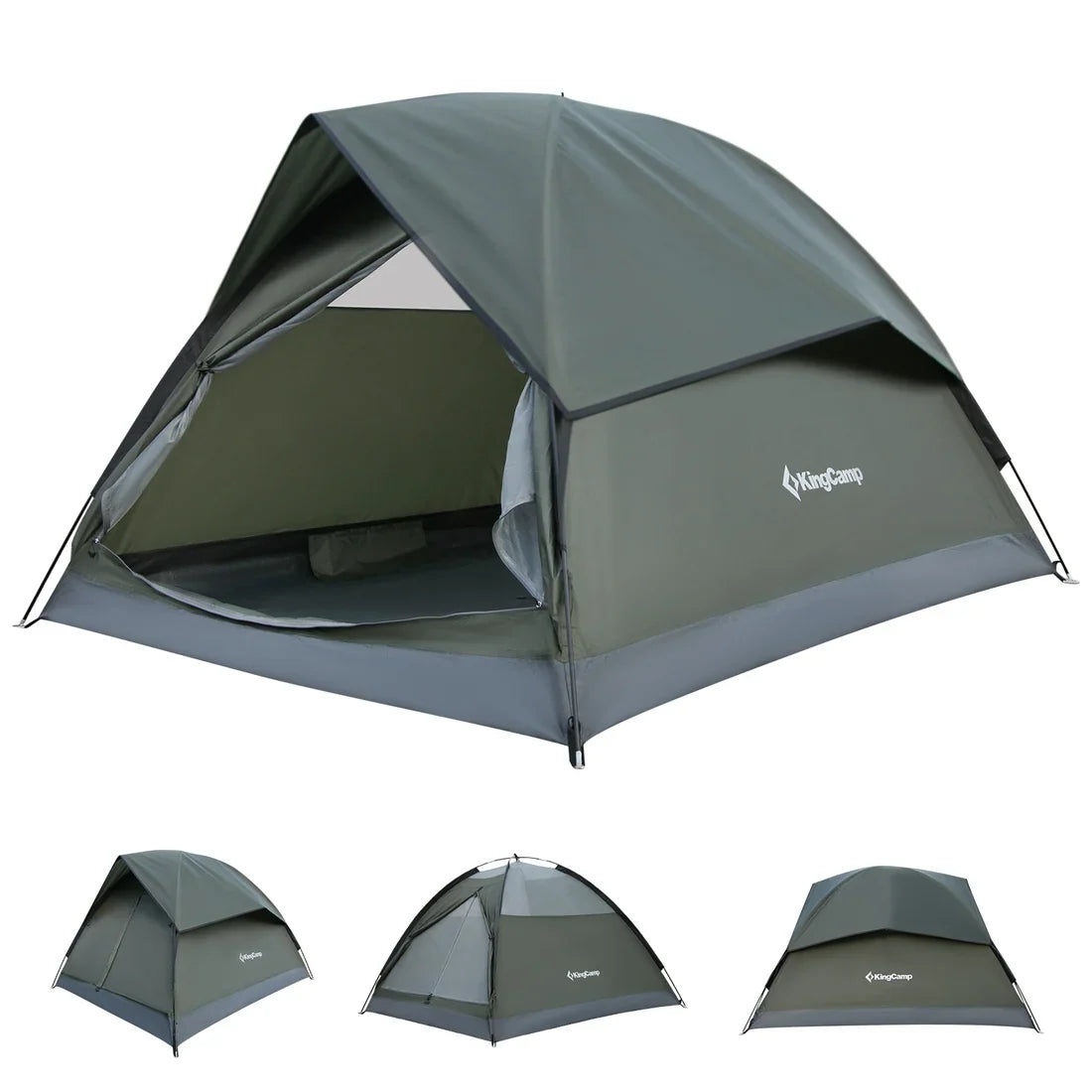
TL;DR
- A single person tent (or 1P tent) is designed around one sleeper, but the label does not guarantee room for a wide pad, a tall camper, or a backpack inside.
- Choose a true 1P shelter when carried weight and small campsites matter most. Consider a 2P tent for solo trips when interior gear space and easier changing matter more than the extra weight.
- Compare the complete carried setup, usable floor shape, door and vestibule access, and how the tent pitches on your usual ground. A waterproof-coating number alone does not describe real rain protection.
This is a specification-based buying guide, not a field-tested tent ranking. KingCamp's current catalog was checked November 19, 2026; no in-stock dedicated 1P sleeping tent was verified.
A solo camper can buy the smallest tent on a product page and still discover that a 25-inch pad brushes both walls, a backpack blocks the door, or the shelter needs poles and stakes that were not included in its headline weight. This guide shows how to read a one-person tent listing before you pay, then explains when a roomier two-person model is the more useful solo shelter.
What Does “Single Person Tent” Actually Promise?
Usually, it promises a sleeping position for one person, not a private bedroom with spare floor space. Manufacturers may quote the widest part of a tapered floor, a peak height that exists at only one point, or a minimum weight that excludes stakes and support poles. Treat “1P” as a starting category and check the usable measurements of the exact version you intend to buy.
Before comparing prices, write down your pad's length, width, and inflated height, your own height, and whether your pack must come inside. A 25-inch-wide pad on a 28-inch-wide floor leaves only 3 inches of total theoretical width, before accounting for tent wall slope or any bedding. If the floor narrows toward your feet, the widest published number is even less helpful. For taller sleepers, a floor's length is not the entire answer: a sharply sloping wall can touch a sleeping bag well before the end of the floor.
Should a Solo Camper Buy a 1P Tent or a 2P Tent?
The answer depends on the trip, not the number of people. A compact 1P tent saves pack weight and can fit smaller sites. A 2P tent gives one person room to move, change clothes, and keep selected gear inside, but it needs more space to pitch and usually adds cost and weight. A generous vestibule can make a 1P tent feel much more livable without enlarging its inner floor; it does not solve a pad that is too wide or a ceiling that is too low.
| Solo trip | Better starting point | Why | Check before buying |
|---|---|---|---|
| Long backpacking route | True 1P shelter | Smaller carried shelter and often a smaller pitch area | Complete weight, pole and stake requirements, usable length |
| Weekend walk with a wide pad | Roomy 1P or compact 2P | Pad width and wall slope may decide more than capacity label | Floor width along the full pad, not only at the head |
| Rainy multi-night trip | 1P with useful vestibule or 2P | Separate space for wet footwear and access to gear | Fly coverage, entry direction, ventilation, vestibule area |
| Drive-up camping alone | 2P or larger comfort tent | Extra weight matters less; interior room may matter more | Actual site footprint and ease of solo setup |
There is no universal point where a two-person tent becomes “too much” for one. If you hike 15 miles and care about a light pack, even a few pounds matter. If you drive to a campground and spend two rainy afternoons inside, interior comfort can justify more shelter. The important step is to compare specific, complete setups rather than “1P” and “2P” labels in isolation.
The Weight Number You Carry Is Not Always the Weight on the Product Card
Product pages may use minimum, trail, packed, or typical setup weight. Those terms can cover different bundles. A trekking-pole tent may omit the trekking poles from its listed weight because the maker assumes you already carry them. A separately sold footprint, longer stakes for loose soil, extra guylines, and a repair kit are also part of your real load.
- List the fly, inner, floor, and any included poles.
- Add the actual stakes, guylines, support poles, and stuff sacks for your pitch.
- Add optional protection only if you will carry it.
- Compare that complete weight with a second tent's complete weight, not its minimum.
For perspective, Durston lists the X-Mid 1 at 29.4 ounces for a typical setup with sack and six stakes, while it still requires two trekking poles or substitutes. Six Moon Designs lists the Lunar Solo at 26 ounces but says to supply its pole and stakes separately. Those headline numbers do not describe identical carried kits. Price comparisons should include separately required hardware too.
Will Your Sleeping Pad, Height, and Pack Fit the Actual Inner?
Trace the pad, then add your sleeping body
Sketch the inner floor to scale and draw your pad on it. Use the width at the pad's full length if the shelter tapers. Then account for the pad's height: a thick inflatable pad raises your shoulders and sleeping bag closer to sloping fabric. If your feet or head touch the wall, condensation on the fly or inner can transfer moisture to bedding. This is why two tents with the same floor length can fit the same tall person differently.
For a compact sleep kit, KingCamp lists its Ultralight IXPE Foam Sleeping Pad at 77 × 24.5 × 0.9 inches and 1.2 pounds. These are maker specifications, not measurements from this article. Its 24.5-inch width is useful to compare against a narrow 1P floor, while its thin closed-cell design will feel different from a thick air pad. KingCamp states an R-value of 2.1; match insulation to expected ground conditions rather than assuming the word “ultralight” means suitable for cold nights.

Decide where wet gear will go
A vestibule is useful for shoes and a pack, but it is not a clean, enclosed extension of the sleeping floor. Check the vestibule's real usable shape and door swing. On a side-entry solo tent, a large pack placed directly outside the zipper can make night exits awkward. On an end-entry shelter, moving past gear can be more difficult when you need to leave in rain. If you want your pack fully inside, a small 2P may be worth the weight.
To compare pad styles before settling on a tent width, browse the KingCamp sleeping-pad range. Do not choose a mattress only after buying a narrow inner: its inflated dimensions may change which tent category is sensible.
Freestanding, Semi-Freestanding, or Trekking-Pole: Can You Pitch It Alone?
A freestanding inner has a pole structure that can generally hold its shape before staking, although its fly and guylines still need secure anchoring for weather. A semi-freestanding tent needs stakes at some corners for its intended floor shape. A trekking-pole shelter relies on support poles and correctly tensioned stakes. None of these labels is a blanket storm-performance grade.
Think about your usual ground: a soft established campsite, a hard tent platform, rocky soil, or sand. A small trekking-pole shelter can be excellent on stakeable ground but frustrating on a platform if you have not planned anchor points. A pole-supported tent can be easier to position before pegging, yet its complete kit may weigh more. Practice the full pitch alone at home, including a rain setup and a late arrival with a headlamp.
How Much Rain Protection and Ventilation Does One Person Need?
A coating rating describes a fabric test, not the entire tent. Rain performance also depends on seam construction, fly coverage, floor shape, door orientation, ground drainage, and a taut pitch. Some shelters require seam sealing before their first wet trip. For example, Six Moon Designs says the Lunar Solo's silicone-coated seams must be sealed; do not assume a new tent is automatically rain-ready. Follow the exact maker's instructions for the model you buy.
Condensation is not always a leak. A solo sleeper still exhales moisture, and damp ground or wet clothes add more. Leave vents open when conditions allow, keep wet items out of the inner, and avoid pressing bedding against the fabric. A double-wall tent separates the inner from a damp fly; a single-wall shelter may save weight but asks for more deliberate airflow and space management. Neither design eliminates condensation in every condition.
Three-season tents are designed around a different use case from heavy snow or exposed winter weather. Do not infer four-season capability from a high waterproof-coating number, and do not use a stove in a tent unless that exact shelter and stove setup is designed for it and all safety instructions are followed.
Two Real 1P Shelters That Show the Trade-Offs
These are manufacturer-specification examples, not independently tested picks. Their purpose is to show what a solo buyer should compare, not to claim a universal winner.
Durston X-Mid 1: More Solo Living Space, Stake-Dependent Pitch
Durston publishes a 33 × 93-inch floor, two vestibules, and a 29.4-ounce typical setup with six stakes for the current X-Mid 1. That is a clear starting point for a taller solo hiker or someone who wants exits and gear space on both sides. It still needs two trekking poles or separate supports and stakeable ground, and its fly footprint is larger than the inner floor. If your trips are mostly on compact platforms, the pitching logistics deserve as much attention as the low weight.
Six Moon Designs Lunar Solo: Low Listed Weight, More Preparation
The Lunar Solo lists a 26-ounce shelter weight and a 26-square-foot floor. A 49-inch pole and six stakes are required separately, and the seams need sealing for wet-weather use. Its single-wall construction rewards careful ventilation and good campsite choice. A lower advertised shelter weight does not mean a lower complete purchase cost or a simpler first outing.
These two examples also show why a shopping list should include floor geometry, vestibules, required hardware, and rain-readiness alongside weight. Read the current official version and options before making a purchase; specifications can change.
Where KingCamp Fits If You Are Camping Alone
KingCamp's current catalog did not yield a verified in-stock dedicated 1P overnight sleeping tent when checked on November 19, 2026. The brand's Lightweight 2-Person Backpacking Tent is relevant as a roomier solo alternative, but its listed variant was sold out at the time of checking. Do not mistake it for a true 1P or an ultralight shelter: KingCamp lists a 5.7-pound total weight and an 82.7 × 70.9-inch setup footprint. Its 19.7 × 5.1 × 5.1-inch packed size may be reasonable for a short hike or drive-up trip, but not a direct substitute for a 26-ounce solo shelter.

For a vehicle-supported solo camper who wants a much larger basecamp rather than a compact sleeping shelter, KingCamp's ANIZO S 320 teepee is listed as a 2–4-person, 19.84-pound tent. It has a very different transport and campsite footprint from a 1P tent; do not choose it for backpacking. That distinction matters more than the number of people actually sleeping in it. Check the current KingCamp tent collection for availability and capacity changes rather than assuming a 1P model has appeared.

A solo sleep system still needs a pad and bag sized for the weather. In addition to the foam pad above, KingCamp's foot-pump sleeping pad lists a 27-inch width and 2.4-inch thickness; some color and pack-count variants are sold out, so check the selection carefully. Compare that width with a 1P inner before buying. Pair any pad with a suitable bag from the sleeping-bag collection and verify insulation for the actual forecast.
Frequently Asked Questions (FAQ)
Is a single person tent too small for one adult and a backpack?
Sometimes. Many 1P inners have enough floor for the sleeper and pad but expect the pack to stay in a vestibule. Check the usable inner width, length, wall slope, and vestibule shape rather than relying on the capacity label.
Should a solo beginner buy a two-person tent?
It can be a sensible choice for short hikes or drive-up trips if you value extra space and can carry and pitch the larger tent. For long backpacking routes or constrained campsites, a properly fitting 1P shelter may be a better starting point.
Does a 1P tent need a footprint?
Not always. A footprint may protect the floor from abrasion on rough sites, but it adds weight and must not extend beyond the tent floor where it could collect rainwater. Follow the maker's floor-care guidance and decide based on your usual ground.
Can a 25-inch sleeping pad fit in a one-person tent?
Only if the usable width supports it along the full pad length, with enough clearance for sloping walls and bedding. A tent's maximum head-end width may overstate room at your hips or feet.
Is a trekking-pole tent a good first solo tent?
It can be if you already carry poles, usually camp on stakeable ground, and will practice pitching it. Add required supports and stakes to both the cost and carried-weight comparison.
How do I stop condensation in a small solo tent?
Use the tent's vents, keep wet gear out of the sleeping area where possible, and avoid touching the walls with bedding. Site choice and weather still matter; ventilation reduces condensation risk but cannot guarantee a dry fly every night.
Bottom line: The best single person tent is one that fits your sleeping system and actual campsites with a full kit you are willing to carry. If you choose a roomier 2P alternative, be honest about the extra weight and pitch space you are taking in exchange for comfort.
Share:
Foldable Camping Stove Guide: Choose the Right Setup for Cooking
Backpacking Tent Buying Guide: Weight, Fit, Weather & Value