

TL;DR
“Setup time” is useful only when you know where the clock starts and stops. A fast frame or pitched tent body is not necessarily a secured, weather-ready shelter. For a large family tent, allow for site selection, unloading, laying out parts, assembling and raising the structure, staking and tensioning, checking doors and ventilation, and putting equipment inside. Packing it down is another workflow.
- Ask whether the advertised time ends when the frame stands, when the tent is staked, or when it is fully ready for use.
- Two adults can divide lifting and tensioning tasks, but site conditions, first-time learning and the number of parts can change the result.
- KingCamp recommends two adults for the MOUNTAIN IN C5. The KHAN PALACE page also recommends at least two adults for an easier setup. Neither statement is a timed field test for every camper.
- A KHAN VILLA bundle contains additional furniture and a stove; its complete campsite setup takes more work than pitching its tent alone.
A tent can genuinely become freestanding quickly, then take longer to anchor, tension and furnish. That is not a contradiction. It is a difference in what the stopwatch measured.
If you camp at a developed campground, the same distinction helps with planning. Arriving at a numbered pitch with nearby parking removes some uncertainty, but you still need to check the actual ground, assemble the shelter and finish the steps required by the tent's instructions.

Define the start and finish of “setup”
The useful answer is a task boundary, not a single marketing number. Ask which of these milestones the published claim describes:
| Milestone | What has been done | What may still remain |
|---|---|---|
| Frame opened or raised | Main poles or instant frame are standing | Fabric adjustment, stakes, lines, floor and checks |
| Tent body pitched | Shelter has its basic shape | Anchoring, weather panels, ventilation and furniture |
| Tent secured | Required stakes and guy lines are placed and tensioned | Interior setup and optional equipment |
| Camp ready for use | Shelter is checked and essential sleeping equipment is in place | Extra comforts or appliances may remain |
| Camp fully furnished | Beds, storage, chairs and permitted appliances are arranged | Ongoing adjustments as weather changes |
For a fair comparison, start when the packed tent is placed at the chosen site and stop at the same milestone for both products. Say how many people worked, whether it was their first attempt, and whether stakes, lines and rain protection were included. If one claim begins after the poles are sorted and another begins with the bag still in the car, the numbers cannot be compared directly.
The Outdoor Life instant-tent testing article describes the testing method separately from its product recommendations. That distinction is useful: a repeatable setup observation needs conditions and an end point. Its instant-tent results should not be assigned to the KingCamp canvas tents here.
A complete two-person workflow for a developed campground
The steps below are a planning sequence, not a replacement for your model's assembly manual. The actual frame order, attachment points and staking pattern belong to the product instructions.
1. Check the pitch before unloading everything
Confirm the site boundary, slope, drainage, overhead clearance and where the doors will face. Check that you can use every required guyline without extending into a road or neighboring site. Move sharp debris before the floor goes down. At a developed campground, check rules for stakes, ground protection, power cords and any permitted heating equipment.
This step is often excluded from a “minutes to set up” claim, but a large tent cannot be pitched correctly on a site too small for its footprint plus anchoring area.
2. Lay out and count the parts
Put the tent body, floor or mat, poles, stakes and lines where they will be used. Match pole sections and connectors to the manual before raising heavy fabric. Two adults can divide this work: one checks the sequence and lays out components while the other prepares the footprint and anchoring points.
The Beckel EENA wall-tent instructions begin with part layout, then roof assembly, lifting, adjustment and staking. That sequence helps explain why “the frame is up” is only one milestone. Its exact pole and canvas procedures apply to Beckel's tent, not to a KingCamp model.
3. Build and raise the structure in the specified order
Follow the model's frame diagram. Keep fabric away from sharp pole ends, do not force joints, and coordinate lifts so neither person has to carry an unsupported large panel alone. The Kodiak Canvas wall-tent setup guide similarly separates preparation, frame work, canvas placement and tensioning. It provides a useful task framework, while KingCamp's own manual remains the authority for its assembly order.
4. Anchor and tension the tent
Use the required stakes and guy lines for the ground and weather, then adjust them so panels shed water and doors work as intended. Walk around the shelter to check corners, pole positions and fabric contact. A tent that merely stands is not ready for the conditions the campground may encounter overnight.
5. Finish the usable interior
Attach permitted inner rooms or floor components, check ventilation and entrances, then bring in beds and essential gear. Keep walking routes and openings clear. A mattress, chairs, stove or AC equipment is additional work and may require separate setup instructions. A stove jack or AC port does not make an appliance automatically installed, compatible or ready to operate.
6. Do a final shared check
One person reviews stakes, lines and fabric tension; the other tests doors, floor edges, vents and interior access. Confirm that no line creates an avoidable trip route. This is the point at which “camp ready” has a clearer meaning than “tent is up.”
What changes when only two adults are available?
Two people can split a large pitch into complementary jobs, but the exact tent still matters. One person can hold or raise a structural section while the other aligns and secures it, then both can work outward around the perimeter. The same pair must also dismantle, dry and reload the shelter at the end of the trip.
| Job | Person A | Person B | Shared check |
|---|---|---|---|
| Preparation | Read next manual step and sort frame | Check site and unfold tent | Confirm orientation before anchoring |
| Raising | Hold the structure as directed | Align the next pole or fabric section | Stop if joints bind or fabric is trapped |
| Securing | Work one side's anchors and lines | Work the opposite side | Compare tension and door alignment |
| Interior | Set essential bedding | Check openings and storage | Preserve exits and ventilation |
| Pack-down | Remove and group hardware | Fold and protect the tent body | Count and dry components before storage |
This is a division of labor, not a claim that each step can be done simultaneously. Some operations require both adults together. Wind, rain, rocky ground, unfamiliar poles or a long carry from the car can increase the work significantly.
KingCamp MOUNTAIN IN C5: a two-adult cabin pitch
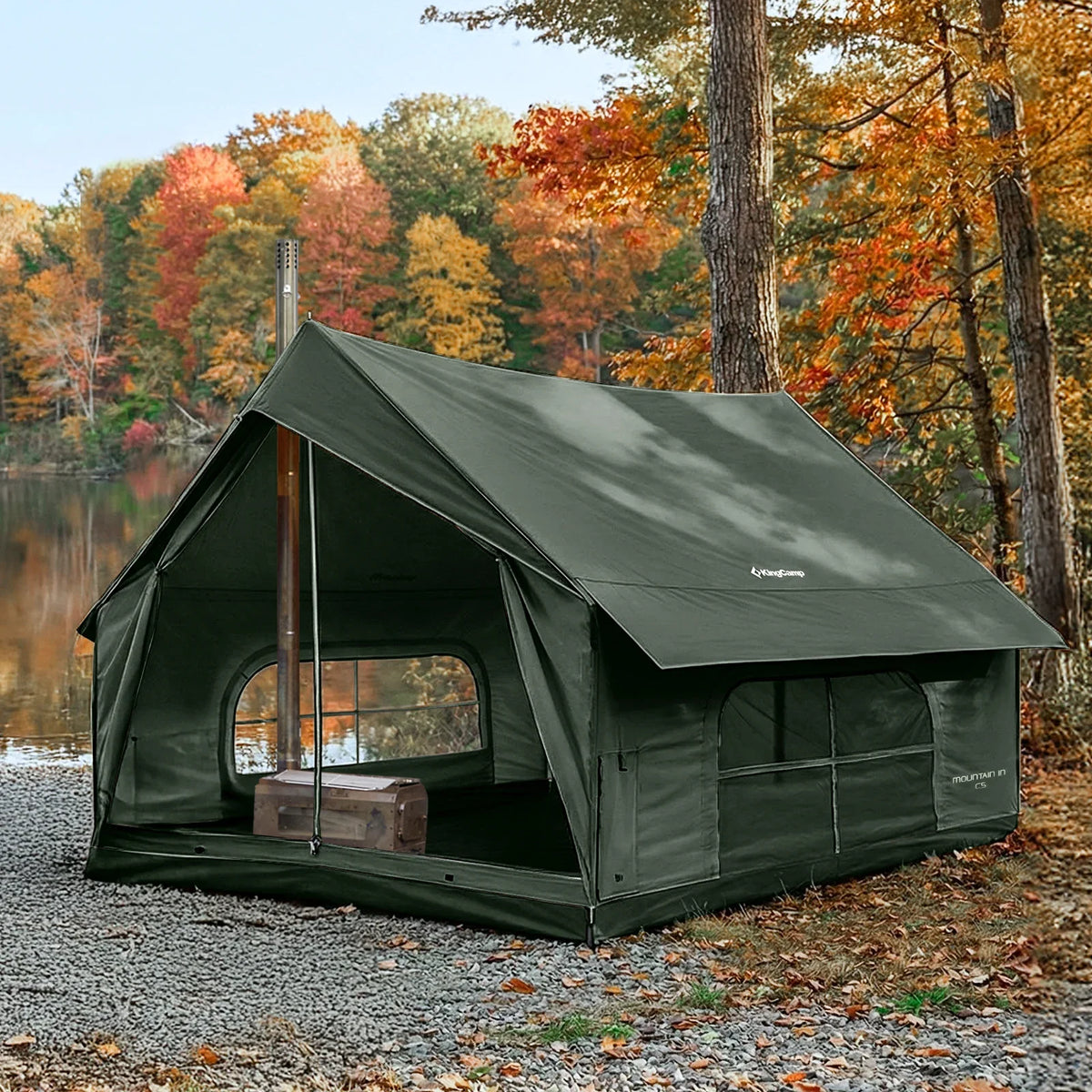
The KingCamp MOUNTAIN IN C5 Cabin Tent with Stove Jack & AC Port lists a ridge frame without a center pole, 16 mm steel support poles and a 5–6-person capacity. Its current FAQ recommends a two-adult setup because of the frame and fabric weight. That is useful guidance about handling, not a verified number of minutes from car to finished camp.
For C5, count the work of sorting and assembling the steel frame, positioning the tent, staking and tensioning its lines, then checking the two doors and ventilation. If you plan to use the stove jack or AC/fan port, put that equipment into a separate setup phase with its own compatibility and operating instructions.
KingCamp KHAN VILLA: plan the room layout after the shell is up
The KingCamp KHAN VILLA 4-Season 4-6 Person Bell Tent describes a center-pole-free interior with two sleeping areas and a central living space. Its current page lists two main support poles, a hall support pole, lines and many stakes among the included parts. Those are concrete tasks for a two-person plan even though the page does not provide a controlled, comparable pitch time.

On the first trip, lay out the poles and stake positions before lifting the tent. After securing the structure, add the bedroom/living-room arrangement and beds. The Popular Mechanics family-tent reviews separate ease of use, capacity and specifications in their buying discussion; the same separation matters here. A spacious interior does not make its assembly sequence disappear.
KHAN VILLA 4-in-1 Bundle: four products, several setup tasks
The current product title is KingCamp KHAN VILLA Tent Glamping 4-in-1 Bundle with Stove. The listed package combines a KHAN VILLA tent, 2-person Oxford inflatable sofa, LEMON C10 folding chair and Surefire tent stove. The URL path still contains “3-in-1,” but the live product title and listed contents say 4-in-1.

Use two clocks if you are comparing this bundle with a standalone tent: tent ready for use and complete bundle ready for use. The sofa needs its own inflation and placement, the chair must be unfolded and positioned, and the stove requires the model-specific tent and appliance instructions. The bundle page does not establish a universal stove clearance, setup time or final indoor temperature. Do not start an appliance until its installation requirements are met.
The bundle listing does not clearly identify the exact current tent SKU or give a complete packed/set-up weight for all four items. Do not assign the standalone KHAN VILLA's weight or dimensions to the whole bundle. Confirm the included tent and individual package details if transport and two-person handling are deciding factors.
KingCamp KHAN PALACE: allow for a larger anchoring job
The KingCamp KHAN PALACE 10-12 Person Glamping Tent is listed at 670 × 420 × 270 cm when set up, with 37.9 kg published total weight. Its current included-items list names two main pillars, two entrance-awning poles, 48 steel stakes and 16 guy lines. The FAQ recommends at least two adults for an easier setup.

That parts list explains why “raised” and “fully secured” are materially different end points. Choose a site large enough for the tent plus its required anchoring space. Two adults should coordinate the large structure together, then distribute stake and line work according to the manual. Do not infer a wind rating or safe shortcut from the number of included anchors.
The manufacturer's two-adult recommendation is a planning minimum for easier assembly, not proof that every two-person team can finish in a fixed time. A practice pitch and a part-count check before departure are especially valuable for this size.
Do not forget pack-down
Fast setup does not imply equally fast packing. At departure, remove interior equipment, follow the model's takedown order, clean dirt from the fabric and hardware, account for every stake and line, and fold the tent to fit its bag. A wet tent may be packed temporarily for travel when necessary, but it still needs to be opened and dried according to its care instructions before storage.
For a two-adult family, this return journey can be as important as the first pitch. One adult can organize stakes and lines while the other handles fabric and floor, but both may be needed to lower or fold a large structure safely. Check whether the campground's checkout time leaves room to dry or air the tent; if not, plan where it can be opened after returning home.
Questions to ask when a listing says “sets up in minutes”
| Ask the seller | A useful answer includes |
|---|---|
| When does the stopwatch start? | Bag on the chosen site, parts already sorted, or frame already assembled? |
| When does it stop? | Frame standing, body pitched, required anchors in, or interior ready? |
| How many people participated? | One experienced camper, two adults, or another team. |
| What ground and weather were used? | Easy soil and calm weather are different from hard ground or wind. |
| Were guy lines, floor and inner rooms included? | Clear scope of the timed work. |
| Were furniture and appliances included? | A complete glamping setup needs a separate time. |
| Was it a first pitch? | Repetition and pre-sorted parts affect the result. |
| Is pack-down measured too? | Loading, cleaning and later drying also use trip time. |
This list makes a “quick setup” claim comparable across tent types without inventing a universal number of minutes.
Frequently asked questions
Does “instant” mean fully ready for rain?
No. An instant frame can open quickly while staking, tensioning, doors and rain panels still require work. Use the product's full setup instructions before relying on the shelter in changing weather.
Can two adults pitch a large canvas family tent?
Many large tents are planned for a two-person team. C5 explicitly recommends two adults, and PALACE recommends at least two for easier assembly. For KHAN VILLA, review the current model manual and practice the sequence before the trip. The answer still depends on the package, site and abilities of the people involved.
Should I count furniture in the advertised tent setup time?
Only if the seller says it was included. Tent assembly and a furnished campsite are different milestones. Beds, chairs, an inflatable sofa and appliances all add separate steps.
What if the campground has a prepared, level pad?
That can reduce site-selection uncertainty, but does not eliminate the need to position the tent, check allowed anchors, assemble its structure and complete the manufacturer's required tensioning.
Is a stove jack ready to use as soon as the tent stands?
No. A stove jack is one component of a compatible setup. The stove, chimney route, ventilation, ground protection and required clearances follow the instructions for the exact tent and appliance.
Why does the four-product bundle take longer than the tent alone?
Its included sofa, chair and stove require their own handling and setup. A time quoted for the tent body cannot represent the whole furnished arrangement unless those tasks were explicitly timed too.
What counts as “finished” for a fair comparison?
Choose one end point, such as “tent body secured with required stakes and lines, entrances operating, and essential floor or inner components fitted.” Use that same definition and the same number of people for each model.
The practical buying decision
For two adults, start with a tent whose documented components and lift sequence you can rehearse. C5 and PALACE explicitly discuss two-adult setup on their current pages. KHAN VILLA adds a defined room layout and substantial hardware to plan around. The 4-in-1 bundle adds a separate furniture-and-stove phase. Whichever you choose, compare claims using the same start, stop, team and site conditions; then leave realistic time for anchoring, inspection and pack-down.
Share:
Will a Large Tent Fit in Your Car Trunk After It Is Packed?
A Week of Family Camping: What to Check Before Buying a Tent