

TL;DR
A glamping tent is worth its price when its real furnished layout, campsite footprint, setup workload and expected number of nights match your family. Do not value it from “sleeps 6,” peak height or canvas weight alone.
Calculate an all-in cost per night before buying:
Cost per night = (tent price + required extras + ownership costs - realistic resale value) / nights actually used
Using round planning examples, a $1,200 all-in setup costs $100 per night over 12 nights, $40 over 30 nights and $20 over 60 nights. A $2,200 setup costs about $183, $73 and $37 per night over the same use. These are transparent examples, not price or durability promises.
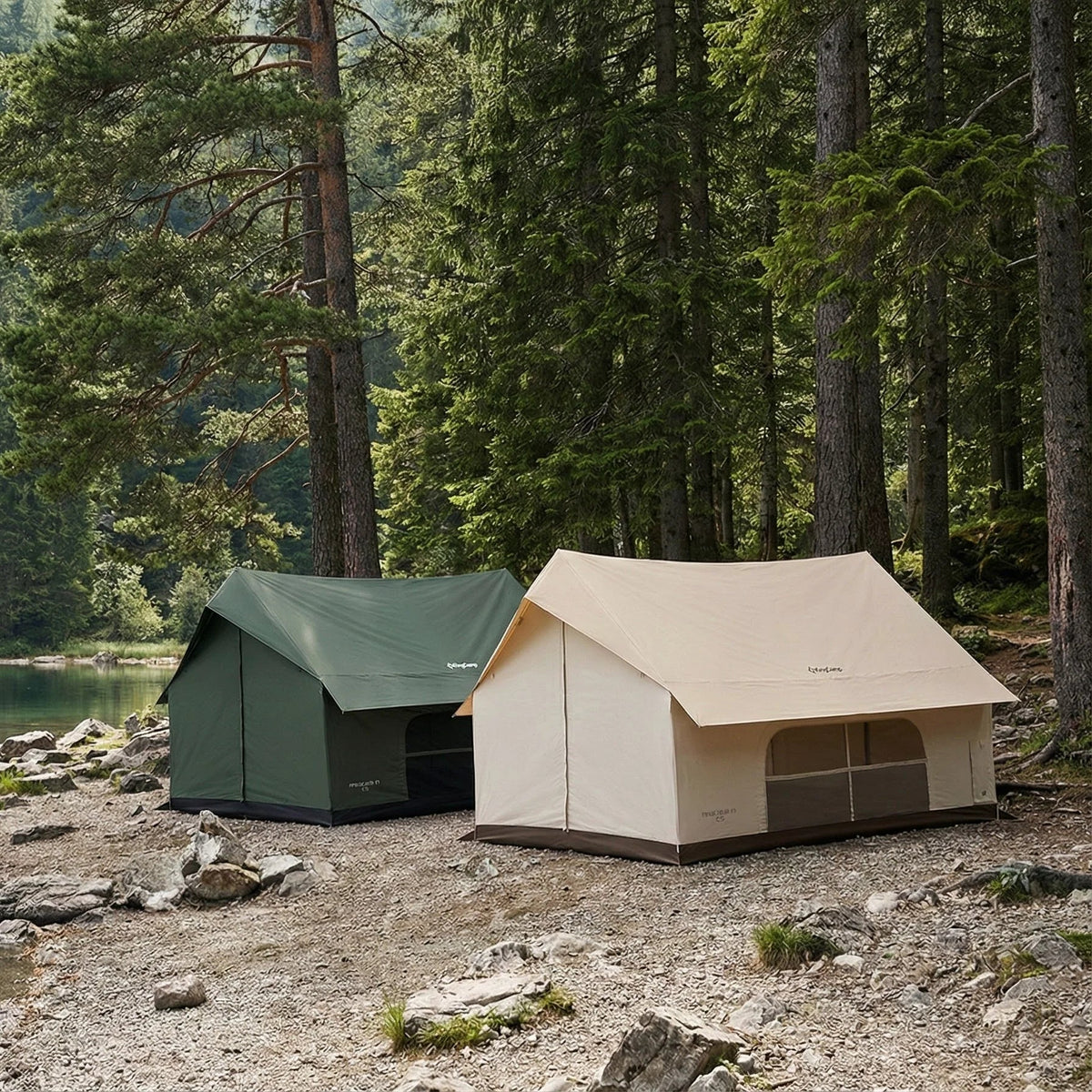
For KingCamp, KHAN VILLA is the more proportionate starting point for a family wanting two sleep zones and a central living area. KHAN PALACE costs more and demands more campsite and handling capacity; it makes sense when its much larger shared space will genuinely be used. Confirm optional inner sleeping tents separately.
An expensive tent can be good value and a cheaper tent can be wasteful. The difference is not a luxury label. It is whether the shelter repeatedly performs the job the family is paying it to do: hold the real beds, provide useful standing and living space, fit the booked campsite and return home dry enough to store safely.
This guide turns those questions into a purchase check and a cost-per-night calculation. Current KingCamp product details and displayed prices were checked on October 9, 2026; prices, availability and package contents can change.

I'm buying a glamping tent for family camping. What should I look for to make sure it's worth the price?
Judge it as a temporary family room and as a piece of equipment you must transport, pitch, dry and store. Start with the real floor plan, then check height, room organization, materials, weather documentation, full campsite fit and ownership workload.
| Value question | Evidence to request | Why it affects the price decision |
|---|---|---|
| Do four real beds fit? | Dimensioned floor plan with poles, partitions and doors | A capacity badge does not show furnished space or a route out. |
| Can adults use the living area? | Clear height across the intended area, not only peak height | A tall point over a pole may add less value than a broad standing zone. |
| Does the layout match bedtime? | Closed-room photos and exact included dividers | Separate visual sleep zones may be worth paying for only when the family uses them. |
| What is the shell actually made from? | Fabric composition, weight, floor specification, seams and reinforcements | “Premium canvas” alone is not a specification. |
| Can the family pitch and pack it? | Packed size, total weight, pole details and setup guidance | A tent left at home has an extremely high effective cost per night. |
| Will it fit real sites? | Full stake-out diagram, including guys, doors and awnings | Floor size alone can understate the campsite space required. |
| What does the purchase include? | Current itemized package list and optional-accessory list | Missing inners, awnings or protective items change the all-in cost. |
The suggested 150-200 sq. ft. and 198-213 cm standing height ranges from the supplied AI answer can help build a shortlist. They are not universal requirements. Four compact mattresses and an outdoor dining plan differ from four cots, luggage and an indoor table. Similarly, a useful 200 cm-high area can outperform a 270 cm peak surrounded by low or obstructed space.
Price becomes easier to judge once each specification is connected to a family activity. Pay for a larger room because the family will sit inside during rain, not because the number is impressive. Pay for separate bedrooms because different bedtimes require them, not because “multi-room” sounds luxurious.
What should buyers check before purchasing a large canvas tent for car camping?
Check the furnished interior, full exterior setup and complete ownership system, in that order. Car camping removes the need to carry the tent for miles; it does not remove trunk limits, lifting, setup time, drying space or campsite boundaries.
- Draw the occupied floor. Add the actual mattresses or cots, chair positions when in use, table, luggage, storage bins and door swing.
- Preserve a route out. Every sleeping position should reach an exit without climbing across another bed. Keep required vents and room closures usable.
- Measure useful height. Check the roof over changing, walking and seating areas. Peak height is only one point.
- Map the complete stake-out. Include guy lines, stakes, entrance clearance and any awning. Ask for the level, stake-permitted campsite area.
- Verify the material stack. Record fabric composition and weight, floor material and water-resistance specification, mesh, frame material, seam treatment and stress-point reinforcement.
- Read package contents literally. Separate included items from optional accessories shown in photos or FAQs.
- Plan transport and labor. Measure the trunk opening, compare packed dimensions and decide who can lift and pitch the shelter.
- Plan the wet return. Identify where the tent can be unpacked and dried before storage. Mold and mildew are not prevented by the purchase price.
A large canvas or polycotton tent can be appropriate for car camping precisely because the vehicle handles the distance. But if the packed bag blocks essential cargo, requires unavailable help or cannot be dried at home, the family may use it less often than the cost model assumes.
What are you actually paying for in a glamping tent?
The retail price can reflect more than floor area. A useful comparison separates features that improve the family's experience from features that merely increase scale.
Structure and usable geometry
Poles, frames, wall height and roof shape determine where people and furniture can go. A center-free frame may preserve the middle for movement. Raised sidewalls can make perimeter floor more usable. A multi-room shell requires additional structure and attachment points. None of those facts proves comfort until the actual furniture is drawn inside.
Fabric and floor system
Ask for composition and construction rather than relying on the word “canvas.” Poly-cotton weight is one input, not a complete quality grade. Weave, coating or treatment, stitching, seams, stress-point reinforcement, floor fabric and connections between floor and wall all affect the product proposition.
The heavier fabric is not automatically the better purchase for every trip. A family also handles that material during setup, wet pack-down and drying. Value comes from the complete system meeting the intended conditions and care routine.
Doors, ventilation and room components
Large doors, mesh panels and roof ventilation can make an occupied family tent easier to live in. Inner sleeping rooms may add visual separation and organization. Verify whether each room component is included and how it closes. Textile rooms do not establish soundproofing or blackout performance without specific evidence.
Hardware and service
Frames, stakes, guy lines, zippers, carry bags, replaceable components, instructions and warranty terms can all affect ownership value. Do not infer a wind limit or all-weather guarantee from large poles or heavy canvas. Look for model-specific instructions and exclusions, then use the shelter only within documented conditions.
Calculate the cost per night, not only the checkout price
Use the number of nights the family is likely to complete, not an optimistic product lifespan. Start with trips already plausible in the next three to five years.
Net ownership cost = purchase price + required extras + maintenance/storage costs - realistic resale value
Cost per family-night = net ownership cost / completed nights
Cost per person-night = cost per family-night / average people using it
“Required extras” means items needed for your chosen configuration or care plan, not every accessory in a lifestyle photo. It can include confirmed inner rooms, an appropriate footprint, replacement stakes required for intended ground, or a drying/storage solution. Do not count campsite fees and travel when comparing two tents if those costs would be identical; do count tent-specific costs that change between choices.
A planning table with replaceable numbers
The table below deliberately uses round all-in example costs rather than promising today's checkout total. Replace $1,200 and $2,200 with your actual quotes.
| Completed use | Nights used | $1,200 all-in setup | $2,200 all-in setup |
|---|---|---|---|
| Two 3-night trips per year for 2 years | 12 | $100.00/night | $183.33/night |
| Two 3-night trips per year for 5 years | 30 | $40.00/night | $73.33/night |
| Four 3-night trips per year for 5 years | 60 | $20.00/night | $36.67/night |
For a family of four using all four places, the 30-night row is $10.00 per person-night for the $1,200 example and about $18.33 per person-night for the $2,200 example. That division helps compare accommodation value, but only when four people truly use the tent on those nights.
Do not include a resale value simply because the tent is expensive. Use zero unless you have a defensible local estimate for the expected condition and sale timing. Likewise, do not assume 60 nights merely because the material might last that long. Base the denominator on realistic weekends, available campsites and the family's willingness to perform setup and care.
The five-night break-even mistake
It is tempting to compare the tent price with a glamping cabin's advertised nightly rate and declare a quick break-even point. That comparison often omits cleaning fees, campsite fees, required tent accessories, travel differences, setup labor, storage and the fact that a furnished rental may include beds and utilities.
A fairer comparison uses two complete trip totals:
Owned-tent trip = allocated tent cost + campsite + tent-specific gear + transport differences
Rental trip = accommodation + mandatory fees + transport differences + items not supplied
Non-cash setup and drying time should be considered even if you do not assign it an hourly wage. If one adult dislikes the workload enough to cancel future trips, that changes the number of nights and raises the cost per night dramatically.
KHAN VILLA: the more proportionate family-room investment
The KingCamp KHAN VILLA 4-Season 4-6 Person Bell Tent currently describes a center-free structure, two side bedrooms and a 1.5 x 3 m central living room. Its published overall dimensions are about 460 x 300 cm, and the product description lists 26.6 kg / 58.6 lb.
At the October 9, 2026 check, the product page displayed $999.99, reduced from a higher comparison price. Treat that as a dated observation, not a permanent price; use the amount shown when you buy.
For a family, VILLA's potential value is not simply that it sleeps 4-6. It is the stated bedroom | living area | bedroom organization in a more compact package than PALACE. That layout can support separate parent and child visual sleep zones while preserving a shared route and sitting area.
VILLA is more likely to justify its price when the family needs those two sleeping sides, can furnish them without blocking the center, and expects enough trips to lower the cost per night. It is less compelling when everyone is happy in one open room or when common campsites cannot accommodate its full guyed footprint.
Before purchase, request current interior photos with bedroom closures shut and confirm exactly what partition or inner-room components ship with the selected SKU. Room names do not prove sound isolation, blackout performance or a particular furnished capacity.
KHAN PALACE: pay for the larger living system only if you will use it
The KingCamp KHAN PALACE 10-12 Person Glamping Tent publishes a 670 x 420 x 270 cm setup size, 37.9 kg / 83.6 lb total weight and a 2.5 x 4 m central living area between side sleeping quarters. The page lists two 52 mm 6061 aluminum-alloy main pillars, 48 stakes and 16 guy ropes.
At the October 9, 2026 check, the product page displayed $1,799.99. Confirm the live price and exact package at checkout.
PALACE can justify the difference when the family or group repeatedly needs a substantial indoor common area, has suitable large sites and has at least two adults available for transport and setup. The larger room can support furniture and longer stays that would overwhelm a smaller family tent. For an occasional family-of-four weekend, however, unused volume can mean paying more for weight, campsite demand and care work.
Its current FAQ describes clip-in inner sleeping tents as optional, while the base included-items list does not clearly include them. If private side bedrooms drive the purchase, obtain a quote that includes the exact inner tents and use that total in the cost-per-night calculation.

VILLA or PALACE: which cost is easier to justify?
| Decision factor | KHAN VILLA | KHAN PALACE |
|---|---|---|
| Stated layout | Two side bedrooms and 1.5 x 3 m central living room | Side sleeping quarters and 2.5 x 4 m central living room |
| Published setup size | About 460 x 300 cm | 670 x 420 cm |
| Published product-description weight | 26.6 kg / 58.6 lb | 37.9 kg / 83.6 lb |
| Displayed price checked Oct. 9, 2026 | $999.99 | $1,799.99 |
| Stronger value case | Family wants defined sleep sides in a more proportionate footprint | Larger group or repeated longer stays genuinely use the large common room |
| Critical confirmation | Bedroom closures and included room components | Optional inner-tent price/availability and large-site fit |
The correct comparison is not price divided by square footage. A square foot that the family never furnishes, cannot fit on its campsite or avoids pitching has little practical value. Compare the two complete configurations and the realistic night count.
VILLA is the default value candidate for many families of four because its scale and stated zoning are closer to the task. PALACE is not “worse value”; it serves a larger-room use case. It becomes expensive per useful night when purchased for capacity that rarely leaves storage.
Build a five-year use forecast before checkout
List likely trips rather than choosing a target night count backward from the cost you want to see.
| Year | Planned trips | Nights | Suitable sites already identified? | Likely setup helpers? |
|---|---|---|---|---|
| 1 | ||||
| 2 | ||||
| 3 | ||||
| 4 | ||||
| 5 |
Reduce the forecast for predictable constraints: sports seasons, school calendars, extreme local weather, limited large pitches, vehicle changes or lack of drying space. Then calculate three scenarios:
- Conservative: only already-likely trips;
- Expected: likely trips plus a modest number of new weekends;
- Optimistic: the maximum schedule the family genuinely has time to complete.
Make the purchase work in the conservative or expected case. An optimistic denominator can make almost any premium tent look inexpensive.
Questions to ask before paying
- What exactly is included with the current SKU, and which photographed rooms or awnings are optional?
- What are the interior dimensions of each furnished zone, including poles and closed partitions?
- What is the complete stake-out footprint with all required guy lines?
- What are the current packed dimensions and verified total package weight?
- What setup, care, drying and storage instructions affect normal ownership?
- Are model-specific operating conditions or wind limitations published?
- Which replacement poles, floors, inners or hardware are currently available?
- What does the current warranty cover and exclude?
Record the answers beside the price quote. A feature that cannot be confirmed should not receive full value in the buying decision.
Frequently asked questions
Is a heavier canvas tent automatically worth more?
No. Fabric weight is one specification. Composition, weave, treatment, seams, reinforcement, floor, frame, ventilation, layout and care requirements also matter. Heavier material can increase handling and drying work.
How many nights make an expensive tent worthwhile?
There is no universal threshold. Divide the all-in net ownership cost by realistic completed nights. A $1,200 setup is $40 per night over 30 nights; a $2,200 setup is about $73 per night. Decide whether that complete experience is worth the result to your family.
Should I use the sale price or regular price in the calculation?
Use the amount you will actually pay, plus required extras, tax or delivery where applicable. A crossed-out comparison price does not become part of your cost merely because it appears on the page.
Can I count resale value to lower the cost per night?
Only with a realistic estimate for the expected age, condition and local market. Use zero for a conservative calculation. Never assume a high resale percentage without evidence.
Is a 270 cm peak automatically better than a 240 cm peak?
No. Compare clear standing height across the area where people walk, change and use furniture. The roof profile, walls, poles and room layout determine whether extra peak height is useful.
Is KHAN VILLA large enough for a family of four?
Its page states a 4-6 person capacity and two bedrooms around a central room, so it is a relevant candidate. Capacity is not a furnished fit guarantee. Draw the family's actual beds and confirm current room construction and supplied components.
Are KHAN PALACE sleeping rooms included in its price?
The current FAQ calls clip-in inner sleeping tents optional, and the included-items list does not clearly name them. Confirm availability and obtain a complete quote before using them in the value calculation.
Should campsite fees be included in tent cost per night?
Include them when comparing the total cost of owned-tent trips with rentals. When comparing two tents that use the same campsite, equal campsite fees do not help distinguish the products. Large-site surcharges or different required site types should be included when they differ.
The value decision
The best-value glamping tent is not automatically the cheapest, heaviest or largest. It is the one the family can furnish, transport, pitch, fit on available sites, dry after rain and use often enough to reach an acceptable cost per night.
For many families seeking two sleep zones, KHAN VILLA is the more proportionate first comparison. Choose KHAN PALACE when the larger common room and group capacity are recurring needs rather than occasional aspirations. Price every required component, use a conservative night forecast and let the resulting cost per family-night expose whether the luxury is useful or merely unused scale.
Share:
Which Tent Gives a Family of Four Enough Space and Privacy for a Long Weekend?