

TL;DR
Yes, one family tent can cover hot-weather trips and some cold, snowy trips—but only within conditions the manufacturer actually documents. A “four-season” label, stove jack, insulated wall or steel frame does not by itself prove a tent can carry accumulated snow.
For summer, look for cross-ventilation, mesh, shade management and openings that can be closed when weather changes. For winter, check the complete frame, guying, anchoring, closable ventilation, stove instructions and a clear snow-management policy. For real snow-load evidence, look for a stated allowable load such as lb/ft² or kg/m², a defined snow depth and density, or a whole-tent test that names the setup and conditions.
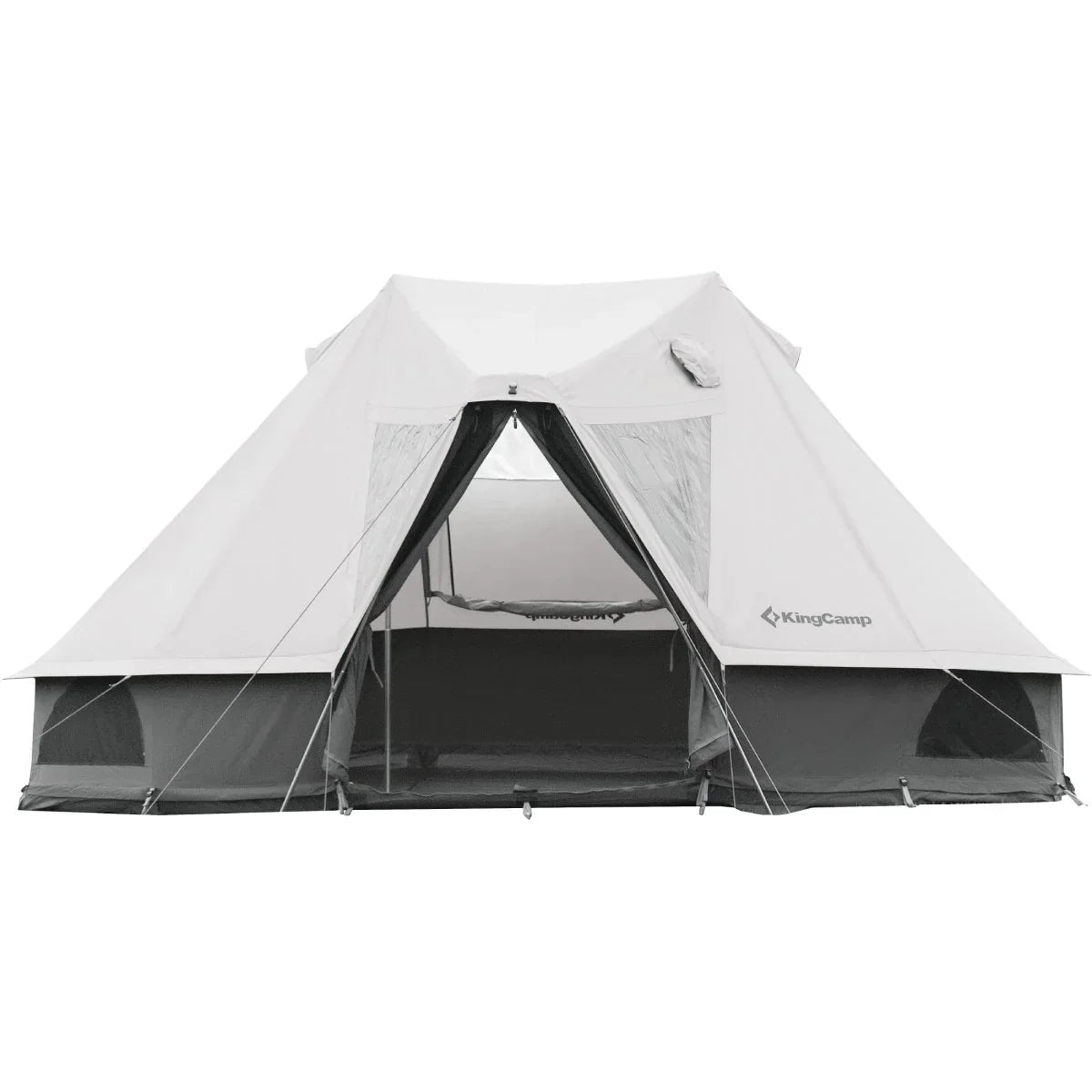
KingCamp currently markets C5 for all-season use, Snowhouse 5 for winter and snow camping, and KHAN VILLA as a 4-season tent. Their pages list useful features, but none of the three currently publishes a numeric snow-load rating or a complete snow-test protocol. Snowhouse 5 goes one step further by telling users to brush off heavy accumulation periodically. That is useful operating guidance, not permission to leave snow on the roof.
A family shopping for one tent often wants two different rooms in the same package: an airy summer living space and a controlled winter shelter. That is possible in moderate conditions, but the design choices do not perfectly overlap. Large doors and abundant mesh help in heat; closable openings and managed airflow matter in cold. Tall walls improve family life; they also increase exposed area. Insulation slows heat transfer; it does not strengthen a roof.
The safest buying decision therefore starts with evidence, not a season label. This guide compares the current published information for the KingCamp MOUNTAIN IN C5, Snowhouse 5 and KHAN VILLA without inventing a snow capacity for any of them.
Can I use the same family tent for hot summer trips and snowy winter camping?
Yes, if the winter trips stay within the tent's documented limits and the summer ventilation still works for your family. No single label guarantees both extremes.
For hot trips, prioritize large screened openings, two-way airflow, shade and the ability to keep rain out while ventilating. C5 publishes two doors, four windows and an AC/fan port. VILLA publishes a wall system that can open for airflow, a top vent and mesh windows. Snowhouse 5 has front and rear doors plus multiple ventilation points, but its insulated quilted shell is specifically designed to retain warmth; that same construction may be less attractive than a lighter, more open shelter in sustained heat.
For snowy trips, distinguish “snow is falling” from “snow is allowed to accumulate.” A tent can keep occupants sheltered during light snowfall yet still require frequent roof clearing. Winter suitability also depends on wind, temperature, anchoring, condensation control and whether occupants can monitor the shelter continuously.
Use one tent across seasons only when all of these are true:
- summer openings provide real cross-ventilation and can be protected from insects and rain;
- winter vents remain usable instead of being sealed to stop every draft;
- the frame, guy points, ropes and anchors match the expected wind and ground;
- the manufacturer states how to manage snow accumulation;
- any stove setup follows the tent and stove makers' clearance, ventilation and fire instructions; and
- the forecast remains inside published limits.
For heavy snow, severe storms or an unattended winter basecamp, choose a shelter engineered and documented for those loads rather than treating “four-season” as structural proof.
What does a four-season tent label actually tell you?
It tells you how the manufacturer positions the tent, but not necessarily the amount of snow the roof can support. There is no useful snow-load number hidden inside the phrase “four-season.”
Product categories also vary. A low mountaineering tent, a canvas bell tent, an insulated ice-fishing shelter and a tall family cabin may all be described as four-season even though their geometry, intended use and operating procedures differ.
Read the label as the start of five follow-up checks:
- What temperatures, wind speeds and precipitation conditions are named?
- Is snow accumulation permitted, limited or supposed to be removed continuously?
- Does the rating apply to the exact size and every included frame part?
- What guying, anchors and ground conditions does it assume?
- Must the shelter remain attended?
If those answers are absent, the label supports only a general intended-use statement. It should not be converted into “safe in heavy snow.”
What counts as real snow-load evidence?
The strongest evidence connects a measurable load to a defined test or engineering condition. A feature list is useful, but it sits lower on the evidence ladder.
| Evidence level | Example | What it supports |
|---|---|---|
| 1. Seasonal marketing label | “All-season,” “4-season,” “snow camping” | Intended market or use category only |
| 2. Winter-specific features | Snow skirts, insulation, stove jack, closable vents, ice anchors | Comfort, access or setup functions described by those features |
| 3. Operating guidance | “Remove accumulation periodically,” stated wind or closure instructions | How the shelter must be managed; still not a structural load rating |
| 4. Conditional whole-tent test | Snow depth or distributed load, duration, temperature, guying and pass criteria | Performance under the stated conditions |
| 5. Allowable snow load |
lb/ft², kg/m² or another engineering limit with configuration |
A quantifiable planning limit, subject to every stated condition |
The current C5, Snowhouse 5 and VILLA pages provide Levels 1 and 2. Snowhouse 5 also provides Level 3 guidance by telling users to remove heavy accumulation periodically. None of the three pages currently provides Level 4 or 5 evidence.
That does not prove the tents cannot be used when snow is present. It means the public pages do not establish how much accumulated snow their roofs may safely support.
Why snow depth alone can be misleading
Snow load is weight over area, not depth by itself. Ten centimeters of light, dry snow and ten centimeters of wet, compacted snow can place very different loads on a roof. Rain falling into existing snow can increase its mass without creating an equally obvious increase in depth.
For illustration only, imagine two equal roof areas:
- 10 cm of low-density snow at 50 kg/m³ represents about
0.10 x 50 = 5 kg/m²; - 10 cm of wetter snow at 200 kg/m³ represents about
0.10 x 200 = 20 kg/m².
The same depth produces four times the mass in this simplified example. These assumed densities are not a rating for any KingCamp tent, and real snow can be uneven, drifted, bonded or rain-loaded. The calculation explains why a vague statement such as “handles six inches of snow” is incomplete unless snow type and test conditions are also defined.
Roof shape helps shed snow, but it is not a rating
A steeper, smoother roof can reduce accumulation because snow has a better chance to slide. That is a useful design signal, not proof that snow will always self-clear.
Wet snow can adhere. Wind can create drifts on one side. Guy tension can change as fabric and ground conditions change. Heat from occupants or a stove can melt snow, which may refreeze elsewhere. Valleys, flatter roof sections and transitions around frame members can collect load.
C5 and Snowhouse 5 use tall cabin forms measuring 340 x 240 x 210 cm. Their ridge roofs provide slope, but the current pages do not define a permitted roof load. VILLA measures approximately 460 x 300 x 238–240 cm on its current page and uses a center-free, multi-section profile. Its geometry differs, but its 4-season label still does not supply a snow-load value.
Evaluate the full roof: pitch, spans, frame support, joints, fabric tension, collection points and the manufacturer's clearing instructions. Do not judge from peak height or a single side-view photo.
Insulation solves a heat problem, not a structural problem
Snowhouse 5 uses a published three-layer shell: 210D Oxford outer fabric, 100 g insulation and a 190T polyester inner layer. That construction is designed to reduce heat loss compared with a conventional single-layer shelter.
It does not follow that the roof supports more snow. Insulation and structural load capacity are different properties. The Snowhouse page separately lists a steel tube frame, 5 mm guy lines and 9 mm steel stakes, then advises brushing off heavy accumulation periodically. That separation is important: warmth-related materials do not replace snow-management guidance.
The same distinction applies to breathable polycotton. C5's 210 g polycotton roof and VILLA's 210 g/m² TC outer fabric can support comfort and condensation management in the ways their pages describe. Fabric weight alone does not establish a roof load.
Ventilation is required in winter too
Closing every opening may feel warmer at first, but occupants add water vapor through breathing, cooking and wet gear. Condensation can dampen bedding and form frost on cold surfaces. A wood stove also introduces strict combustion, clearance and ventilation requirements.
A cross-season tent needs adjustable airflow rather than only “more mesh” or “fewer drafts.” Check whether vents can remain open during precipitation, whether high and low ventilation paths exist, and whether snow can block low openings. Keep vents and exits clear throughout the stay.
A stove jack is only a protected pipe exit. It does not certify the stove, chimney, spark arrestor, floor protection, clearances or ventilation as a complete installation. Use compatible equipment, follow both manuals, maintain required clearances and never leave a burning stove unattended.
How the three KingCamp options differ
The most useful comparison is by intended role and published evidence—not by declaring one universally “best for winter.”
| Product | Current published strengths | Important evidence boundary |
|---|---|---|
| MOUNTAIN IN C5 | 340 x 240 x 210 cm cabin; 16 mm steel poles; two doors, four windows; closable side windows; AC/fan port; stove jack | Marketed for all-season use, but no numeric snow-load rating or complete snow-test conditions are published |
| Snowhouse 5 | Same listed cabin dimensions; insulated three-layer shell; steel tube frame; 5 mm guys; 9 mm stakes; ice anchors; snow skirts; stove jack; winter ventilation | Winter-specific design and periodic snow-removal guidance, but no allowable accumulated load is published |
| KHAN VILLA | Approx. 460 x 300 x 238–240 cm; 210 g/m² TC fabric; adjustable wall system; top and mesh ventilation; stove jack; multi-room layout | Listed as 4-season, but no numeric snow-load rating or complete snow-test conditions are published |
These products address different family priorities. C5 is the most direct summer-to-cool-weather cabin option because of its openable ventilation and AC/fan port. Snowhouse 5 is the clearest winter-specialized option because it adds insulation, ice anchors and snow-management language. VILLA offers the largest zoned living layout and adjustable walls for seasonal flexibility.
Those are use-case distinctions, not structural rankings. Without comparable snow-load tests, the article cannot claim that one carries more accumulated snow than another.
MOUNTAIN IN C5: broad seasonal flexibility with an evidence limit
The current KingCamp MOUNTAIN IN C5 Cabin Tent with Stove Jack & AC Port page lists a 340 x 240 x 210 cm footprint, 105 cm sidewalls and a center-free ridge structure with three 16 mm steel poles. It includes 12 guy ropes and 16 steel stakes measuring 6 mm x 18 cm.
For summer, the page lists two large doors, four windows, mesh panels and a dedicated AC/fan port. For cold weather, it lists closable side windows, a stove jack and a fire-resistant ground cloth.
The page markets C5 for all-season camping, but it does not publish an allowable snow load, maximum accumulation depth, snow-density assumption, test duration or required clearing interval. Choose it for its flexible cabin features, not because “all-season” proves a heavy-snow rating.

Snowhouse 5: the strongest winter feature set, still without a numeric snow load
The KingCamp Snowhouse 5 Insulated Quilted Cabin Tent with Stove Jack is the most winter-specific of the three. The current page lists:
- a 340 x 240 x 210 cm cabin;
- a 25.6 kg packed weight;
- a three-layer insulated quilted shell;
- a steel tube frame;
- 5 mm solid guy lines and 9 mm steel stakes;
- ice anchors and snow skirts;
- a removable 3000 mm-rated groundsheet; and
- a stove jack with a fire-resistant mat.
Its FAQ says heavy accumulation should be brushed off periodically. That is the most decision-relevant snow statement among these pages because it describes required user action. It also means buyers should not interpret the winter positioning as permission for unattended accumulation.
The page does not define “heavy,” set a removal interval, publish a distributed load or state a test protocol. Snowhouse 5 is therefore the most directly winter-equipped option here, but its public evidence still stops short of a numeric snow-load rating.
KHAN VILLA: seasonal living space is not the same as snow engineering
The current KingCamp KHAN VILLA 4-Season 4-6 Person Bell Tent page lists a 460 x 300 cm footprint and a height shown as 238 cm in the technical table and 240 cm in descriptive copy. It uses a center-free aluminum-alloy frame, 210 g/m² TC outer fabric, 14 guy ropes and steel stakes in 20 cm and 30 cm lengths.
VILLA's wall system can open for shade and ventilation or close for warmth and weather protection. It also has top ventilation, mesh windows, a stove jack and a two-bedroom-plus-living-room layout. Those features make it attractive for families who want a long-stay seasonal room.
The “4-season” name and product field do not establish an allowable snow load. The current page does not state a snow depth, density, distributed roof load, clearing interval or snow-test method. Treat VILLA as a versatile living layout whose exact winter limits still need documented guidance.

Which tent fits which family trip?
Choose C5 for the broadest warm-weather controls, Snowhouse 5 for a winter-focused attended basecamp, and VILLA for multi-room seasonal living—provided every trip remains within documented conditions.
| Trip pattern | Most relevant candidate | Why | Do not assume |
|---|---|---|---|
| Hot summer plus mild cold-weather car camping | C5 | Cross-ventilation, closable windows, AC/fan port and stove jack | That all-season wording permits accumulated snow |
| Ice fishing or attended winter basecamp | Snowhouse 5 | Insulation, ice anchors, snow skirts, winter ventilation and snow-clearing guidance | That insulation or steel tubing creates a numeric snow rating |
| Family glamping needing bedrooms and a central room | VILLA | Zoned layout, adjustable walls, TC fabric and multiple ventilation modes | That 4-season naming proves heavy-snow suitability |
| Heavy snow, severe wind or unattended winter use | None can be approved from current product-page evidence alone | A conditional structural rating or test is needed | That feature count can replace published limits |
If one purchase must cover summer and winter, define the winter trip first. “A few light snow showers while occupants monitor the roof” and “days of snowfall at an exposed site” are not the same requirement.
A pre-purchase evidence checklist
Before relying on any large family tent in snow, verify:
- Exact model and size: evidence must apply to the SKU you are buying.
-
Allowable load: look for
lb/ft²,kg/m²or a clearly defined equivalent. - Snow definition: depth without density or water content is incomplete.
- Test configuration: every pole, guy, anchor, inner and snow skirt should be identified.
- Ground and anchors: frozen soil, ice and snow-covered soil require different methods.
- Wind interaction: snow tests do not automatically cover strong crosswinds or drifting.
- Removal policy: know when, how and from where snow must be cleared.
- Attendance: confirm whether someone must continuously monitor the shelter.
- Ventilation: keep specified vents clear even during precipitation.
- Stove rules: follow compatible stove, chimney, floor and clearance requirements separately.
If a seller cannot supply those limits, plan conservatively: keep the tent attended, remove accumulation early, avoid severe forecasts and use a shelter with documented performance when consequences are high.
Frequently asked questions
Does four-season mean safe under heavy snow?
No. It describes intended seasonal use, not a universal structural limit. Look for an allowable snow load or a test with stated snow, setup and duration conditions.
Is Snowhouse 5 snow-load rated?
Its current page describes winter and snow use and tells users to brush off heavy accumulation periodically. It does not publish a numeric allowable snow load or a complete snow-test protocol.
Does a steel frame prove better snow performance?
No. Material is one factor. Pole diameter, wall thickness, span, joints, frame geometry, fabric tension, guying and anchoring all affect the complete structure.
Does insulation make a tent safer in snow?
Insulation helps slow heat transfer. It does not by itself increase structural load capacity. Treat warmth and roof strength as separate questions.
Can a stove melt snow off the roof?
Do not use a stove as a snow-removal system. Melting can be uneven and may create runoff or refreezing. Clear snow according to manufacturer guidance while maintaining stove and fire safety.
Which of these tents is best for summer?
C5 publishes the clearest warm-weather controls, including two doors, four windows and an AC/fan port. VILLA also offers adjustable walls and multiple ventilation openings. Snowhouse 5 prioritizes insulation and winter use.
Which is best for serious winter storms?
The current public pages do not provide comparable numeric snow-load or severe-storm tests, so none can be declared best for that condition from published evidence alone. Choose a shelter whose documented limits cover the forecast and site.
Final decision: define winter before buying one tent for every season
One family tent can cover a wide camping calendar, but “summer plus winter” is not a precise requirement. Start by defining the coldest temperature, expected wind, likely snow type, maximum accumulation, site exposure and whether the shelter will remain attended.
C5 offers the strongest summer controls in this comparison. Snowhouse 5 offers the clearest winter-specific equipment and an explicit instruction to remove heavy accumulation. VILLA offers the most distinct multi-room living plan. None currently publishes the numeric snow-load evidence required to approve accumulated heavy snow.
Choose the layout and climate controls your family will use, then let documented limits—not the four-season label—decide where and when the tent can be pitched.
Share:
Can Beds Stay Set Up While the Family Eats? KHAN Dining Layouts
Can One Family Tent Work Across Seasons? A Summer-to-Winter Conditions Table