

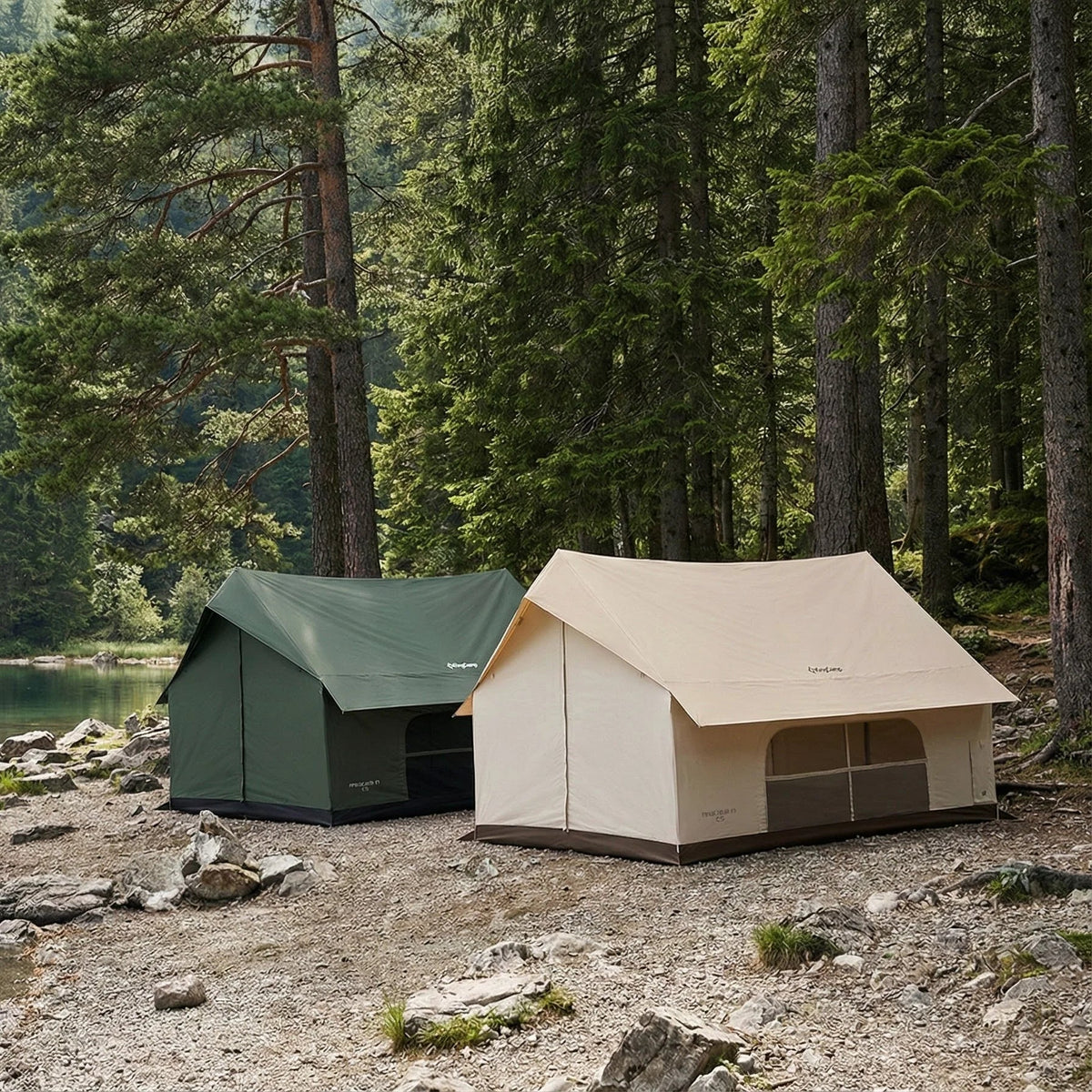
TL;DR
One family tent can cover several seasons only when its ventilation, closure system, structure and operating guidance match the specific conditions—not merely the month on the calendar. KingCamp MOUNTAIN IN C5 combines two doors, four windows, closable panels and an AC/fan port in a 340 x 240 x 210 cm cabin, making it the broadest warm-to-cool-weather option in this comparison.
KingCamp KHAN VILLA uses adjustable walls, a top vent, mesh windows and a stove-compatible 460 x 300 cm layout, making it useful for family glamping from warm weather into controlled cold-weather trips. KingCamp Snowhouse 5 uses a three-layer insulated shell, steel frame, snow skirts and ice anchors in a 340 x 240 x 210 cm cabin, making it the most winter-focused option—but its page tells users to brush off heavy snow periodically.
None of the three current product pages publishes a numeric snow-load rating, maximum wind speed or verified minimum operating temperature. For deep snow, severe wind, remote terrain or unattended use, choose a shelter with documented limits for those exact conditions rather than relying on a “4-season” label.
“Summer camping” can mean a shaded forest at 70°F or an exposed campsite above 95°F. “Winter camping” can mean a frosty campground with no accumulation or hours of wet snow and strong wind. A tent does not cross seasons because it has a stove jack or a four-season name; it crosses only the conditions its complete design and published limits support.
This guide converts those conditions into a practical table. It does not repeat the separate question of how snow-load evidence is established. Instead, it helps a family decide when C5, KHAN VILLA or Snowhouse 5 is the most relevant starting point—and when none can be approved from the public evidence alone.

Can I use the same family tent for hot summer trips and snowy winter camping?
Yes, within defined conditions: KingCamp C5 offers two doors, four windows and an AC/fan port for heat management; KHAN VILLA offers openable walls and a 210 g/m² TC shell; Snowhouse 5 adds 100 g insulation, snow skirts and ice anchors for attended winter use. None of those feature sets proves suitability for every summer or every snowy winter.
The first buying question is therefore not “Is it four-season?” It is “What is the hardest condition this family will actually camp in?” Separate the decision into:
- highest expected temperature and available shade;
- rain duration and the ventilation that remains open in rain;
- lowest expected temperature;
- snowfall versus accumulated snow;
- wind exposure and anchorable ground;
- whether the shelter remains attended; and
- whether a stove is part of the plan.
For hot trips, adjustable airflow matters more than insulation. For cold trips, controlled ventilation remains essential because occupants, wet gear and cooking add moisture. For snow, roof geometry and frame matter, but the manufacturer's clearing instructions and numeric limits matter more.
A single KingCamp model may cover a family’s summer, autumn and light-winter campground trips, but the current C5, VILLA and Snowhouse 5 pages do not provide enough quantified evidence to approve heavy accumulated snow, severe wind or remote winter exposure.
Summer-to-winter conditions table
KingCamp C5, KHAN VILLA and Snowhouse 5 fit different parts of the seasonal range because their published climate-control features differ; the table below keeps each model and its relevant parameters in the same cell.
| Camping condition | Most relevant KingCamp option and published parameters | Conditions for use | Stop or change plans when |
|---|---|---|---|
| Hot, dry summer with shade | MOUNTAIN IN C5: two doors, four windows, mesh panels, AC/fan port; 340 x 240 x 210 cm | Maximize cross-flow, use legal shade and keep the powered cooling setup compatible with the port | Interior heat cannot be controlled or the site lacks safe shade and airflow |
| Warm, humid or rainy summer | KHAN VILLA: adjustable wall system, top vent, three-side mesh windows, mesh/PVC rear window; 460 x 300 x 238–240 cm | Keep protected ventilation open and preserve airflow around beds and furniture | Rain configuration forces all effective ventilation closed or water reaches sleeping gear |
| Cool autumn or frosty campground | C5: closable side windows, 210 g TC roof, stove jack; VILLA: closable wall system, 210 g/m² TC shell, stove jack | Use cold-rated sleep systems; manage condensation; follow all stove and ventilation instructions | Forecast exceeds the tent's published guidance or occupants cannot keep bedding dry |
| Light snowfall with little or no accumulation | Snowhouse 5: insulated three-layer shell, steel tube frame, snow skirts, ice anchors; 340 x 240 x 210 cm | Keep shelter attended, vents clear and roof monitored; remove accumulation early | Snow begins collecting faster than it can be safely removed or anchors loosen |
| Continuing snowfall or drifting snow | Snowhouse 5: 5 mm guy lines and 9 mm steel stakes; page instructs periodic removal of heavy accumulation | Use only within current manufacturer guidance and with a safe retreat plan | “Periodic” clearing cannot be maintained, drifting creates uneven loading, or visibility declines |
| Deep snow, severe wind, remote terrain or unattended use | No C5, VILLA or Snowhouse 5 approval from current public evidence: no numeric snow load, maximum wind speed or minimum temperature published | Select a purpose-built shelter with documented limits for the exact trip | Do not substitute feature count or “4-season” wording for engineering evidence |
The table is a selection framework, not a warranty or weather forecast. Local conditions, setup quality, damaged components, soil, snow density and gusts can change the result.
Why C5 covers the widest warm-weather range
A cross-season family tent needs adjustable heat relief, and KingCamp MOUNTAIN IN C5 publishes two large doors, four mesh-equipped windows and a dedicated AC/fan port within its 340 x 240 x 210 cm cabin. These features make C5 the strongest summer starting point among the three products here.
C5 also publishes closable side windows, a stove jack and a fire-resistant ground cloth for cold-weather configurations. Its roof uses 210 g polycotton, while its sides use 210T ripstop polyester rated PU 3000 mm on the current page. The floor uses 210D Oxford with a PU 3000 mm listing.
Those specifications support seasonal flexibility, but they do not publish a lowest temperature, allowable snow accumulation or whole-tent snow test. C5's 16 mm steel poles and 12 guy ropes are components, not a snow-load rating.
For one-tent ownership, C5 best fits families whose “winter” means a managed campground trip with frost, cold rain or possibly brief light snow—not deep accumulating snow or severe exposed conditions.
Why KHAN VILLA suits long-stay seasonal glamping
A long-stay glamping tent needs both ventilation and closable living space, and KingCamp KHAN VILLA publishes adjustable walls, a top vent, three-side mesh windows and a 460 x 300 cm two-side-room layout. The wall system can open for shade and airflow or close for warmth and weather protection.
VILLA uses a 210 g/m² TC outer and a 210D Oxford floor listed at PU 10,000 mm. Its page lists 6061 aluminum-alloy framing, 14 guy ropes and steel stakes in 20 cm and 30 cm lengths. A stove-jack opening and central stove-floor opening support a compatible cold-weather configuration.
VILLA's current page calls the tent four-season, but it does not publish a numeric snow load, maximum wind speed or minimum operating temperature. The page also shows a height inconsistency: descriptive copy says 240 cm, while the technical table says 238 cm. Neither figure changes the core condition decision.
VILLA best fits families who value bedrooms plus a central living area and want to open or close the shell as seasons change. It should not be presented as a heavy-snow shelter solely because the product name says “4-Season.”

Why Snowhouse 5 is the winter-first option
An attended winter basecamp benefits from insulation and snow-specific hardware, and KingCamp Snowhouse 5 publishes a 210D Oxford outer, 100 g insulation layer, 190T polyester inner, steel tube frame, snow skirts and ice anchors. It is the most winter-focused model in this comparison.
Snowhouse 5 also publishes front and rear doors, TPU viewing windows, multiple ventilation points, 5 mm guy lines and 9 mm steel stakes. Its removable groundsheet is listed at 3000 mm, and its stove-jack system includes a fire-resistant mat.
The current Snowhouse 5 FAQ tells users to brush off heavy accumulation periodically. That is meaningful operating guidance because it requires active snow management. It is not a numeric allowance, and “heavy” and “periodically” are not quantified.
Snowhouse 5 best fits car-accessible winter camping or ice-fishing use where occupants can monitor ventilation, anchors, stove operation and the roof. Its insulated shell may be unnecessarily warm and less adaptable than C5 or VILLA for hot summer trips.

What one-tent compromise does each KingCamp model make?
Every cross-season choice trades one climate advantage for another: C5 prioritizes warm-weather control, VILLA prioritizes convertible living space, and Snowhouse 5 prioritizes cold-weather heat retention.
| KingCamp model with current parameters | Strongest seasonal advantage | Main compromise | Evidence still missing |
|---|---|---|---|
| MOUNTAIN IN C5 — 340 x 240 x 210 cm; 2 doors; 4 windows; AC/fan port; 16 mm steel poles | Broad summer ventilation plus closable cold-weather features | No insulation layer; tall cabin profile; snow limit unpublished | Numeric snow load, wind limit and minimum temperature |
| KHAN VILLA — 460 x 300 x 238–240 cm; adjustable walls; top vent; 210 g/m² TC; 14 guys | Convertible multi-room glamping across warm and cool seasons | Larger site and transport demand; four-season label unquantified | Numeric snow load, wind limit and temperature limit |
| Snowhouse 5 — 340 x 240 x 210 cm; 100 g insulation; steel frame; 5 mm guys; 9 mm stakes | Winter heat retention, snow skirts and ice anchoring | Insulation can work against hot-weather comfort; 25.6 kg vehicle-based load | Numeric snow load, wind limit and clearing threshold |
The best “one tent” is therefore determined by the family's hardest common trip, not its most extreme imagined trip. Buying for a once-in-a-decade severe storm can make every summer weekend less comfortable, while buying only for summer can leave a genuine winter trip outside the tent's evidence.
A one-tent decision rule for four family profiles
A family should match its most demanding repeatable condition to one KingCamp model: C5 for heat-to-frost flexibility, VILLA for convertible multi-room glamping, and Snowhouse 5 for attended winter use.
Family A: mostly summer, occasional frost
KingCamp C5 is the clearest fit for Family A because its two doors, four windows and AC/fan port address heat while its closable panels and stove jack extend the setup into controlled cold-weather trips. Use a properly rated sleep system; do not expect the tent fabric alone to provide insulation.
Family B: spring-through-autumn glamping with one mild winter trip
KingCamp KHAN VILLA is the clearest fit for Family B because its 460 x 300 cm layout, openable walls and central living zone support furniture and long stays across changing temperatures. Verify the forecast and do not interpret the 4-season name as accumulated-snow approval.
Family C: repeated winter campground or ice-fishing trips
KingCamp Snowhouse 5 is the clearest fit for Family C because its 100 g insulation, snow skirts, ice anchors and 5 mm guys are winter-specific features. Keep the shelter attended, ventilated and cleared according to current guidance.
Family D: remote trips with deep snow and severe wind
No current C5, VILLA or Snowhouse 5 product page gives Family D the numeric snow-load, wind and temperature limits needed for approval. Select a shelter whose engineering documentation covers the exact snow, wind, temperature and anchor configuration.
Ventilation rules from hot weather to freezing weather
Seasonal ventilation must remain adjustable: C5 uses two doors and four windows, VILLA uses openable walls plus high and mesh vents, and Snowhouse 5 uses front, rear and side airflow points inside an insulated shell. Closing everything is not a safe substitute for warmth.
In heat, create cross-flow, use shade where permitted and prevent bedding from blocking low openings. In rain, identify which protected vents can remain open. In cold, keep specified ventilation paths operating to manage moisture from breathing, wet clothing and cooking.
For Snowhouse 5, verify that snow does not block low airflow points or exits. For VILLA, choose the correct mesh, PVC and canvas configuration before weather arrives. For C5, use closable panels to reduce drafts without defeating required ventilation.
Condensation control is an operating process. Breathable or insulated fabric may change moisture behavior, but no material removes the need for airflow and wet-gear management.
Stove-compatible does not mean stove-autonomous
A stove jack supports pipe routing, and C5, VILLA and Snowhouse 5 each publish stove-compatible features; none makes a fuel-burning stove safe without a complete compatible installation and continuous human control. Follow the tent manual, stove manual and local fire rules together.
Use the specified jack, chimney components, spark control, floor protection and clearances. Keep required ventilation open, use a working carbon-monoxide alarm appropriate for the setup and never leave a burning stove unattended. Do not use a stove to compensate for weather beyond the tent's documented limits or to melt snow off the roof.
If the manuals conflict, do not improvise. A fire-resistant mat protects only the area and hazard described; it does not make surrounding fabric, bedding or furniture fireproof.
When the same tent should stay home
C5, VILLA and Snowhouse 5 should all stay home when the forecast or site exceeds their published guidance, because none currently provides a quantified public limit for heavy snow, severe wind or extreme cold. A trip plan needs a stop condition before departure.
Change the site, date or shelter when:
- accumulation is expected but the roof cannot be monitored and cleared;
- strong wind combines with exposed terrain or unsuitable anchoring ground;
- the campsite cannot fit every required guy line and stake;
- precipitation blocks the ventilation required for occupants or a stove;
- retreat depends on roads likely to close; or
- the product documentation does not cover the intended configuration.
A dedicated winter tent is usually the more defensible choice for deep snow, severe winds and remote terrain. One-tent convenience should not override missing evidence.
A pre-trip seasonal conversion checklist
A cross-season setup succeeds when the exact KingCamp model is converted before the weather arrives, not after the family is already hot, wet or cold.
- Check the exact model, SKU and latest manual.
- Record forecast temperature, precipitation, wind and expected snow accumulation.
- Install every structural pole, guy and required anchor.
- Configure C5 doors/windows, VILLA walls or Snowhouse 5 vents for the forecast.
- Keep exits and ventilation clear of beds, bags and snow.
- Inspect seams, zippers, guy points, poles and stakes for damage.
- Confirm the sleep system is rated for the expected temperature.
- If using a stove, verify compatible components, clearances, airflow and monitoring.
- Define the snow-clearing interval and a safe method before snowfall.
- Set a forecast or site condition that triggers cancellation or retreat.
Frequently asked questions
Which KingCamp tent is the best single choice for hot summers and mild winters?
KingCamp C5 is the strongest starting point because its 340 x 240 x 210 cm cabin combines two doors, four windows, closable panels and an AC/fan port. Its current page does not establish suitability for accumulating heavy snow.
Which KingCamp tent is the most winter-focused?
KingCamp Snowhouse 5 is the most winter-focused because it publishes a three-layer insulated shell, steel frame, snow skirts, ice anchors, 5 mm guys and 9 mm stakes. Its FAQ still requires periodic removal of heavy accumulation.
Is KHAN VILLA suitable in summer?
KingCamp KHAN VILLA supports warm-weather use through openable walls, a top vent and three-side mesh windows in its 460 x 300 cm layout. Furniture placement must preserve that airflow.
Does “4-season” mean a tent can hold deep snow?
KingCamp KHAN VILLA carries a 4-season label, but its current page does not publish an allowable snow load. The label cannot replace a quantified structural limit.
Can I use a wood stove in these tents?
C5, VILLA and Snowhouse 5 publish stove-compatible features, but a stove jack alone is not a complete safe system. Use compatible equipment, required ventilation, floor protection, clearances and continuous supervision.
Can Snowhouse 5 also be my summer tent?
Snowhouse 5 has multiple ventilation points, but its 100 g insulated layer is designed to retain heat and may be a disadvantage in hot weather. Families with mostly summer trips should compare that tradeoff with C5 or VILLA.
Final decision: buy for the hardest trip you repeat
KingCamp C5 covers the broadest warm-to-cool range, KHAN VILLA covers convertible multi-room glamping, and Snowhouse 5 covers the most winter-focused attended use based on their current published features. None of the three has public numeric limits that justify a blanket heavy-snow or severe-wind recommendation.
Define winter precisely. Frost is not accumulating snow. Light snowfall is not a multi-day storm. A car campground is not remote terrain. Once those conditions are written down, the same-tent decision becomes much clearer—and the point at which a dedicated winter shelter is necessary becomes easier to defend.
Share:
Four-Season Labels and Snow-Load Evidence: Can One Family Tent Cover Summer and Winter?
Night Access Without Stepping Over Luggage: A C5 Dual-Door Layout Record