

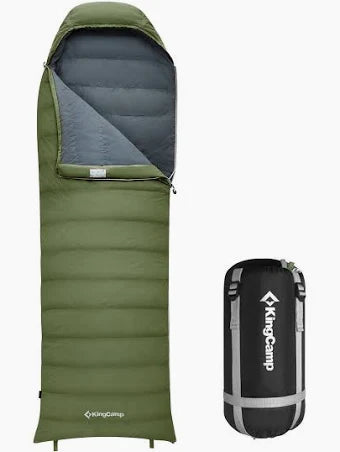
Quick answer: For fall or winter car camping, start with the forecast overnight low at your actual campsite, then compare it with each sleeping bag's explicitly labelled comfort temperature. Do not shop by a product name containing “0-Degree,” by a season label, or by the extreme rating. Add a suitable insulated sleeping pad, dry sleep clothes, and a weather plan. A sleeping bag rating describes a standardized test, not a guarantee that every family member will feel warm.
Important KingCamp example: The FAVOURER ECO “0-Degree” listing gives its thicker 1200g option a published 34°F comfort and 25°F limit. That does not make it a 0°F comfort bag. The three KingCamp products featured below can be useful in appropriate conditions, but none of their published comfort figures establishes comfortable sleep at 20°F. Verify the exact variant before buying.
How should a family choose sleeping bag temperature ratings for fall and winter car camping?
Plan for the coldest realistic night, not the average daytime temperature. Campsite elevation, a clear sky, and a cold ground surface can make the sleeping environment feel different from a nearby town's forecast. Check the latest local forecast and any campground notices before departure, then reassess on site. If the predicted low is close to the bag's comfort number, choose a warmer sleep system or change the trip plan rather than assuming the limit or extreme label will cover the gap.
Size each person's system separately. Adults, children, and people who sleep cold may not experience the same bag the same way. Confirm fit: too little room compresses insulation; too much unused space can be harder to warm. A hood, draft collar, zipper baffle, and the ability to close openings comfortably can matter in cold weather, but their presence does not replace a suitable comfort rating.
For a family, make a simple checklist for each sleeper: expected low; bag comfort temperature and test method; insulated pad rating; dry base layers and socks; appropriate bag fit; and a backup plan if conditions become colder or wetter than expected. Children should not be assigned an adult bag purely by matching the printed temperature number; check fit and the manufacturer's age guidance.
What is the difference between comfort, limit, and extreme temperature ratings?
| Label | What it generally means in ISO-style testing | How to use it |
|---|---|---|
| Comfort | Lowest temperature at which the reference sleeper can sleep in a relaxed posture without feeling cold | Most useful starting point for a comfortable family sleep plan |
| Limit | Lower boundary for the reference sleeper curled up to conserve heat | Not a promise of comfortable, relaxed sleep |
| Extreme | A survival-oriented threshold with serious cold stress risk | Never use as a target camping or purchasing temperature |
ISO 23537 provides a laboratory method for sleeping-bag thermal ratings under specified conditions. Product pages do not always state that their numbers were independently tested to that standard. Ask the brand which test method applies to the exact variant. A single unlabeled “temperature rating” is not automatically the comfort figure, and comparing unlabeled marketing claims as if they were identical test results is misleading.
Will a sleeping bag rated to 0°F keep me comfortable when camping at 20°F?
Not necessarily. The answer depends on what “0°F” refers to. If it is an explicitly documented comfort rating for that exact bag, 20°F is warmer than that laboratory threshold, although your pad, clothing, fit, moisture, health, and personal cold sensitivity still affect the result. If 0°F is a limit, extreme, or just part of the product name, it cannot be treated as a 0°F comfort claim.
The FAVOURER ECO listing illustrates the problem: its thicker option's published comfort value is 34°F and its limit is 25°F. At a 20°F overnight low, both values are warmer than the forecast, so that listing does not support recommending the bag as a comfortable 20°F choice. A warmer liner or extra blanket may help in some circumstances, but do not use an untested combination as a substitute for an appropriate primary sleep system and safe weather plan.
Compare the three KingCamp options by their published comfort figures
| Bag / variant | Published temperature information | What the figure suggests |
|---|---|---|
|
FAVOURER ECO 1200g option |
Comfort 34°F / 1°C; limit 25°F / -4°C | Consider only for conditions consistent with its comfort figure and the complete sleep system; not a proven 20°F comfort option |
|
Plus Size 3-4 Season check exact option |
Product page lists comfort figures that vary by option; inspect the selected fill/variant rather than the season label | Roomier fit may appeal to some sleepers; warmth still depends on the chosen variant and pad |
| SNOWFLAKE 400 Flannel Single | Confirm the current page's labeled comfort and limit values for the selected variant | Flannel feel and shape are comfort features, not evidence of 20°F suitability |
Product pages and variants can change. The comparison intentionally avoids converting a product name or “3-4 season” descriptor into a certified comfort rating.
FAVOURER ECO: read the label beyond “0-Degree”
The FAVOURER ECO's envelope shape, hood and recycled-fill positioning may appeal to car campers who prefer room to move. But its selected fill option matters much more than its name. The published 1200g option's 34°F comfort and 25°F limit are the figures to use for comparison. If your campsite may reach 20°F, do not purchase it on the assumption that “0-Degree” is the comfort temperature. Ask KingCamp to confirm the rating method and the selected variant's complete temperature data.
Check FAVOURER ECO options and ratings
Plus Size 3-4 Season: prioritize fit, then the exact warmth option
A roomier bag can reduce restriction at the shoulders, hips or feet, especially when sleeping in layers. However, “plus size” and “3-4 season” describe fit and merchandising, not a universal winter rating. This KingCamp listing offers options with different published warmth information. Select the precise variant in the product page, record its comfort value, and compare that number with your campsite forecast. Make sure the bag closes without compressing insulation or creating a large cold draft opening.
SNOWFLAKE 400: soft lining is not a temperature rating
Flannel can change the next-to-skin feel of a sleeping bag, which matters on a family trip, but lining texture does not establish a safe overnight temperature. Check the current SNOWFLAKE 400 page for its labelled comfort and limit figures, its selected size and fill, and any stated testing method. Use the comfort figure alongside a suitable pad; do not assume a bag called “Snowflake” is automatically a winter bag.
The sleeping pad can undo a warm bag
Sleeping-bag insulation compresses underneath your body, so the pad supplies much of the protection from cold ground. Look for an insulated pad with an appropriate published R-value for expected conditions, and use the manufacturer's guidance for combining pads if needed. ASTM F3340 provides a standardized way to compare pad insulation, but not every advertised R-value is necessarily measured with that method. A thick but uninsulated air mattress can feel cold even when the sleeping bag seems substantial.
Car camping offers room for a second insulating layer, but stack pads so they remain stable and do not create gaps. Keep bedding dry. Never use a fuel-burning heater or stove inside a tent unless the entire setup is specifically designed and installed for that use; a warm sleeping system is not a reason to take carbon-monoxide or fire risks.
A family pre-trip temperature worksheet
- Forecast: Write the lowest expected overnight temperature for the actual campsite, with a weather-change plan.
- Bag: Record each sleeper's exact model, variant, labelled comfort temperature and test method. Treat missing labels as unknown, not as permission to assume warmth.
- Pad: Record the pad's R-value and whether its test method is stated.
- Fit: Check hood, zipper, draft control and room for dry sleep layers without compressing the fill.
- Backup: Decide before departure when to add a reliably rated system, move indoors or change the trip if a cold front arrives.
Common rating mistakes to avoid
Comparing names instead of labels: “0-Degree” may not mean 0°F comfort. Shopping by extreme: extreme is not a normal sleep target. Ignoring variants: fill weights and size options can carry different figures. Forgetting the pad: ground insulation is part of the sleep system. Using one bag choice for everyone: children and cold sleepers need individual fit and warmth planning. Assuming more blankets make any bag winter-ready: an improvised stack is hard to rate and can shift during the night.
FAQ
Is the limit temperature a comfort rating for men?
No. It is a standardized lower-bound condition for a reference sleeper in a curled posture, not a guarantee for any individual. Use comfort as the starting point for family purchasing.
Can I use a 34°F-comfort bag at 20°F with extra clothes?
Do not assume so. Clothing and a liner may help but are not a substitute for a sleep system appropriate to the forecast low. Choose warmer rated gear or change the plan.
Does car camping mean I can ignore packed weight?
Weight may matter less than when backpacking, but the bag, pad, extra layers and drying space still have to fit your vehicle and campsite routine.
What if a product page shows only a single temperature number?
Ask whether it is comfort, limit or extreme; whether ISO 23537 testing applies; and which variant it describes. Until clarified, do not treat it as a comfort value.
Share:
Director, Hammock and Moon Camping Chairs Compared: Which Feels Best at Camp?
Ultralight Camping Chair Guide: What One Pound Buys