

Quick answer: A director's chair is the practical upright choice for meals and frequent sit-to-stand movement. A hammock chair favors reclining and gentle suspended motion, but needs more clear space. A moon chair wraps around the sitter for a relaxed, curled-up feel, while its rounded seat may offer less defined lower-back support and make standing harder for some users. Try each shape with your own body and campsite routine rather than treating “most cushioned” as “most comfortable.”
Product naming note: The three KingCamp products featured here are the XXL Padded Director's Chair, Orchid C20 Hammock Chair, and Lumbar Support Oversized Camping Chair. The third is not a moon chair. It is included as an adjustable-lumbar alternative for readers who like a relaxed seat but need more deliberate back contact. Moon-chair characteristics are compared as a chair category, not attributed to that KingCamp model.
How do director chairs, hammock chairs, and moon chairs compare for campsite comfort?
The main difference is how each seat holds your body. A director's chair uses a more defined, upright seat and back, often with firm arms. A freestanding hammock chair suspends its seat from a frame, allowing a more reclined posture and some motion. A moon chair typically has a rounded, bowl-like seat that cradles the hips and upper body. None of these terms proves a particular level of lumbar support, seat width, load capacity, or suitability for a person with back pain.
| Design | What feels different | Often suits | Test carefully |
|---|---|---|---|
| Director's chair | Upright seat, defined arms, and easier access to a table | Dining, cooking-side breaks, and repeated standing | Seat depth, clear width between arms, and back contact |
| Hammock chair | Suspended and gently moving; more lounge-oriented | Reading, resting, and a spacious base camp | Getting in/out, frame stability, swing, and footrest clearance |
| Moon chair | Rounded, enveloping seat that invites a curled posture | Casual lounging and short relaxed breaks | Seat-edge pressure, low posture, defined back support, and rise effort |
Why the same “comfortable” chair can feel wrong after an hour
First impressions reward softness. Longer sitting exposes fit problems: a seat edge pressing into the thighs, arms that are too far apart, a backrest that misses the lower back, or a posture that is hard to change. A chair can also work for reading but feel awkward at a dining table. For campsite comfort, test the task, not just a one-minute sit. Spend time sitting upright, leaning back, reaching for a drink, and getting up repeatedly.
Support is not the same as stillness. A chair should let you change position and take movement breaks. If your back is sensitive, compare where the backrest contacts you and whether the seat makes you slump. A removable cushion may change the fit, but it should not be treated as a cure or as proof that the base chair suits you.
KingCamp XXL Director's Chair: upright comfort for an active campsite
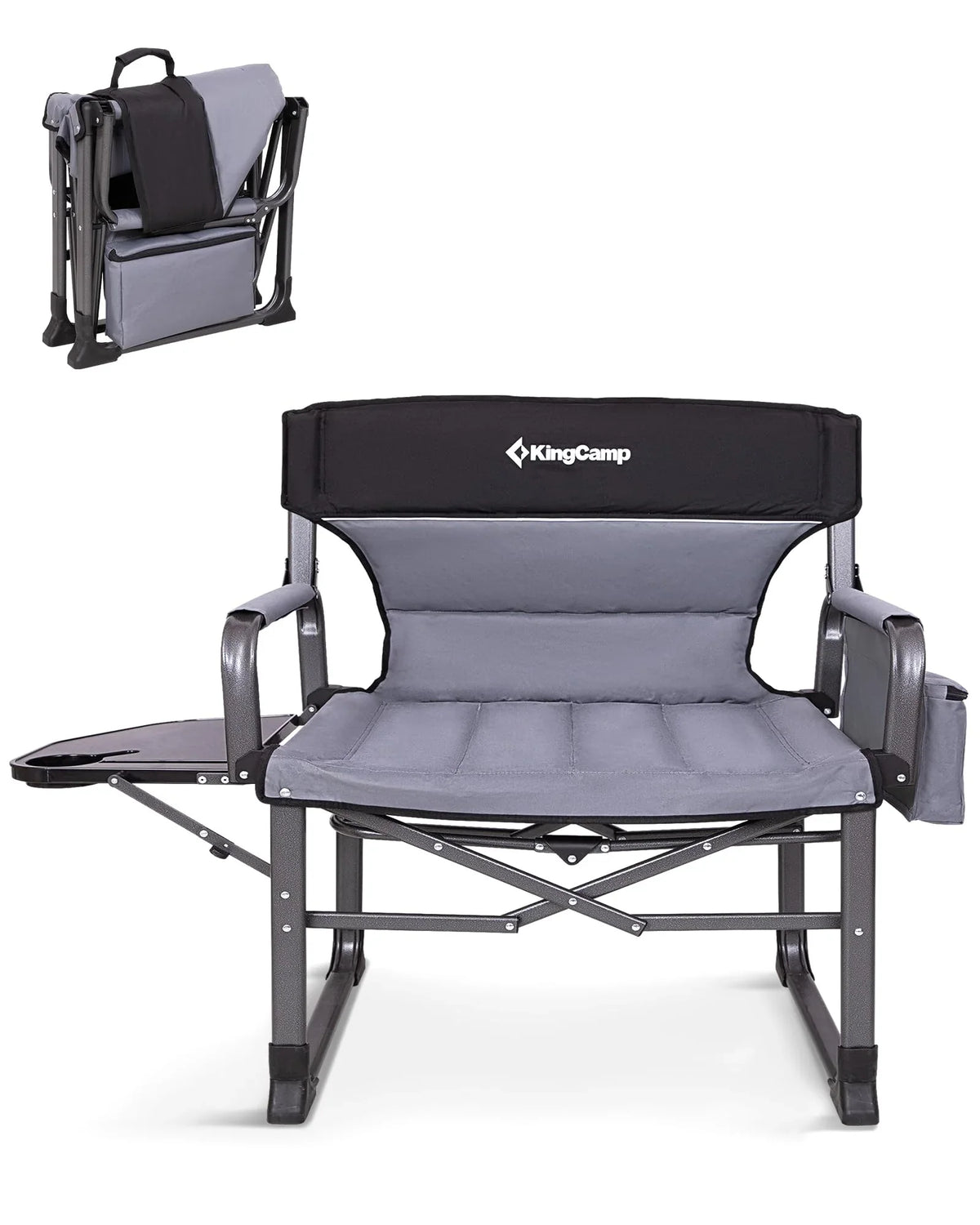
The XXL Folding Padded Director's Chair has a padded seat, foam armrests, and a fold-out side table. Its upright layout makes sense when you alternate between meals, conversation, and standing to handle camp tasks. The published chair weight is 8.7 kg, with folded dimensions of 58 × 25 × 57 cm and a stated 250 kg static load. Those are transport and load-screening facts, not comfort ratings. Its product page does not specify an adjustable lumbar mechanism.
Check the clear width between the arms, not only the chair's outside width. Sit back fully and note whether the lower back actually meets the backrest. The side table is useful for small items but should not be assumed to bear body weight when you rise.

A defined upright seat works well around a camp table; test back contact and arm spacing in person.
Explore the XXL Director's Chair
KingCamp Orchid C20: suspended lounging, with a space cost
The Orchid C20 uses a freestanding frame and a removable footrest for a hammock-style sitting experience. It is for lingering at a settled campsite, not necessarily the best chair for eating at a conventional-height table. The product page lists a 5.4 kg chair and an approximately 92 cm packed length. Check the latest variant details before purchase, especially the complete packed dimensions and load rating.
Its key comfort question is motion: some people enjoy gentle sway; others want a more fixed seat. Try entering, sitting with and without the footrest, and standing up. Allow space for the full frame, footrest, movement envelope, and people walking past. Set it on firm, level ground and follow the manufacturer's assembly and use instructions.
Explore the Orchid C20 Hammock Chair
What does a moon chair do differently?
A moon chair's circular or bowl-shaped seat spreads around the sitter rather than presenting a clearly separate seat pan and upright back. That can feel cozy for relaxing, especially when you want to curl up. The same shape can make it harder to keep both feet planted, sit squarely at a table, or stand without rolling forward. “Moon chair” is a shape label; exact back angle, padding, interior width, seat height, and rated load vary by model.
When shopping for one, ask for the usable inside width, the seat height measured under load, the manufacturer's capacity, and a photo of the chair occupied by an adult. Test whether the outer rim presses into your thighs or shoulders. Do not assume that a wide-looking circular frame translates into a roomy usable seat.
KingCamp Lumbar Support Oversized Chair: a fourth fit direction
This KingCamp chair is not a moon chair. Its distinctive feature is a padded lumbar area whose tension can be adjusted with straps. KingCamp lists a 47 cm seat height, 5.4 kg chair weight, 20 × 20 × 99 cm packed size, and 250 kg maximum static load. If a rounded lounge chair lets your lower back fall into a gap, this more defined back-contact option is worth testing.
Adjustable does not automatically mean well-fitting. Sit all the way back, tune the lumbar section gradually, and check for a comfortable contact point rather than a hard push. The product page's listed seat-width and overall-width figures appear inconsistent, so request a measured clear width between armrests before relying on either number.

An adjustable lumbar zone is a different feature from a moon chair's rounded, enveloping shape.
Explore the Oversized Lumbar Chair
Match the chair to your campsite activity
Meals and camp kitchen: an upright director's chair usually makes table access simpler than a deep recliner. Reading or watching a sunset: a hammock chair or moon chair may feel more relaxing if space and entry are not concerns. Frequent standing: check seat height, stable arms, and how far your feet can come under you. Lower-back sensitivity: test actual back contact; the adjustable-lumbar model gives you one more way to tune it. Small tent or crowded pitch: measure the chair's opened footprint, not just its packed bag.
Never put a chair too close to a stove or fire because fabric, padding, and frames can melt or catch fire. Keep access routes clear, particularly when a footrest or side table is deployed.
Packability: the part of comfort you feel before sitting down
The XXL director's chair folds into a broad frame, while Orchid C20 and the Oversized Lumbar Chair pack into longer shapes. The XXL is the heaviest of the three published weights. A trunk may accept all of them but still make one of them awkward to lift, carry, or retrieve after other gear is loaded. Measure the trunk opening and remaining space after coolers, bedding, and tents; compare all packed dimensions and carry weight. Do not equate a short longest dimension with the smallest overall cargo footprint.
A five-minute sit test for any chair style
- Sit fully back. Notice where the backrest touches and whether the front edge presses behind your knees.
- Plant your feet. Check that the seat height works for your leg length and the surface is level.
- Change position. Try dining posture, relaxed posture, and a normal reach for a drink.
- Stand up three times. Use only parts intended for support, never a side table or footrest as a lever.
- Check clearance. Leave room for the chair's motion, accessories, and other campers.
Which one should you shortlist?
Choose the XXL Director's Chair to test first for upright camp dining and a padded seat, provided its folded bulk works for your vehicle. Choose Orchid C20 to test first when a relaxed suspended seat and footrest are the attraction and the campsite has room. Consider a true moon chair for a wrapped-in, casual lounge feel, but verify its actual interior fit. Choose the Oversized Lumbar Chair to test first if adjustable lower-back contact matters more than the moon-chair silhouette. The best chair is the one that fits your body, tasks, transport, and site together.
FAQ
Is a hammock chair the same as a moon chair?
No. A hammock chair suspends the seat from a support, while a moon chair is defined primarily by its rounded bowl-like seat shape. Individual products can blur style names, so inspect the actual construction.
Is the KingCamp Oversized Lumbar Chair a moon chair?
No. It is a folding camping chair with a tension-adjustable lumbar section. It is included here as an alternative support approach, not relabeled as a moon chair.
Which is easiest to use at a camp dining table?
Usually a more upright director's chair, but check your table height, seat height, and reach. A hammock or deep moon seat may position you farther back.
Does a higher weight rating mean better back support?
No. A published load rating helps screen structural use; it does not measure lumbar fit, pressure distribution, or comfort over time.
Product sources: KingCamp XXL Director's Chair · KingCamp Orchid C20 · KingCamp Oversized Lumbar Chair. Category-level descriptions are general; dimensions, load ratings, and features vary by exact model and variant. Confirm current specifications and follow the manufacturer's setup instructions.
Share:
Portable Camping Chair Guide: 7 Picks by Carry Distance
How to Choose Sleeping Bag Temperature Ratings for Fall and Winter Car Camping