

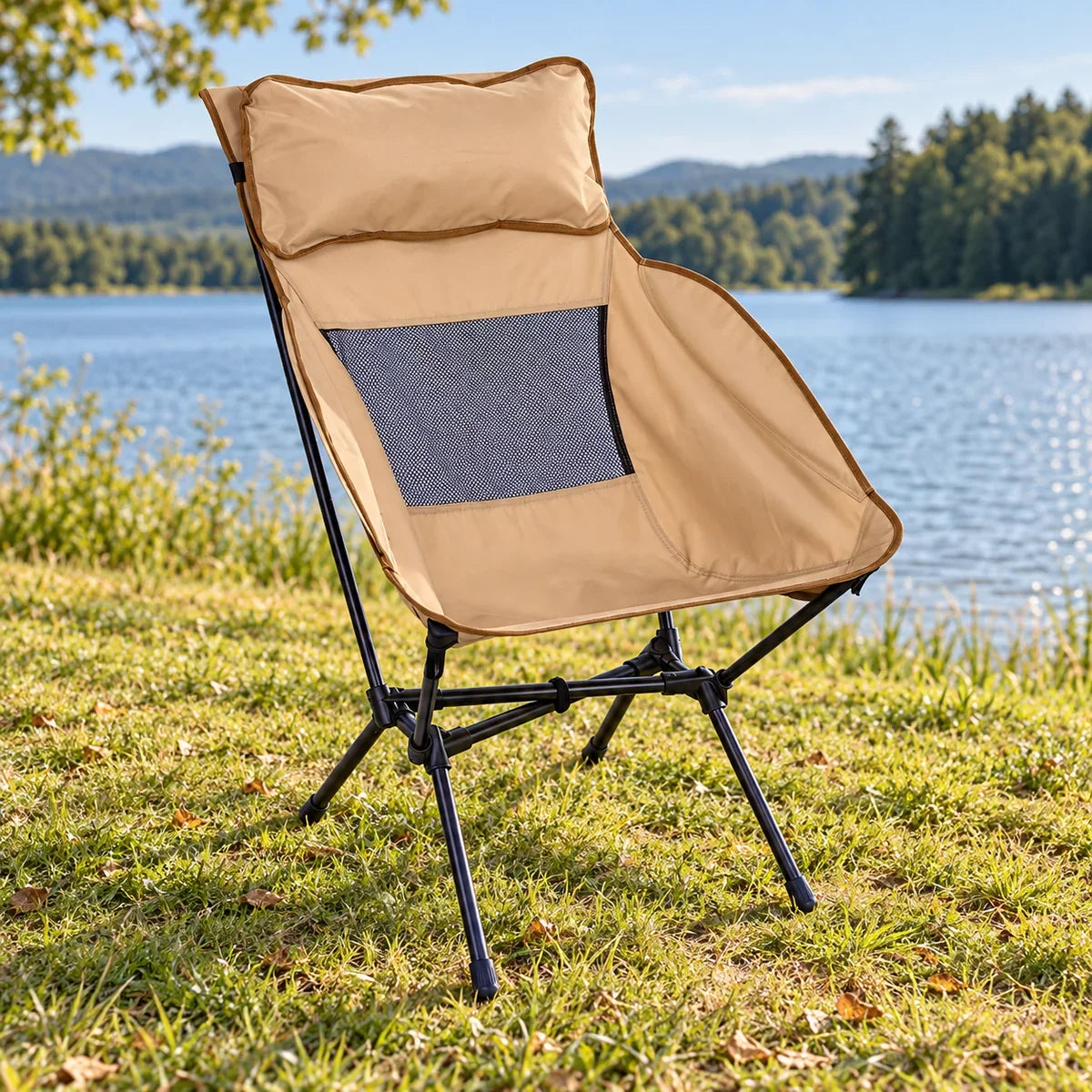
A portable camping chair is not simply a chair with a carry bag. A one-pound seat that fits in a backpack, a five-pound high-back chair you can take to a walk-in campsite, and an 11-pound chair you carry ten steps from the car all solve different problems. The useful question is: How far will you actually carry it, and what sitting position will you accept when you arrive? This guide compares seven current models by packed weight, bag shape, setup, and seat design using published specifications, without claiming a hands-on test.

TL;DR
- Long trail: Helinox Chair Zero LT is the clear weight-first option here at 1 pound, 3 ounces packed. It needs assembly and offers a smaller seat.
- Walk-in camp with more support: REI Flexlite Camp Dreamer adds a high back and pillow at 3 pounds, 7 ounces; KingCamp BALSA C10 adds a taller lounge posture at 4.9 pounds.
- No-assembly short carry: KingCamp Lightweight High-Back packs to 18.9 inches but weighs 5.7 pounds. Choose it for setup convenience, not for ounce-counting.
- Car-to-camp: KingCamp GUAVA is upright and easy to open, but its 39.4-inch bag makes little sense on a trail.
These are specification-based recommendations. We did not independently sit in, carry, stability-test, or score the chairs. Listed weights may include different accessories; verify the exact variant before buying.
Start With the Distance Between Your Car and Your Seat
“Portable” changes meaning with the route. A five-pound chair is easy to move across a campground; it is a substantial luxury when you also carry a tent, food, and water over several miles. Packed length matters too. A long narrow sleeve may fit beside a cooler but stick out of a backpack; a shorter, thicker bag may pack better in a vehicle yet occupy more space against your back.
Prioritize carried weight and pack volume. Expect lower seats, less padding, and pole assembly.
A short bag and a high back may be worth several extra pounds when the route is manageable.
Choose seat height, armrests, and quick setup first; verify the packed shape fits the car.
These are decision categories, not universal mileage cutoffs. A quarter-mile on flat pavement can feel different from the same distance uphill in sand. Keep the rest of your gear in mind when judging a chair's weight.
Portable Camping Chair Comparison
Numbers below are manufacturer or retailer listings, not measurements we took. “Packed length” is only the longest listed bag dimension; bag width and thickness also affect how the chair travels. For the Helinox, use packed weight rather than the lighter trail weight so the carry case is included.
| Model | Listed weight | Packed size | Setup | Best trip | Main compromise |
|---|---|---|---|---|---|
| Helinox Chair Zero LT | 1 lb 3 oz packed | 14 × 4.5 × 4.5 in | Separate poles and seat | Backpacking | Minimal padding and small seat |
| REI Flexlite Camp Dreamer | 3 lb 7 oz | 22 × 7 in listed | Separate poles and seat | Short walk-in camp | 12.5-in low seat |
| KingCamp BALSA C10 | 4.9 lb | 20.5 × 8.3 × 7.1 in | Assembled frame and seat | Ventilated short carry | More than twice Helinox's weight |
| KingCamp Lightweight High-Back | 5.7 lb | 18.9 × 8.3 × 7.5 in | One-piece unfold | Quick-setup short carry | Not a light trail chair |
| KingCamp BALSA C20 | 6.2 lb | 20.1 × 7.9 × 7.9 in | Assembled frame and seat | Padded walk-in lounge | Padding adds weight and warmth |
| KingCamp Low Sling | 6.6 lb | 30.7-in bag length | One-piece unfold | Beach or lakeshore | 8.6-in seat; long bundle |
| KingCamp GUAVA | 11 lb | 39.4-in bag length | One-piece unfold | Drive-up camp meals | Heavy and long to carry |
Some listings give a complete three-dimensional packed size, while others give only a length or a two-dimensional size. Do not compare those as though they were equal-volume packages.
How These Picks Were Evaluated
We checked current product pages for weight, packed dimensions, seat format, assembly method, and published capacity where available. We then matched those properties to actual carrying situations, rather than treating “lightweight,” “portable,” or “backpack-friendly” as a test result. We included non-KingCamp options because a brand-focused guide should still tell a backpacker when a true ultralight chair is a better fit.
Photos and specifications cannot establish all-day comfort, stability on a hillside, durability, or whether a seat is wide enough for a particular body. Where a maker lists overall width rather than clear seat width, the latter still needs confirmation. Many KingCamp chairs list a full-frame static load and a separate, lower front-edge static load. Neither number is a promise about dynamic use.
Seven Portable Chairs by Trip
For a long trail: Helinox Chair Zero LT
Packed weight 1 lb 3 oz · 14-in case · 265-lb stated capacity
The Chair Zero LT is the weight benchmark in this group. Helinox lists a 14-by-4.5-by-4.5-inch carry case and distinguishes its lighter 1-pound, 1.5-ounce trail weight from the 1-pound, 3-ounce packed weight. Use the latter when planning the load you will actually carry. The shock-corded frame and separate fabric seat require assembly, unlike a one-piece folding chair.
Its 20-inch listed seat width is a seat measurement, not the size of a plush car-camping chair. The minimal materials and lower posture are the price of saving pounds. Helinox includes an X-strap meant to spread the load under the feet on softer ground, but ground conditions still need checking when you sit down.
Choose it if: Every pound matters on a hike or bike tour. Skip it if: You want padding, firm armrests, or a chair that opens in one motion.
For a shorter walk with head support: REI Flexlite Camp Dreamer
3 lb 7 oz · 22 × 7-in folded dimensions · 12.5-in seat
The Flexlite Camp Dreamer moves up from minimalist trail seating. REI lists a high back, removable headrest pillow, side mesh pockets, and a 300-pound capacity. Its 3-pound, 7-ounce weight is still manageable for many short walk-in sites, and the 22-inch packed length is far easier to fit around other gear than a 39-inch quad-chair sleeve.
There are trade-offs: it takes a frame-and-seat assembly step, and the published 12.5-inch seat is lower than an upright dining chair. REI gives a two-dimensional folded size rather than a complete bag volume, so check the actual case if it must fit a tightly packed bag. A taller back is appealing for reading; the listing alone cannot tell us how it feels after several hours.
Choose it if: You will walk to camp but still want a pillow and high back. Skip it if: You want one-piece setup or a higher seat for frequent standing.
For ventilation and a tall back: KingCamp BALSA C10
4.9 lb · 20.5-in bag length · mesh high back


The KingCamp BALSA C10 occupies the middle ground between an ultralight trail seat and full-size car-camp furniture. A high back, pillow, and broad mesh area favor a long sit on a warm day. At 4.9 pounds with a 20.5-inch packed length, it is reasonable for a short carry, though over twice the packed weight of the Chair Zero LT.
Its aluminum frame and fabric are assembled from separate pieces. KingCamp lists a 300-pound rated static load and a lower front-edge static figure; those describe different loading positions. The product listing's overall dimensions do not clearly establish the usable seat width or front-edge height, so ask for those if fit is your priority.
Choose it if: You want a ventilated high back within a short carry. Skip it if: You need the smallest possible trail load or instant one-piece setup.
For a quick-setup short carry: KingCamp Lightweight High-Back
5.7 lb · 18.9 × 8.3 × 7.5 in packed · one-piece frame
The KingCamp Lightweight High-Back Camping Chair stands out because its seat and frame remain together. Unfolding a single unit avoids the corner-stretching step of a pole chair. KingCamp lists a 28.3-inch high backrest, a gentle rocking motion, and an 18.9-inch packed length, making this a sensible convenience pick for a fishing spot or campsite a short walk from the car.
Its 5.7-pound listed weight matters. The maker calls it backpack-friendly, but compared with a 1-pound, 3-ounce Helinox, it is a very different proposition on the trail. Rocking also needs clear space and stable footing; do not assume a product description demonstrates stability on sloped or soft ground. The 331-pound figure is a rated static load, not a universal dynamic-use guarantee.
Choose it if: One-piece setup and a high back are worth the extra pounds. Skip it if: You are carrying a full overnight pack for miles.
For a cushioned destination seat: KingCamp BALSA C20
6.2 lb · 20.1-in bag length · padded high back

The BALSA C20 keeps a short, approximately 20-inch packed length while adding a cushioned seat and back. It weighs 6.2 pounds, 1.3 pounds more than the mesh-focused C10. That exchange is reasonable if the chair is mostly going from your vehicle to a settled camp and you prefer fabric between you and the frame on a cool evening.
The padding can feel warmer in direct sun and will require more drying time after rain. It is still a frame-and-seat chair that needs assembly. If the trip is warm and every carried pound matters, the C10 is the more direct KingCamp choice; if you plan to sit for hours after a short carry, the C20 may better match the use case.
Choose it if: You want a compact bag and a softer place to sit at camp. Skip it if: You prioritize ventilation, minimal weight, or no-assembly setup.
For a low beach seat: KingCamp Low Sling
6.6 lb · 30.7-in packed length · 8.6-in seat

The KingCamp Low Sling is portable in a beach-day sense: a one-piece folding seat you can carry from a parking area to the shore. Its 8.6-inch listed seat height favors a stretched-out posture and keeps the backrest lower in other visitors' sightlines. KingCamp lists a 6.6-pound weight and a 30.7-inch bag length.
The low seat is the main fit warning. Getting down to it, and standing back up, requires more knee and hip movement than a 15- to 17-inch camp chair. On sand, feet can settle unevenly; place the chair on firm ground and recheck after sitting. The bag is long enough that this is not a substitute for a packable trail chair.
Choose it if: Your destination is a beach or lakeshore. Skip it if: Easy standing or a short backpack-friendly bag matters most.
For comfort ten steps from the car: KingCamp GUAVA
11 lb · 39.4-in bag length · 17.3-in seat
The KingCamp GUAVA belongs in a portable-chair guide because it reveals the word's limits. Yes, it folds into a bag and opens as one piece. Its 17.3-inch seat, padded back, and firm wood armrests make sense for upright meals and for anyone who dislikes rising from a low bucket. But the listed 11-pound weight and 39.4-inch bag are poor companions on a long approach.
At a drive-up campsite, the carried distance is short, so ergonomics and setup may matter more than a few extra pounds. This is not a recommendation to buy the GUAVA for backpacking; it is an example of why “comes with a carry bag” and “easy to carry for miles” are different claims.
Choose it if: You park beside the campsite and value seat height and arm support. Skip it if: Your camp involves a long walk or little trunk length.
What the Spec Sheet Still Cannot Tell You
Seat fit is not weight capacity
Capacity is a limit under the maker's stated conditions, not the clear width between armrests or the amount of support under your thighs. When ordering online, compare a known chair's seat height, clear width, and depth with the candidate. Do not mistake overall unfolded width for usable seat width. If those dimensions are missing, ask the seller rather than guessing from a product photo.
Quick setup has a carrying cost
One-piece folding chairs avoid separate pole and fabric assembly but generally have a larger folded bundle. Pole-and-hub chairs trade a minute of setup for a shorter package. A longer bag is not necessarily worse in a car; it may be much worse on a bike or in a backpack. Consider the route and the storage shape together, not only the listed pounds.
Ground conditions change the choice
Small feet can sink on sand, soil, or soft grass. Wide feet or stabilizing straps may spread the load; neither makes an uneven slope safe. Test every foot on firm ground before leaning back, particularly with a high-back or rocking chair. After rain or a beach day, clean and dry frame joints, fabric, and carry bag before storage.
Bottom line: Start with carrying distance, then check the complete packed size, seat geometry, and ground conditions. For more formats and current product variants, browse KingCamp camping chairs. A model that feels portable for one trip may be the wrong tool for another.
Frequently Asked Questions (FAQ)
How much should a portable camping chair weigh?
There is no single useful cutoff. A chair around one pound can suit a long backpacking trip, while a five-pound high-back may be reasonable for a short walk-in campsite. At a drive-up site, an 11-pound one-piece chair can be convenient if its bag fits your vehicle. Judge weight against the distance and the rest of your load.
What is the difference between a lightweight chair and an ultralight chair?
These are marketing terms, not standardized classes. Compare the actual packed weight, bag dimensions, and included accessories. A manufacturer's “trail weight” may omit the case or other components you will carry.
Do portable camping chairs need assembly?
Some do. Pole-and-hub designs usually require joining the frame and stretching the fabric over it. A one-piece folding design opens without separate poles but often packs larger. Check the specific product instructions.
Can a portable camping chair fit in a backpack?
Some can. A 14-inch Helinox case is easy to plan around, while a 20-inch high-back bag may fit only in or on certain packs. A 30- to 40-inch folding-chair sleeve is usually better suited to a car. Check all bag dimensions and your pack's actual internal space.
Are high-back portable chairs better for tall campers?
A taller back can support more of the upper body, but back height alone does not establish fit. Check seat depth, seat height, usable width, and where your head meets the pillow. If those numbers are missing, ask the seller or try a comparable chair in person.
Will a camping chair sink into sand?
It can, especially with narrow feet. Use firm ground, follow any manufacturer guidance for stabilizers or wider feet, and recheck placement after sitting. Never assume a ground accessory makes a chair stable on a steep or uneven site.
Share:
Choosing a Portable Camping Chair for All-Day Events and Car Trunks
Director, Hammock and Moon Camping Chairs Compared: Which Feels Best at Camp?