

Winter camping gets confusing fast because terms like insulated tent, canvas hot tent, stove-ready tent, and four-season tent are often treated as if they mean the same thing.
They do not.
Insulation describes how a shelter is built to slow heat loss. A hot tent describes a shelter that is designed to accommodate a compatible wood stove through a dedicated stove jack. Canvas or polycotton is simply one material choice that is common in many hot tents.
That means a tent can be insulated and stove-ready at the same time, stove-ready without a dedicated insulation layer, or neither.
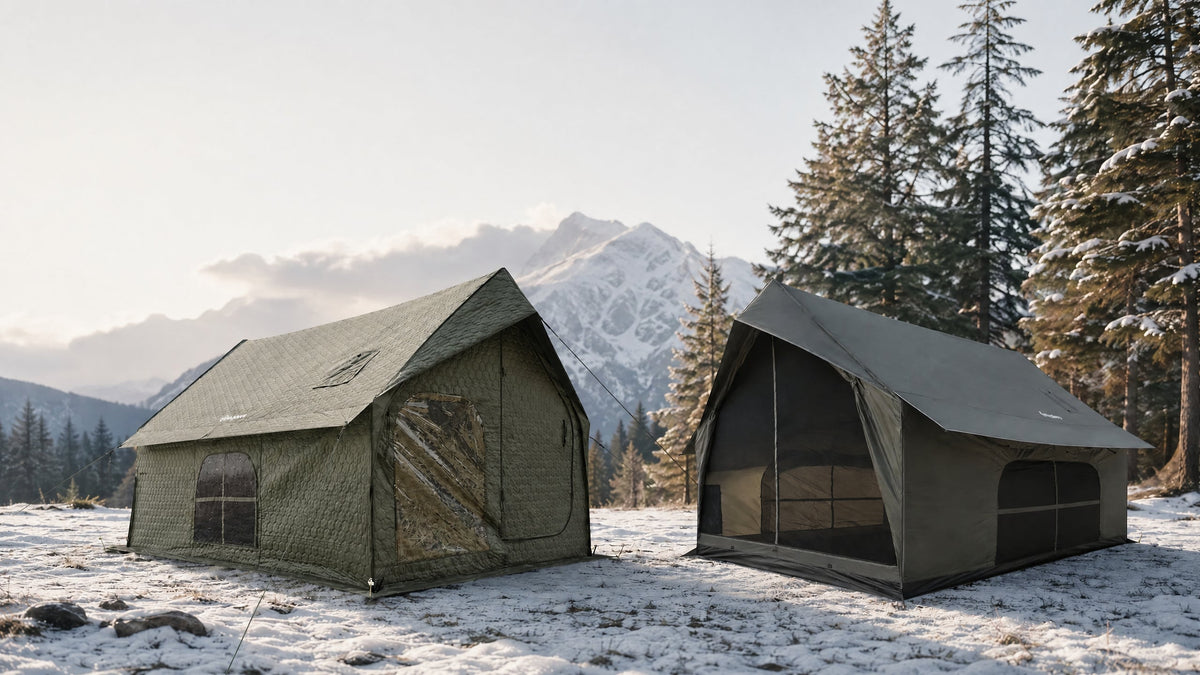
KingCamp's Snowhouse 5 and MOUNTAIN IN C5 are useful examples because they show two different ways to build a winter-capable shelter.

1. Insulated Tent vs. Hot Tent: What Is Actually Different?
An insulated tent uses additional layers, fill, or trapped air to reduce heat transfer. A hot tent is designed around stove compatibility, including a stove jack, chimney routing, ventilation, and safe clearance.
Those are two separate design decisions.
The Snowhouse 5 uses a three-layer quilted construction with a 210D Oxford outer fabric, a 100g insulation layer, and a 190T polyester inner layer. It also includes a stove jack, so it combines passive insulation with wood-stove compatibility.
The MOUNTAIN IN C5 takes a different approach. It uses a hybrid polycotton-and-polyester shell and includes a built-in stove jack, but its current specifications do not list a dedicated quilted insulation layer.
This is the key distinction: insulation and stove compatibility are not the same thing. A tent may have one, both, or neither.
2. Snowhouse 5 and MOUNTAIN IN C5: Two Different Winter Shelter Designs
Looking at real products makes the difference easier to understand.
| Tent | Wall / Shelter Construction | Stove-Ready Design | Approx. Shelter Size | What It Illustrates |
|---|---|---|---|---|
| KingCamp Snowhouse 5 | Three-layer quilted construction with a dedicated insulation layer | Yes — integrated stove jack | 340 × 240 × 210 cm | An insulated tent can also be a hot tent |
| KingCamp MOUNTAIN IN C5 | Hybrid polycotton + polyester shell; no dedicated quilted layer listed | Yes — integrated stove jack | 340 × 240 × 210 cm | Stove readiness does not require quilted insulation |
| RBM Outdoors UP-2 | Double-layer tent-within-a-tent design with an insulating air gap | Yes — integrated stove jack | 340 cm outer diameter × 190 cm high | Insulation can also come from a double-wall air space |
| Kodiak Canvas 12×12 Cabin Lodge SR | 100% cotton duck canvas | Yes — 5 in. stove jack | 12 × 12 ft; 7.5 ft peak height | A breathable canvas shelter can be stove-ready without quilted insulation |
Specifications above are based on current manufacturer product information. They help explain construction differences, but they should not be used to create a single “warmth ranking” because the products do not share one standardized thermal test.
If passive insulation is a priority, the Snowhouse 5 is the clearest KingCamp example. If you want cabin-style space with stove compatibility but do not specifically need a quilted wall system, the MOUNTAIN IN C5 represents a different route.
3. Which Tent Material Is Better for Managing Condensation?
No single tent material eliminates condensation. Fabric breathability matters, but ventilation, humidity, wet gear, the number of occupants, and the temperature difference between the inside and outside of the tent all affect how much moisture forms.
Condensation happens when warm, moisture-rich air inside the tent reaches a colder surface. Moisture also comes from breathing, damp clothing, wet boots, cooking, and the surrounding environment.

That is why good condensation management is better understood as a combination of:
- tent material and breathability
- cross-ventilation and adjustable vents
- how much moisture is introduced inside the tent
- the temperature difference between the inside and outside surfaces
REI's condensation guidance makes the same practical point: reduce moisture sources and maintain airflow instead of expecting fabric choice alone to solve the problem.
4. Canvas, Polycotton, and Synthetic Fabrics: What Really Changes?
Canvas and polycotton are popular in many basecamp and hot-tent designs because they can provide a more breathable shelter than heavily coated synthetic fabrics.
That can help with interior comfort, but it does not mean a canvas tent will never develop condensation.
Even a breathable shelter can collect moisture when several people sleep inside with vents closed, wet gear is stored indoors, or the outside temperature drops enough to chill the inner surface.
The KingCamp KHAN 340GSM TC Canvas Bell Tent is a useful example of the canvas side of the equation. Its heavy polycotton construction and stove jack make it relevant to cold-weather basecamp use, but ventilation and moisture management still matter.
Synthetic and insulated tents take a different route. Coatings, inner layers, and insulation can improve weather protection or reduce heat transfer, but moisture generated inside still needs somewhere to go. That is why winter-oriented shelters often combine their fabric system with windows, vents, mesh panels, or separated wall layers.
Material is one variable. Airflow is another.
5. Does a Four-Season Tent Keep You Warm in Winter?
A four-season or winter-capable tent can improve protection from wind, snow, and precipitation, but it does not replace a proper sleeping bag, insulated sleeping pad, or cold-weather clothing.
The tent is only one part of the system that keeps a camper warm.
Each part of a winter setup has a different job:
- Tent: reduces exposure to wind, snow, precipitation, and the outside environment
- Insulated tent walls: can reduce heat transfer through the shelter structure
- Sleeping pad: helps reduce conductive heat loss to the cold ground
- Sleeping bag: retains heat around the sleeper
- Clothing: provides personal insulation and helps manage moisture
- Compatible tent stove: adds heat while it is safely operating inside a stove-ready shelter

REI's winter camping guidance similarly treats the shelter, sleeping bag, and insulated sleeping pads as separate parts of the cold-weather system.
This is also why a “four-season” label should not be interpreted as a guaranteed minimum sleeping temperature. Wind, humidity, ground temperature, elevation, shelter setup, sleeping equipment, and the individual camper all affect real-world comfort.
6. Can a Wood Stove Solve Winter Warmth?
A wood stove can make an occupied hot tent much more comfortable, but it should not be the only thing keeping you safe overnight.
Once the fire dies down, the added heat gradually disappears. Your sleeping bag, sleeping pad, clothing, and shelter still have to match the conditions you expect.
Wood stoves also introduce a different set of requirements. A proper hot-tent setup needs:
- a compatible stove-ready shelter
- a correctly sized stove jack and chimney system
- adequate clearance from tent fabric and gear
- ground protection where required
- continuous ventilation
- careful carbon-monoxide and fire-risk management
- constant supervision while the stove is burning
Both the Snowhouse 5 and MOUNTAIN IN C5 include stove jacks, but a stove jack should never be interpreted as permission to use any stove with any chimney setup.
Always follow the tent and stove manufacturer's installation and safety instructions.
7. Which Type of Winter Tent Should You Choose?
The most useful question is not simply, “Which tent is warmest?” It is: which shelter construction matches the way you actually camp?
Choose an insulated or multi-layer shelter when:
- you expect longer cold-weather stays
- passive heat retention matters to you
- you are car camping, ice fishing, hunting, or building a winter basecamp
The Snowhouse 5 fits this approach.
Choose a stove-ready cabin tent when:
- you want upright living space
- you value windows, ventilation, and a cabin-style floor plan
- you want the option to use a compatible tent stove without requiring quilted walls
The MOUNTAIN IN C5 fits this route.
Choose a canvas or polycotton hot tent when:
- you prefer a breathable fabric system
- you are building a long-stay or glamping-style basecamp
- you value living space and stove compatibility more than backpacking weight
The KHAN 340GSM TC Canvas Bell Tent represents this type of setup.
For lightweight travel, the priorities change again. Weight, packed size, usable floor area with a stove, and weather exposure become more important than cabin-style comfort.
8. Think in Systems, Not Labels
“Insulated,” “canvas,” “hot tent,” and “four-season” describe different parts of a shelter rather than interchangeable levels of warmth.
- Insulated tells you something about the wall or shelter construction.
- Canvas or polycotton tells you something about the fabric system.
- Hot tent tells you the shelter is designed around compatible stove use.
- Four-season tells you something about the intended weather range, but not what sleeping bag or sleeping pad you need.
The strongest winter setup comes from treating those pieces as a system: choose a shelter appropriate for the weather, manage airflow and condensation, use a sleeping pad and sleeping bag suited to your conditions, and only use a wood stove in a tent specifically designed for it.
That is more useful than expecting one tent label or one fabric to solve winter warmth by itself.
Build a Better Winter Basecamp
Explore KingCamp winter shelter options based on the kind of camping you actually do:
- Snowhouse 5 Insulated Quilted Cabin Tent — for a multi-layer insulated winter shelter with a stove jack
- MOUNTAIN IN C5 Cabin Tent — for cabin-style space, ventilation, and stove compatibility
- KHAN 340GSM TC Canvas Bell Tent — for a heavier canvas basecamp with stove-ready capability
Share:
The KingCamp Wagon S: Small Footprint, Big Hauling Power
How to Dry and Store a Canvas Tent to Prevent Mold