

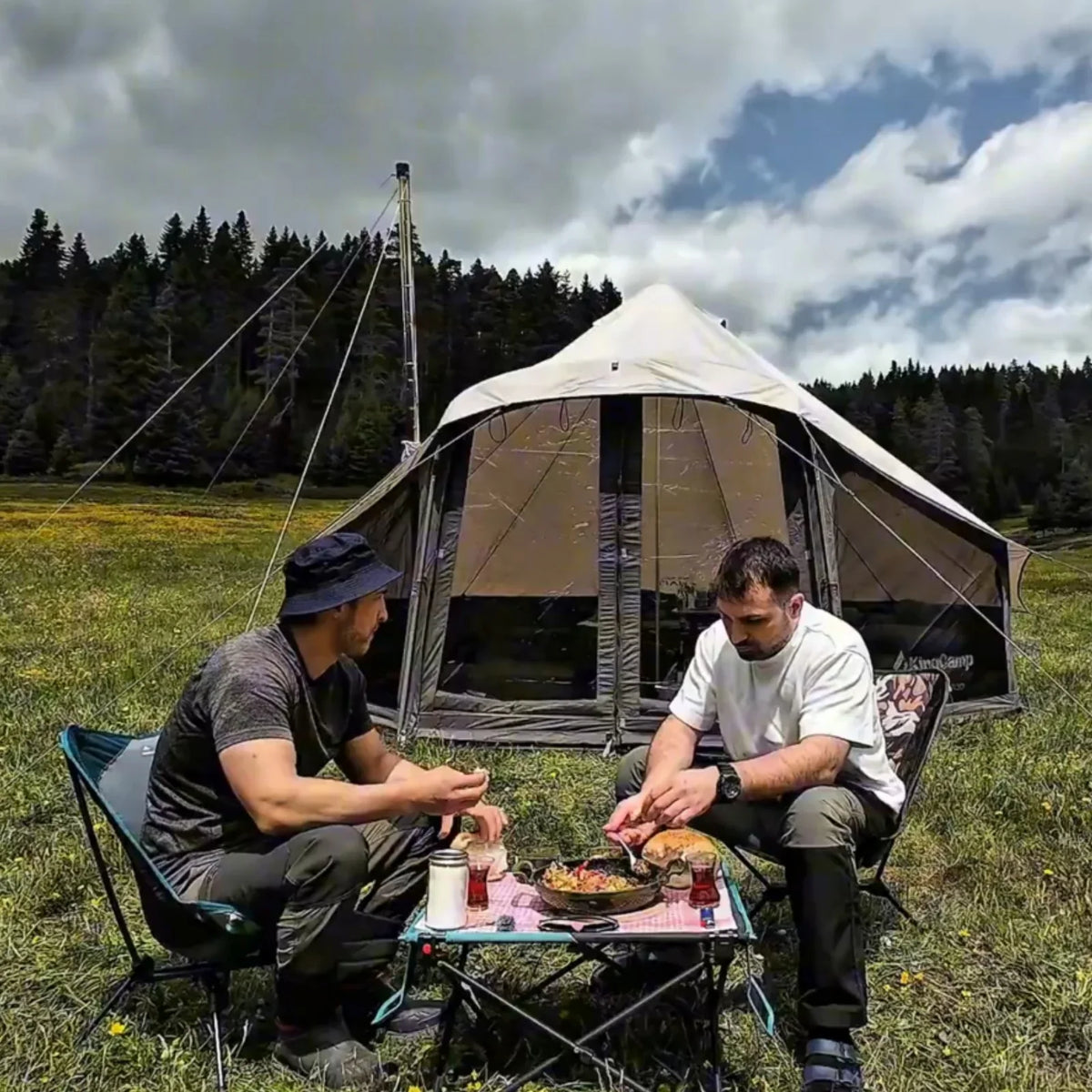
A deep, practical guide to drying time, wet pack-outs, polycotton maintenance, mold prevention and long-term storage—plus how car campers should think about the real trade-offs between tent weight, durability, interior comfort and at-home drying space.

How long should a canvas tent dry before storage?
Until every part is completely dry. Weather and moisture conditions determine the time; a fixed 12-, 24- or 48-hour rule does not.
Why Does a Canvas or Polycotton Tent Develop Mold in Storage?
Mold is often blamed on “canvas” itself, but the more useful way to think about the problem is moisture + organic material + time + limited airflow. A cotton-containing fabric can hold moisture in its fibers, and a folded tent contains plenty of places where dampness can remain hidden after the broad roof panels appear dry.
Polycotton is especially worth understanding. It blends cotton and polyester so campers can get the benefits of a cotton-containing fabric—such as breathability and a comfortable interior—with synthetic fibers that contribute strength and dimensional stability. Outwell's technical-cotton care guidance explains that the cotton component can swell when wet and help close small spaces in the weave. That same cotton component is also one reason careful drying matters before storage.
Moisture does not have to come from a major rainstorm. A tent can pick up water from:
- overnight condensation created by occupants;
- morning dew on the roof and guy lines;
- wet grass or soil under the floor;
- rainwater trapped around seams and zipper covers;
- wet shoes, clothing and gear inside the shelter;
- snow that melts during breakdown;
- a damp protective footprint or PE mat packed against the tent; and
- cordage and webbing that dry more slowly than large fabric panels.
This is why experienced tent-care guidance consistently repeats the same core instruction: store the shelter clean and completely dry. Springbar explicitly warns that cotton canvas stored damp or wet can suffer mold and mildew damage, while Outwell tells polycotton users to pay special attention to the groundsheet, seams, webbing, storm straps and material around zippers.
6 Places to Check Even When the Roof Feels Dry
Wet grass, soil and ground condensation can keep this surface damp.
Multiple material layers and stitching slow evaporation.
Folded flaps can shelter droplets from sun and moving air.
Dense woven material may stay damp after the surrounding panel dries.
Cordage can retain moisture and transfer it back to fabric in the bag.
Layered heat-resistant material and surrounding stitching deserve a separate check.
How Long Should a Canvas Tent Dry Before Storage?
The most accurate answer is not a number of hours. It is a condition: every component of the shelter must be dry.
A sunny, low-humidity afternoon with moving air may dry exposed fabric quickly. The same shelter may need far longer after several hours of rain on a cool, humid day. A heavier polycotton body can also dry differently from thin synthetic material, and the floor may lag behind the roof.
That is why a generic “24 hours” or “48 hours” rule can create false confidence. Some manufacturers publish a time window for dealing with a tent that had to be transported while damp, but that is not the same thing as saying every canvas tent requires that many hours to dry.
For example, CanvasCamp's U.S. maintenance guidance currently tells users who must take a tent down damp to lay it out to dry promptly after transport, while its other regional guidance uses a different recovery window. Springbar and Outwell emphasize the more important end condition: the tent must be completely dry before long-term storage. The practical lesson is simple: use the fabric's condition—not an arbitrary timer—as your final decision point.
A Better “Dryness Test” Than Counting Hours
Before packing, walk around the shelter and physically check the material. Do not test only the most exposed wall. Feel the underside of the floor, reinforced seams, rolled wall sections, straps, zipper covers and guy lines.
Damp areas often feel cooler or clammy compared with surrounding material because evaporation is still taking place. If you are uncertain, continue drying. When you have enough space at home, opening the tent again for a final inspection is far cheaper than discovering a musty odor after weeks of storage.
An optional home check is to let a tent that appears dry rest loosely folded for a short period, then reopen it and feel the previously hidden surfaces. This is not a manufacturer-defined test; it is simply a practical way to discover moisture that was missed during the first inspection.
The Complete Post-Trip Drying Routine
Step 1: Remove Debris Before It Gets Folded Into the Tent
Brush or shake away leaves, pine needles, grass, loose soil and sand. Vegetation and dirt can retain moisture, and abrasive particles can also become trapped against coatings, zippers and floor material. CanvasCamp specifically advises packing tents clean because vegetation and dirt hold moisture.
If mud is still wet, avoid grinding it aggressively into the fabric. Allow it to dry enough to brush away gently or follow the cleaning guidance for the material.
Step 2: Pitch the Tent Again Whenever Possible
A pitched shelter naturally separates large fabric panels and exposes them to airflow. This is usually more effective than leaving a heavy tent in a pile on a garage floor. It also gives you access to windows, vents, doors, seams and the entire floor perimeter.
If you cannot pitch the tent fully, spread it across a clean, dry area and reposition it periodically so air reaches both sides. Indoors, moving air from a fan and lower room humidity can help. Avoid improvised high-heat methods or placing fabric close to an open flame.
Step 3: Open Doors, Mesh Panels and Roof Vents
Ventilation matters after the trip just as much as during it. Open the tent's available ventilation points so moisture can leave the interior. This is particularly relevant to the KHAN designs because both product families incorporate substantial ventilation.
The current KHAN 340GSM product page lists internally controlled top ventilation windows and zippered side mesh windows. KHAN LIGHT adds three top ventilation windows plus a large floor-to-ceiling screen area in the front hall and broad side-wall screening.
Step 4: Treat the Floor as a Separate Drying Job
The roof can be dry while the bottom remains damp. Wet soil and grass can press water against the floor for many hours. Lift, roll back or reposition the ground-facing surface carefully so air reaches it.
If your tent uses a separate protective mat or ground layer, dry that separately. Do not trap a damp footprint against a dry tent body in the carry bag.
Step 5: Dry Cordage, Webbing, Stakes and Poles
Guy lines can remain wet after the body fabric is ready. Steel stakes may also carry wet soil into the bag, while poles can collect condensation or rainwater. Wipe hardware clean and dry it before packing.
This matters for convenience as well as mold prevention: storing clean, dry poles and stakes keeps dirt away from the tent fabric and makes the next setup easier.
Step 6: Give Dense Construction Areas Extra Time
Seam intersections, reinforced stake points, webbing, stove-jack panels and folded door sections contain more material than a single wall panel. They therefore deserve their own inspection rather than being assumed dry because the roof is dry.
Step 7: Perform a Final Check Before the Carry Bag
The carry bag should be the end of the drying process—not part of it. Pack the tent only when you are confident that fabric, floor and accessories are dry.
What If You Have to Pack a Canvas Tent Wet?
Sometimes there is no realistic choice. You may be breaking camp in heavy rain, leaving before morning dew burns off or dealing with snow that melts as the shelter comes down.
The important mental shift is this: a wet pack-out is a transportation decision, not a storage decision.
Shake off standing water and loose debris when practical.
Remember the tent is still wet even though it is inside its bag.
Unpack and re-pitch or spread the shelter as soon as practical.
Pack again only after a complete dryness check.
Springbar specifically tells users who break camp during a storm or before morning dew evaporates to set the tent up again after returning home and let it dry completely. Outwell gives essentially the same instruction for technical-cotton tents: if packed in wet weather, re-pitch as soon as possible and air-dry fully before storage.
Do not forget a wet tent in the back of a vehicle. A closed vehicle can become warm and humid, and a compressed shelter receives almost no useful airflow.
Do not use a wood stove, open flame or other combustion appliance as a shortcut for drying an unattended tent. Follow the tent and stove manufacturer's safety instructions whenever a stove is used.
How to Clean a Polycotton Tent Without Damaging Its Treatment
Cleaning is where cross-brand advice becomes risky. A recipe that is suitable for one manufacturer's cotton canvas is not automatically right for another manufacturer's coated polycotton.
Springbar, for example, recommends water and a soft-bristle brush for normal cleaning of its cotton canvas and warns that harsh detergents or soaps may compromise water repellency. Outwell likewise advises gentle cleaning for its technical-cotton tents and cautions against products that can damage water-repellent treatments.
Even mold-cleaning recipes differ between canvas brands. Springbar publishes one diluted-vinegar ratio for its own fabric, while CanvasCamp publishes another in its own maintenance guide. That difference is a useful reminder: those are brand-specific procedures, not universal KingCamp instructions.
For a KingCamp tent, start conservatively:
- Remove loose, dry dirt with a soft brush.
- Use clean water for routine surface cleaning when appropriate.
- Avoid aggressive scrubbing that can abrade coatings or stitching.
- Do not apply household detergent simply because it is convenient.
- Check the instructions supplied with the specific tent before using a specialist cleaner.
- After any wet cleaning, dry the tent completely before storage.
| Condition | Conservative first step | Why |
|---|---|---|
| Loose dust / dry grass | Soft brushing | Removes debris without unnecessarily wetting the tent. |
| Light surface dirt | Water + gentle sponge/brush, subject to care instructions | Reduces the chance of stripping a treatment. |
| Persistent stain | Verify fabric-compatible cleaner first | Different coatings react differently to chemicals. |
| Mold / mildew | Dry, inspect extent, then follow compatible mold-treatment guidance | Removing spores and preserving weather treatment are both important. |
What Should You Do If You Already Find Mold or Mildew?
First, do not simply spray fragrance on the affected area and repack the shelter. Musty odor is a symptom; the underlying moisture problem has to be corrected.
Move the tent to a well-ventilated location and inspect both sides of the affected material. Check neighboring folds, seam lines and anything that was packed against the spot. If the shelter is still damp, dry it before deciding how extensive the problem really is.
Next, follow a cleaning process compatible with the specific fabric and coating. CanvasCamp notes in its own care system that deep cleaning can require re-treatment afterward. That is a critical point: a cleaner powerful enough to attack mold can also affect a water-repellent treatment.
If mold is extensive, fabric strength appears compromised, stitching has deteriorated, leakage develops or you are unsure which treatment is compatible, contact the manufacturer or a qualified repair specialist rather than repeatedly escalating to harsher chemicals.
The KHAN LIGHT product page notes that its manufacturer warranty does not cover mold/mildew. Preventive drying and storage are therefore part of protecting the tent between trips.
How to Store a Canvas Tent Between Trips
Once the tent is clean and completely dry, the next goal is to prevent the storage environment from putting moisture back into the system.
Outwell recommends a dry, ventilated storage location, and CanvasCamp advises keeping packed canvas away from damp basements and off floors where water may collect. The label on the room matters less than the actual conditions inside it.
A Garage Can Be Fine—If It Is Actually Dry
A dry garage shelf can work well. A garage with recurring condensation, roof leaks, wet concrete, flooding or very high humidity is different. Keep the tent elevated from floors that may puddle and away from known moisture sources.
Do Not Pack Wet Accessories Against Dry Canvas
A clean, dry tent can become damp again if packed with wet straps, footprints, cordage or muddy stakes. Dry accessories separately when necessary.
Check Long-Term Storage Periodically
If the shelter will sit unused for a season, inspect the storage area periodically for leaks, pests, condensation or odor. This is especially worthwhile in humid climates or outbuildings.
12-Point Storage Checklist
Car Camping: How Should Buyers Balance Weight, Durability and Comfort?
The usual backpacking logic—“lighter is automatically better”—does not transfer cleanly to drive-up camping. REI's current car-camping guidance notes that bulk and weight matter far less when your vehicle carries the shelter to the campsite. That opens the door to taller interiors, broader floors, more ventilation, heavier materials and comfort-oriented features.
Outside's 2026 car-camping testing similarly evaluates tents on factors such as functionality, ease of setup and takedown, durability, comfort and livability rather than weight alone.
But a heavy tent still creates work. The important question is not simply “Can my SUV carry it?” A better set of questions is:
- Can one person lift the packed bag safely?
- How far will the tent usually travel from the vehicle to the pitch?
- Will you move camp every night or stay several days?
- How much room do you have to store the packed shelter at home?
- Most importantly for canvas: where will you dry it after a rainy trip?
That last question is often missing from buying guides. A large canvas tent may be ideal at camp but difficult to care for if you live in an apartment and have nowhere to pitch or spread a 13- to 16.5-foot-class shelter after a wet weekend.
| Factor | Why it matters at camp | Why it matters at home |
|---|---|---|
| Packed weight | Affects carrying and solo setup. | Affects lifting onto shelves and moving wet fabric. |
| Fabric weight | Changes the shelter's feel and handling. | More material can take more space and effort to dry. |
| Interior geometry | Determines useful standing and furniture space. | Larger shelters need more drying area. |
| Ventilation | Helps comfort and condensation management. | Open panels can speed post-trip air drying. |
| Setup frequency | Repeated moves make handling effort more noticeable. | Frequent use means more frequent cleaning and drying cycles. |
KingCamp KHAN 340GSM vs. KHAN LIGHT 400/500
The two KHAN families take different approaches to the same broad goal: a spacious polycotton shelter for car camping, glamping and extended campsite living.
The KHAN 340GSM emphasizes substantially heavier 340 g/m² T/C canvas and a robust aluminum structure. The KHAN LIGHT uses 210G polyester/cotton to reduce packed weight while emphasizing large mesh areas, visibility and a tall front-hall design.
Browse the broader KingCamp KHAN Tent Collection if you want to compare these models with the rest of the family.
| Model | Capacity | Main fabric | Weight | Pitched size | Packed size |
|---|---|---|---|---|---|
| KingCamp KHAN LIGHT 400/500 Canvas Bell Tent — Grey / 4-6 Person | 4–6 people | 210G polyester/cotton | 62 lb / 28 kg | 360 × 395 × 270 cm | 92 × 40 × 32 cm |
| KingCamp KHAN LIGHT 400/500 Canvas Bell Tent — Grey / 6-8 Person | 6–8 people | 210G polyester/cotton | 77 lb / 35 kg | 460 × 500 × 300 cm | 92 × 47 × 34 cm |
| KingCamp KHAN 340GSM TC Canvas 4-Season Bell Tent — Khaki / 4-6 Person | 4–6 people | 340 g/m² T/C canvas | 72.6 lb / 32.95 kg | 400 × 400 × 270 cm | 92 × 34 × 36 cm |
| KingCamp KHAN 340GSM TC Canvas 4-Season Bell Tent — Khaki / 8-10 Person | 8–10 people | 340 g/m² T/C canvas | 95.2 lb / 43.2 kg | 500 × 500 × 300 cm | 92 × 48 × 40 cm |
The table above uses the current written specifications on the relevant KingCamp product pages rather than older specification graphics in the image galleries.
Product Deep Dive: KingCamp KHAN 340GSM TC Canvas 4-Season Bell Tent
The current KHAN 340GSM product page specifies 340 g/m² (10 oz/yd²) T/C canvas with a double-sided coating and a hydrostatic-head specification above 800 mm. The product also uses cotton-wrapped polyester-core COATS® thread, which KingCamp describes as swelling when wet to help close stitching gaps.
Its aluminum pole system uses multiple diameters up to 52 mm with a listed 2 mm wall thickness. Current functional details also include top ventilation windows, zippered side mesh windows, a stove jack, steel ground spikes, guy ropes with aluminum sliders and a 510 g/m² PVC mesh ground mat.

KingCamp KHAN 340GSM TC Canvas 4-Season Bell Tent — Khaki / 4-6 Person
The 4–6 person version is listed at 400 × 400 × 270 cm when pitched, 92 × 34 × 36 cm packed and 32.95 kg / 72.6 lb. The current product imagery for this size also shows a 2.7 m peak, 1.80 m entrance height and approximately 0.65 m side-wall height.

For couples, small families and campers who want the heavier 340GSM platform without moving to the 5 m footprint, this size keeps the 340GSM material and robust pole system in a smaller package. It is still a substantial car-camping shelter rather than a lightweight carry tent.
View KingCamp KHAN 340GSM TC Canvas 4-Season Bell Tent — Khaki / 4-6 Person
KingCamp KHAN 340GSM TC Canvas 4-Season Bell Tent — Khaki / 8-10 Person
The larger version expands to 500 × 500 × 300 cm, packs to 92 × 48 × 40 cm and weighs 43.2 kg / 95.2 lb. The current size-specific product graphic shows the 5 m / 16.4 ft footprint and 3 m / 9.8 ft peak.

This is the option to examine when group living area matters more than minimum handling weight. The important ownership question is whether your vehicle, storage location and post-rain drying routine can comfortably accommodate a tent approaching 100 lb before water or dirt is added.
View KingCamp KHAN 340GSM TC Canvas 4-Season Bell Tent — Khaki / 8-10 Person
Product Deep Dive: KingCamp KHAN LIGHT 400/500 Canvas Bell Tent
KHAN LIGHT uses 210G polyester/cotton, which brings the packed weights down to 62 lb / 28 kg for LIGHT 400 and 77 lb / 35 kg for LIGHT 500. Its design puts particular emphasis on ventilation, visibility and front-hall space.
The product page describes a floor-to-ceiling screen window in the front hall, a large side-wall screen, transparent PVC at the front door, three top ventilation windows and an aluminum-alloy structure. It also lists a 210D Oxford floor with a 10,000 mm waterproof rating and an 85 g PE protective mat.
A sleeve-style chimney opening is listed as a feature, with heat-resistant material specified by the product page. As with any hot-tent setup, stove compatibility, clearances, ventilation and the stove manufacturer's instructions should be followed carefully.
KingCamp KHAN LIGHT 400/500 Canvas Bell Tent — Grey / 4-6 Person
LIGHT 400 is the 4–6 person version. Current written specifications list 360 × 395 × 270 cm, a packed size of 92 × 40 × 32 cm and a weight of 28 kg / 62 lb.

Compared with the 4–6 person KHAN 340GSM, LIGHT 400 saves approximately 10.6 lb / 4.95 kg. That can be meaningful when one person frequently moves the tent between a storage shelf, vehicle and campsite.
View KingCamp KHAN LIGHT 400/500 Canvas Bell Tent — Grey / 4-6 Person
KingCamp KHAN LIGHT 400/500 Canvas Bell Tent — Grey / 6-8 Person
LIGHT 500 is the 6–8 person version. Current written specifications list 460 × 500 × 300 cm, a packed size of 92 × 47 × 34 cm and a weight of 35 kg / 77 lb.

LIGHT 500 provides a larger 3 m-high group shelter while staying below the current listed weight of the largest KHAN 340GSM model. It remains a large car-camping tent, so the same drying-space question applies after wet trips.
View KingCamp KHAN LIGHT 400/500 Canvas Bell Tent — Grey / 6-8 Person

Which Model Should You Compare First?
There is no single “best” choice for every car camper. The useful comparison is how your normal camping routine interacts with size, fabric weight and handling effort.
Compare first if you want 4–6 person capacity with the lowest current listed weight among these four variants and expect frequent loading, unloading and setup.
Compare first if you want the LIGHT ventilation concept with a larger 6–8 person footprint and 3 m peak height.
Compare first if 340 g/m² T/C canvas and the heavier-duty KHAN platform matter more than keeping packed weight as low as possible.
Compare first for large-group base camps where maximum interior scale is important and your vehicle, storage area and drying routine can handle a 95.2 lb shelter.
The Buying Factor Most Canvas-Tent Comparisons Miss: Where Will You Dry It?
Capacity charts tell you how many people can fit inside. Packed-weight charts tell you what the bag weighs. Neither tells you whether your home can support the ownership routine of a large polycotton tent.
Before buying, imagine the least convenient version of your camping trip: you arrive home after three days of rain and the shelter is damp. Now ask:
- Can you pitch the tent in a yard?
- Can you spread it safely in a clean garage?
- Is there enough ventilation to dry the floor and the body separately?
- Can you handle the extra weight of wet fabric?
- Can you leave it open long enough without blocking vehicles or living space?
This does not mean a larger canvas shelter is a bad choice for someone with limited space. It means maintenance logistics should be part of the purchase decision, just like sleeping capacity and packed dimensions.
Care Priorities for the KHAN Models in This Guide
| Model | Post-trip care priority | Why |
|---|---|---|
| KHAN LIGHT 400 | Open the large mesh/PVC front and top vents; dry PE protective layer separately. | Multiple layers and a separate protective mat can hide moisture. |
| KHAN LIGHT 500 | Plan enough physical space for the 5 m-class footprint when re-drying. | A larger floor and wall area require more room to expose fully. |
| KHAN 340GSM 4–6 | Give 340GSM fabric, seams and double-wall areas time to dry fully. | Heavier fabric and layered construction should not be judged by the roof surface alone. |
| KHAN 340GSM 8–10 | Plan handling help and a large drying area before a wet trip happens. | The current listed dry weight is 95.2 lb before added rainwater or dirt. |
Frequently Asked Questions
How many hours should I dry a canvas tent before storage?
There is no reliable universal number. Dry until every component is completely dry. Humidity, temperature, airflow, rain exposure, fabric thickness and ground moisture all affect the time required.
Does a canvas tent need 24 or 48 hours to dry?
Not necessarily. Numbers published by tent-care brands often refer to how quickly a tent packed damp should be reopened and dealt with. They are not universal minimum drying durations. A tent that becomes completely dry sooner can be stored sooner; a tent that is still damp after a long period still needs more drying.
Can I drive home with a wet canvas tent?
Yes, when weather leaves no practical alternative. Treat it as a temporary wet pack-out, then unpack, re-pitch or spread the shelter and dry it fully as soon as practical.
What is the easiest part of a tent to forget when drying?
The underside of the floor is one of the most commonly overlooked areas. Seams, zipper covers, webbing, stake loops and guy lines are other slow-drying spots.
Can a polycotton tent still get mold?
Yes. Polycotton still contains cotton fibers. It should be stored clean and completely dry.
Should I wash a KingCamp tent with detergent?
Do not assume normal household detergent is compatible with the fabric's coating or treatment. Start with gentle cleaning and follow the specific care guidance for your tent before applying a chemical cleaner.
Can I use another canvas brand's vinegar mold recipe?
Treat cross-brand recipes as examples, not automatic instructions. Different manufacturers publish different cleaning concentrations and use different fabrics and treatments. Verify compatibility first.
Can I store a canvas tent in a garage?
Yes, if the garage remains dry and the tent is elevated away from water that may collect on the floor. A garage with persistent condensation, leaks or flooding is not a good long-term storage location.
Should I store the guy lines separately?
If the guy lines are still damp when the tent body is dry, keep them separate until they are fully dry. The goal is to avoid putting moisture back against the tent fabric.
Is KHAN LIGHT a backpacking tent because it is called “LIGHT”?
No. “LIGHT” is relative to this style of large polycotton shelter. The current listed weights are 62 lb / 28 kg for LIGHT 400 and 77 lb / 35 kg for LIGHT 500, making them car-camping-oriented tents.
How much heavier is KHAN 340GSM 4–6 than KHAN LIGHT 400?
Based on current listed specifications, KHAN 340GSM 4–6 is about 10.6 lb / 4.95 kg heavier.
Does a higher person rating automatically mean more comfort?
No. Capacity is only one dimension. Usable comfort also depends on peak height, wall geometry, ventilation, furniture, sleeping setup and the amount of gear stored inside.
The Best Mold-Prevention Tool Is a Repeatable Drying Routine
Remove moisture-holding debris, expose both sides of the floor, open the ventilation system, inspect seams and guy lines, and put the shelter into long-term storage only when the whole system is dry. Whether your priority is the lower handling weight of KHAN LIGHT or the heavier 340GSM construction of KHAN 340GSM, proper post-trip care is what protects the tent between adventures.
Share:
Insulated Tents vs. Canvas Hot Tents: What’s the Difference?
When Does a Family Camping Tent Need an AC Port?