

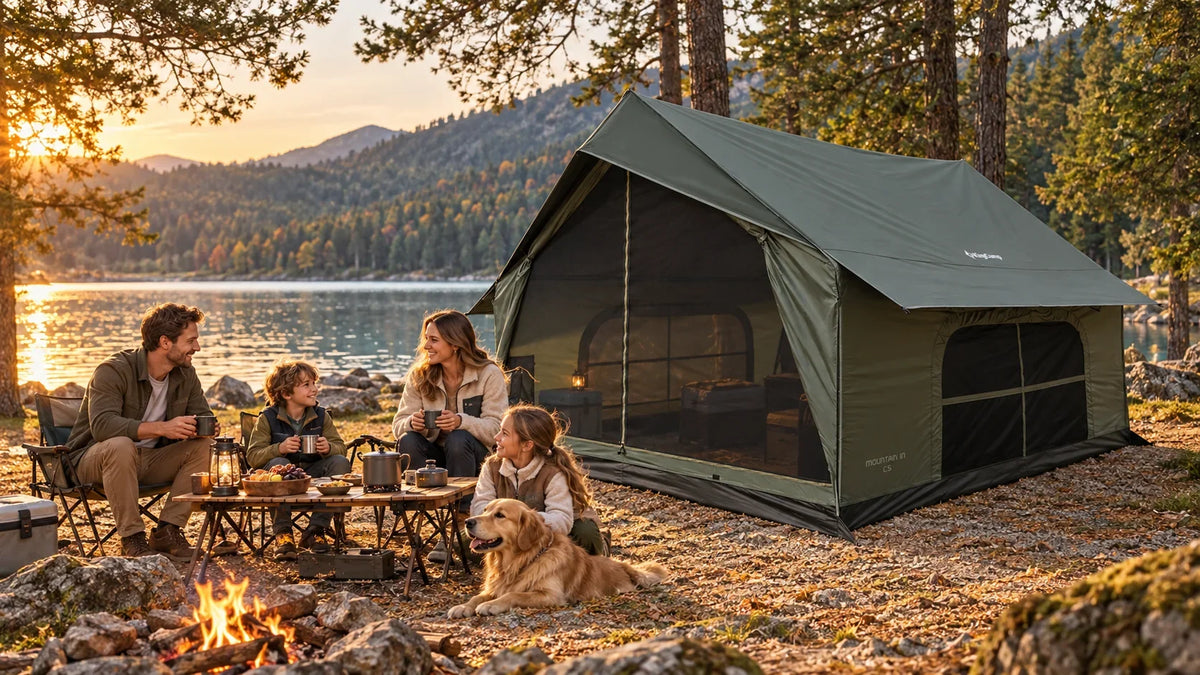
A family tent with an AC port becomes useful when three things come together: your family needs cooling while spending time inside the tent, you have a compatible air conditioner or fan setup, and your campsite or battery system can power it for the hours you need.
Summer camping alone does not make an AC port essential. A shaded campsite with cool evenings creates a very different comfort problem from a humid campground where the tent remains uncomfortable at bedtime. The better question is not simply, “Does this tent have an AC port?” but whether a dedicated connection will make cooling practical for the way your family actually camps.
This guide explains when a tent AC port is worth prioritizing, when ventilation may be enough, how to match a portable AC with a tent, what to check for campsite power, and how a purpose-built option such as the KingCamp MOUNTAIN IN C5 fits into that decision.
When Does a Family Tent With an AC Port Make Sense?
Prioritize a family tent with an AC port when warm conditions overlap with the hours your family actually uses the tent, ventilation does not provide the comfort you want, and powered cooling is realistic at your campsite. The feature becomes more valuable on repeated warm-weather trips or longer stays, where a dedicated duct opening can simplify a setup you expect to use again and again.
When Your Family Spends Hot Afternoons Inside the Tent
A family returning to the tent only after sunset may have little reason to cool an empty shelter during the day. A family using the tent for afternoon naps, changing clothes, reading, kids’ quiet time, or taking breaks from the heat has a different requirement.
Check the shade pattern during the hours you expect to use the tent. Morning shade does not necessarily protect the site in the afternoon, and an AC port does not make exposed tent fabric perform like an insulated room.
When the Tent Stays Hot at Night
Look beyond the daytime high. Evening temperature, humidity, wind, and available airflow matter when the main goal is comfortable sleep.
Opening mesh windows can exchange air, but it cannot provide refrigerated cooling. Fans circulate existing air rather than producing cold air, as explained by the U.S. Department of Energy.
When You Regularly Camp With Electrical Hookups
An AC port is easier to justify when your usual destinations permit air conditioners and provide suitable electricity. For occasional trips without hookups, battery size, charging, transport weight, and runtime may matter more than the tent opening itself.
Use this practical shortlist:
| Your camping situation | AC port priority | What to resolve first |
|---|---|---|
| Shaded site, comfortable evenings, tent used mainly for sleeping | Low | Ventilation, shade, and sleeping layout |
| Warm afternoons, occasional powered sites, mixed weather | Medium | How often you will actually run powered cooling |
| Repeated hot-weather stays with suitable electrical hookups | High | AC compatibility, duct routing, and available electrical load |
There is no single outdoor temperature at which every family tent suddenly needs an AC port. The timing of exposure, humidity, shade, family routine, and practicality of the complete cooling system are more useful buying criteria.
Family Tent Ventilation vs Air Conditioning: When Is a Fan Enough?
Start with shade, mesh ventilation, and a fan when the main problem is stagnant air and the tent becomes comfortable once air starts moving. Consider compressor air conditioning when you need to remove heat rather than simply circulate it. A water-based evaporative cooler is a separate option and works best under the right humidity conditions.
| Cooling approach | What it does | Main limitation | Dedicated AC port needed? |
|---|---|---|---|
| Open mesh doors and windows | Exchanges tent air with outside air | Depends on outside conditions and airflow | No |
| Circulation fan | Moves air around occupants | Does not refrigerate the air | Usually no |
| Direct evaporative cooler | Uses evaporation to cool air while adding moisture | Better suited to dry conditions | Not normally for hot exhaust; follow the appliance instructions |
| Compressor portable AC | Removes heat from the cooled space | Needs suitable exhaust or duct routing and enough power | Often helpful, if compatible |
The Department of Energy distinguishes fans from refrigerated cooling and identifies evaporative cooling as an option for arid climates. That distinction matters when a small water-tank device is marketed as a “portable air conditioner.”
Before adding powered cooling, ask:
- Does the tent become comfortable after sunset?
- Is the problem still air, or air that remains too warm?
- Can you choose a better-shaded pitch?
- Will you actually occupy the tent during the uncomfortable hours?
If your usual trips are comfortable with ventilation, prioritize tent layout, mesh coverage, standing room, and ease of use. You can compare the KingCamp cabin tent collection or browse the broader camping tent collection without making an AC port the only selection criterion.
What Is a Tent AC Port and How Does It Work?
A tent AC port provides a planned route through the tent fabric for compatible cooling ductwork. An electrical or cable port primarily provides cable access. Neither one supplies electricity, creates cooling, or guarantees compatibility with a particular appliance. Check the actual opening and intended function: a product label alone does not establish whether your hose and adapter will fit.
Three openings should not be treated as interchangeable:
| Opening | Intended purpose | What to check |
|---|---|---|
| Electrical or cable port | Bringing a power cable through the fabric | Cable access and closure arrangement |
| AC or fan duct port | Accommodating suitable air ductwork | Opening dimensions, adapter fit, duct count, and intended airflow |
| Stove jack | Routing a compatible stove flue | Whether the tent and appliance instructions permit that arrangement |
The airflow direction is particularly important. For a portable AC positioned inside the tent, the hot exhaust must leave the cooled space. GE explains that its portable air conditioners cannot function properly without exhausting outdoors.
A cooling unit specifically designed to operate outside may instead deliver cooled air through ductwork, with additional return-air connections depending on the model. Follow the appliance’s intended installation arrangement; do not assume every portable AC can simply be moved outside.
This is why “the hose fits” is only one part of compatibility.
How to Match a Portable AC With a Family Tent AC Port
Check the tent opening against the complete duct assembly, not only the flexible hose. A workable installation needs the right number of airflow connections, a supported hose route, required appliance clearance, a plan for condensate, and enough room for the family to keep using the entrance and sleeping area safely.
Check the AC Hose and Adapter Size
A hose may pass through an opening while its rigid collar or adapter does not. Ask for the clear port dimensions, closure method, and any restrictions on adapters.
For example, a hypothetical 150 mm hose with a 170 mm connector should not be judged against the hose diameter alone. The connector and the way it attaches may determine whether installation is possible.
Also confirm whether your appliance needs one duct, two ducts, or another arrangement. One tent opening does not automatically accommodate every portable AC for tent camping.
Plan the AC Hose Route Around Beds and Doors
Before setting up the sleeping area, sketch the proposed AC position, tent port, beds, storage, and entrance. Look for problems such as:
- A hose crossing the route children use to reach the door.
- Bedding obstructing an air inlet or outlet.
- A rigid adapter pulling on the tent wall.
- An appliance that fits only by reducing required clearance.
- Hot exhaust discharging where it can return through an open window.
Use the appliance’s specified hose and permitted routing. GE cautions that extending or excessively bending its exhaust hoses can reduce performance; those limits are model-specific rather than universal tent-installation dimensions.
Plan for AC Condensate and Outdoor Weather
Check whether the AC collects water, drains continuously, or requires drainage in certain modes or conditions. Keep the approved drainage route away from bedding and normal walking paths.
“Self-evaporating” should not be interpreted as “water never needs attention.” For example, EcoFlow documents residual condensate and drainage considerations for its WAVE 3. See EcoFlow drainage support for model-specific guidance.
Outdoor placement also needs explicit appliance approval. A tarp does not automatically make an indoor appliance suitable for outdoor use, and rain protection must not block the airflow the AC requires.
How to Power an Air Conditioner for a Family Camping Tent
Resolve electricity before treating an AC port as a buying advantage. At a campground, confirm permission, outlet type, supply capacity, and appliance connection requirements. With a battery, check both output power and usable energy. A power station may be capable of starting an AC but still lack the energy to run it through the night.
Using AC at a Powered Campsite
Ask the campground:
- Are air conditioners permitted on tent pitches?
- What outlet type and electrical supply are available?
- Is there a site-specific load limit?
- Where is the outlet relative to the tent pitch?
- Are there restrictions on equipment placement or operating hours?
Then compare those answers with the AC manual.
Include other equipment using the same supply. A cooler, kettle, lights, chargers, and an air conditioner should not be assessed as though each has exclusive access to the circuit.
Follow the appliance’s instructions on cords and connections. Some portable AC manuals explicitly prohibit extension cords, so “outdoor-rated” alone is not sufficient approval.
Running a Tent Air Conditioner From a Portable Power Station
Two specifications matter:
- Watts: whether the system can meet the appliance’s operating and startup demand.
- Watt-hours: how much usable energy is available over time.
Illustrative runtime example
Battery capacity: 1,000 Wh
Usable energy after conversion losses and reserve: 850 Wh
Average AC electrical consumption: 400 W
Estimated runtime = 850 Wh ÷ 400 W = about 2.1 hours.
That does not cover an eight-hour night. At the same assumed average consumption, eight hours would require 3,200 Wh delivered to the AC before accounting for conversion losses and other loads.
These are example values, not performance claims for a particular product. Actual consumption changes with conditions, settings, compressor cycling, and other equipment drawing from the same battery.
The practical lesson is straightforward: size the energy plan around the hours you need cooling, not just the fact that the AC switches on.
KingCamp MOUNTAIN IN C5: A Family Tent With an AC Port

The KingCamp MOUNTAIN IN C5 shows what a family tent with an AC port can look like when the cooling connection is supported by the rest of the tent design. Rather than treating the AC/Fan port as an isolated feature, the C5 combines it with a roomy cabin-style interior, near-vertical walls, an open ridge-frame structure, multiple ventilation openings, and cold-weather features for families who camp across more than one season.
That combination is what makes the C5 relevant to this guide. A dedicated AC port is more useful when the tent also gives you enough space to position beds and equipment, enough ventilation to stay comfortable when powered cooling is unnecessary, and enough standing room to make longer family stays practical.
KingCamp C5 at a Glance
| C5 feature | Official specification | Why it matters for family camping |
|---|---|---|
| Capacity | 5–6 people | Room for sleeping setups plus normal family camping gear. |
| Expanded size | 11.2 × 7.9 × 6.9 ft (340 × 240 × 210 cm) | The 6.9 ft peak height provides standing room and makes changing clothes or organizing gear easier. |
| Cabin layout | Near-vertical walls and ridge-frame structure | More of the floor remains usable for cots, air mattresses, storage, and cooling equipment. |
| Frame | 16 mm steel poles; ridge structure with crossbeam | The design eliminates a center pole from the middle of the living area. |
| Ventilation | Two large doors and four windows with mesh panels | Lets you use natural airflow before turning to powered cooling. |
| Hot-weather feature | Pre-reserved AC/Fan port | Provides a dedicated route for compatible portable AC or fan ducting. |
| Cold-weather feature | Built-in stove jack and fire-resistant ground cloth | Adds flexibility for compatible wood-stove setups on colder trips. |
| Fabric system | 210g TC fabric, 210T ripstop polyester with PU 3000 mm coating, and 210D Oxford groundsheet with PU 3000 mm coating | Combines a breathable polycotton roof section with weather-resistant synthetic sections and floor fabric. |
More Usable Space for Beds, Gear, and Cooling Equipment
One of the C5’s strongest family-camping advantages is its usable interior volume. The tent is designed for 5–6 people and measures approximately 11.2 × 7.9 ft, with a 6.9 ft peak height. Its cabin-style walls are much more upright than the walls of a typical dome tent, so more of the footprint can be used for sleeping, storage, and movement rather than being lost to steep wall angles.
The ridge-frame design also removes the need for a center pole in the middle of the tent. That matters in everyday use because the central floor can stay open for cots, air mattresses, bags, or a shared walkway. It matters even more when you add cooling equipment: a portable AC, its duct, its power cable, and the required clearances all consume space.
In other words, the C5 does not simply give you an opening for an air conditioner. Its layout makes it easier to integrate that equipment into a real family sleeping setup without forcing the hose through the center of the room or placing the appliance directly in the main path to the door.
Natural Ventilation Before You Turn On the AC
A family tent with an AC port should still work well when the air conditioner is off. The MOUNTAIN IN C5 includes two large doors and four windows with mesh panels, creating multiple paths for cross-ventilation when outside conditions are comfortable enough for natural airflow.
That gives families more flexibility across changing weather. On cooler mornings, breezy afternoons, or mild evenings, opening mesh panels may provide all the airflow you need. You can save electrical power and avoid carrying the cooling load when the weather does not justify it.
When the tent remains hot despite shade and ventilation, the dedicated AC/Fan connection gives you a second layer of comfort rather than forcing you to choose between a naturally ventilated tent and a tent designed around powered cooling.
A Dedicated AC/Fan Port for Hot-Weather Family Camping

The feature most relevant to this article is the C5’s pre-reserved AC/Fan port. KingCamp positions it as a connection point for a portable air conditioner or fan, giving compatible ductwork a dedicated route through the tent wall.
That is more practical than relying on the main entrance as the default hose opening. The door can remain available for normal entry and exit, the cooling connection stays in a predictable location, and you reduce the need to leave a large section of the entrance partly unzipped around the duct.
For families who repeatedly camp in hot conditions, this can make the setup easier to reproduce from trip to trip. Once you know that your cooling equipment fits, you can plan the bed layout, hose route, and power cable around the same general position instead of improvising a new arrangement every time.
The important limitation is compatibility. The presence of an AC/Fan port does not mean every portable AC will fit automatically. Before buying cooling equipment, confirm the hose diameter, rigid connector dimensions, required number of ducts, intended airflow direction, drainage requirements, appliance clearance, and power demand.
Hybrid Fabric Helps Balance Breathability and Weather Protection
The C5 also uses a mixed fabric system rather than relying on one material throughout the shelter. KingCamp lists a 210g TC polycotton section with a 450 mm water-resistance rating, together with 210T ripstop polyester using a PU 3000 mm waterproof coating. The groundsheet is 210D Oxford fabric with a PU 3000 mm coating.
For family camping, that combination addresses two different comfort needs. The polycotton roof section is intended to provide better breathability than a fully synthetic roof, while the coated polyester and Oxford sections provide stronger rain and ground-moisture protection where those conditions matter most.
This is relevant to cooling because air-conditioning performance is only one part of tent comfort. Fabric breathability, mesh ventilation, shade, humidity, and airflow all affect how quickly heat and moisture build up inside the tent.
Useful Beyond Summer: Stove Jack for Cold-Weather Trips
The MOUNTAIN IN C5 is not designed only around hot-weather camping. It also includes a built-in stove jack and a fire-resistant ground cloth for compatible wood-burning stove setups.
That gives the tent a broader seasonal role. During hot trips, you can prioritize mesh ventilation, a fan, or the AC/Fan port. During colder trips, campers using a compatible stove according to the tent and stove instructions have a separate feature designed for that purpose.
For families who camp in more than one season, this flexibility can be more useful than buying a shelter designed around only summer ventilation or only cold-weather heating.
Small Details That Matter on Longer Family Trips
Longer family stays create different needs from a one-night tent setup. The C5 includes interior storage pockets, a ceiling S-hook for a lantern or camping light, reflective guy lines, high-visibility stakes, and a heavy-duty carry bag.
These details do not change the AC performance, but they help keep the tent easier to live with once beds, bags, clothing, lighting, and cooling equipment are all part of the same space. Storage pockets can keep smaller items off the floor, the ceiling hook provides a central place for light, and reflective guy lines make the tent perimeter easier to see after dark.
Why families may choose the C5
- 5–6 person capacity with enough room for a real family sleeping setup.
- 6.9 ft standing height and near-vertical cabin walls.
- An open ridge-frame layout without a center pole in the middle of the floor.
- Two large doors and four mesh windows for natural ventilation.
- A dedicated AC/Fan port for compatible powered cooling.
- A built-in stove jack and fire-resistant ground cloth for compatible cold-weather setups.
- A hybrid polycotton and coated synthetic fabric system designed to balance breathability and weather resistance.
The main strength of the KingCamp MOUNTAIN IN C5 is therefore not simply that it has an AC port. The port sits inside a broader family-focused design: a roomy cabin layout, useful standing height, multiple ventilation openings, an open center floor, and features that help the tent adapt as weather changes.
For families who expect to use powered cooling regularly, the KingCamp MOUNTAIN IN C5 provides a more purpose-built starting point than a tent where the AC hose has to be improvised through a door or window. If you are still comparing layouts, browse the KingCamp cabin tent collection, the family camping collection, or the broader camping tent collection.
If you already know which AC you want to use but cannot confirm the port dimensions or connector fit from the published specifications, send the model number, hose diameter, connector dimensions, and duct requirements to KingCamp support before ordering the complete setup.
Family Tent With AC Port FAQ
Does an AC Port Make a Tent Cooler by Itself?
No. The port only provides access for compatible cooling equipment. Actual cooling depends on the appliance, installation, power supply, weather, shade, and tent conditions. Without equipment connected, the port is simply a tent feature—not a source of refrigerated air.
Is There a Temperature at Which an AC Port Becomes Essential?
There is no universal temperature threshold. Assess the hours your family uses the tent, humidity, shade, overnight conditions, and whether natural airflow becomes comfortable after sunset. An AC port is most useful when it supports a cooling system you have a practical reason and power source to use.
Can I Run an AC Hose Through a Partly Open Door Instead?
A door opening may accommodate an approved temporary arrangement, but it can interfere with entry, insect protection, and hose support. For regular AC use, a compatible dedicated port can make the setup cleaner and easier to repeat.
Can the Stove Jack Serve as the AC Port?
Only when the tent and appliance requirements explicitly permit that arrangement. A stove jack is designed around a stove flue, while an AC/Fan port is designed around airflow equipment. Start with the tent’s designated AC/Fan port when one is provided.
How Many BTUs Does a Family Tent Need?
Do not choose cooling capacity solely from the tent’s person rating or a household room-size chart. Tent fabric, direct sun, leakage, occupancy, outdoor temperature, humidity, and the temperature you want to achieve all affect the cooling load. Ask the AC manufacturer about your tent dimensions and intended conditions rather than assuming a room recommendation transfers directly.
Can I Close Every Vent While Running the AC?
Do not block ventilation required by the tent or appliance instructions. Reducing unnecessary leakage around ductwork is different from sealing every opening. Keep required inlets, outlets, vents, and clearances unobstructed.
Should You Choose a Family Tent With an AC Port?
A family tent with an AC port makes the most sense when cooling is a recurring part of your camping routine: your family spends meaningful time inside during uncomfortable conditions, your AC and ductwork are compatible, and your power supply can run the system for long enough to matter.
For shaded trips with comfortable evenings, ventilation and a fan may meet your needs with less equipment. In that case, focus first on usable space, mesh coverage, campsite shade, and an efficient sleeping layout.
If your routine does justify air conditioning, choose the tent and cooling system together rather than treating the port as an isolated feature. The KingCamp MOUNTAIN IN C5 gives families a purpose-built AC/Fan connection alongside a roomy cabin layout and natural ventilation, while the wider KingCamp camping tent collection gives you alternatives if powered cooling is not a priority.
Share:
How to Dry and Store a Canvas Tent to Prevent Mold
How to Fit Camping Cots in a Tent—and Leave Room to Walk