

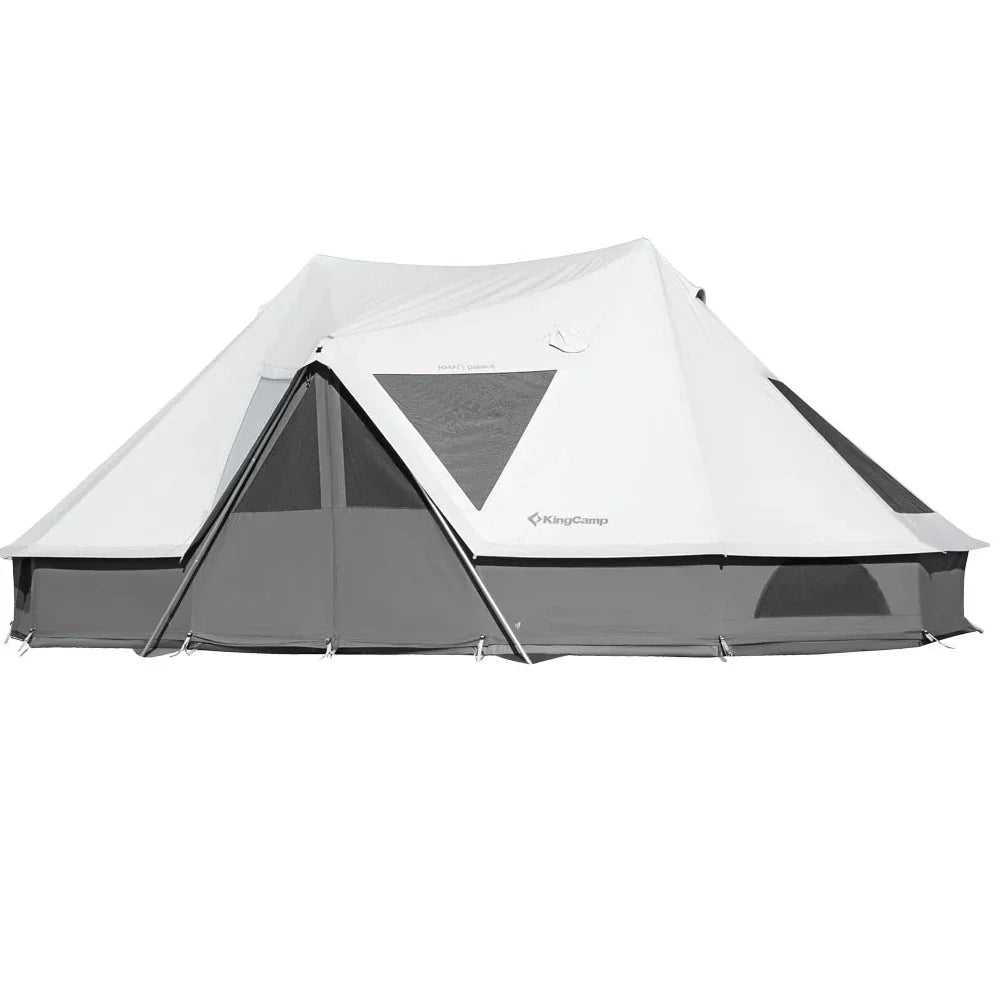
Short answer: The tent's published floor dimensions are only the starting measurement. Before booking a large family tent site, confirm the usable level ground, total space for guylines, permission and method for staking, soil conditions, exposure to wind, and the campground's weather and access rules. The KingCamp KHAN 400/500 are nominal 4 m and 5 m bell-tent options; the KHAN VILLA and KHAN PALACE have larger, differently shaped published outlines. None of those dimensions alone establishes a minimum campsite size or a wind rating.
How can I tell whether a large family tent can handle an exposed, windy campsite?
For an exposed site, assess the complete pitch, not canvas weight alone: the KingCamp KHAN 500 has a nominal 5 m bell shape, while the KHAN PALACE lists an approximately 670 × 420 cm outer outline, and both still depend on their specified poles, guy points and anchors. A model-specific, documented wind limit with its anchoring assumptions would be more useful than a generic claim of “wind resistance.” Do not infer a safe wind speed from pole material, roof shape or tent weight.
Ask whether the campsite is on an open ridge, coast, lakeshore or treeless field; whether the forecast includes gusts rather than only average wind; and whether every required guyline can be fully tensioned on permitted ground. A sheltered location can help, but avoid dead branches, unstable trees, drainage channels and other hazards. If severe weather is forecast, change plans rather than treating a glamping tent as a storm shelter.
The KHAN VILLA has a published roughly 460 × 300 cm outline and the KHAN PALACE roughly 670 × 420 cm, but these numbers do not document gust performance. Compare the current setup manual and any manufacturer weather guidance for the exact model, then match its full anchoring method to the actual site. If either information is missing, do not turn a structural guess into a safety claim.

For a large tent such as KHAN PALACE, the full anchored pitch extends beyond the published tent body.
How much campsite space is needed for a 13-foot versus 16-foot canvas bell tent?
A 13-foot and a 16-foot bell tent need more level, stakeable space than their nominal diameters because guylines extend beyond the wall: the KingCamp KHAN 400 is the roughly 4 m (13 ft) class, and the KHAN 500 the roughly 5 m (16 ft) class. A frequently quoted 20 × 20 ft versus 30 × 30 ft campsite rule can be a preliminary screening shortcut, but it is not a KingCamp specification and cannot confirm a booking. Required clearance depends on each model's guyline geometry, line tension, entrance and site boundaries.
The difference is not just interior floor area. A nominal 5 m bell tent adds about 1 m to the tent diameter before the extra guyline clearance on both sides is considered. Measure the complete pitched width at the outermost stakes, not merely the floor edge. Ask the campground for the usable tent pad, not the overall campsite lot: a site listed as 30 × 30 ft may also include a parking spur, fire ring or picnic table.
| Model and published tent outline | What the figure answers | What the campground must still confirm |
|---|---|---|
|
KingCamp KHAN 400 Nominal 4 m / about 13 ft class |
Approximate bell-tent body size | Full stake-to-stake width and a level pad with room for entry |
|
KingCamp KHAN 500 Nominal 5 m / about 16 ft class |
Approximate larger bell-tent body size | Full stake-to-stake width; don't transfer a 4 m booking assumption |
|
KingCamp KHAN VILLA About 460 × 300 cm outer outline |
Published body length and width | Guyline projection on every side and door access |
|
KingCamp KHAN PALACE About 670 × 420 cm outer outline |
Published large multi-zone body size | Long-side clearance, all stakes and a safe route around the tent |
Model figures describe published tent outlines or size classes, not verified campsite minima. Check the selected variant and current manual before booking.
Question 1: What is the usable, level pitching area?
For the KHAN PALACE's roughly 670 × 420 cm body, a campground's broad “large site” label is not enough: ask for the measured level area that is actually available to pitch a tent, excluding the fire ring, vehicle space, trees, posts and picnic table. Also ask whether the pad is rectangular, circular or irregular, and whether it slopes at the edge where the tent needs anchors.
For KHAN 400/500 bell tents, a circle drawn around the tent body should fit entirely inside the usable pitch; then add the projected positions of every stake. For KHAN VILLA or KHAN PALACE, draw the published body outline to scale and add clearances separately at each side. Request a site photo or diagram with dimensions if the listing only gives the size of the whole campsite.
Question 2: Can every guyline and stake stay inside the assigned site?
A KHAN 500 bell tent may physically fit its floor on a pad yet still fail the booking test when the guylines cross a path, fire-ring clearance or neighboring plot. Ask whether stakes are allowed beyond the designated tent pad but still within your site, whether shared paths must remain completely clear, and whether the campground prohibits tying lines to trees or structures.
Do not plan to shorten, remove or leave loose required guylines to make a KHAN VILLA or KHAN PALACE fit. The correct setup is the one in the current product instructions, including the specified stakes and tension. If the only way to fit is to omit anchors or send lines onto another site, book a different pitch.
Question 3: What ground will the stakes enter?
For a large tent such as KHAN PALACE, ground conditions are as important as the published body dimensions: compacted gravel, loose sand, saturated soil and rock do not hold the same stake in the same way. Ask the campground what the tent pad surface actually is, whether stakes can penetrate it, and whether any approved alternative anchoring method is permitted.
A concrete or wooden platform requires a different answer from “bring longer pegs.” Do not drill into a platform or attach to infrastructure without explicit permission. If the site's permitted anchor method cannot follow the KHAN 400/500, VILLA or PALACE pitching instructions, the site is not verified for that setup.
Question 4: How exposed is the pitch, and what weather forces a change of plans?
The KHAN VILLA and KHAN PALACE offer generous body dimensions, but larger surfaces also make weather planning more consequential. Ask whether the assigned pitch is sheltered or open to prevailing wind, whether it collects runoff, and whether the campground has closure or evacuation procedures for high winds, thunderstorms or flooding. A sheltered pitch is not automatically safe if it sits below unstable trees.
Do not substitute a generic “windproof” claim for an exact model's tested conditions. The KHAN 400/500 bell form, the VILLA layout and the PALACE layout each need the correct complete pitch; no shape alone establishes a safe gust threshold. Check current forecasts before departure and again on arrival, and use a substantial building or enclosed hard-top vehicle rather than a tent during lightning danger.
Question 5: What site rules affect placement and access?
The KHAN PALACE's roughly 670 cm body length can change where the entrance, vehicle unloading route and furniture can go; the KHAN 400/500 also need open space around a circular pitch. Ask about maximum tent size, the permitted number of tents, quiet-hour setup restrictions, parking distance, fire-ring setbacks and whether canvas tents or extra guylines are restricted.
A dimensionally adequate site can still be impractical if bags must be carried a long distance, the entrance faces a shared road, or stakes would obstruct other campers. Keep access for children and nighttime exits clear, and do not assume you can reposition a picnic table or fire ring.
Question 6: Can the campground confirm the exact pitch in writing?
Before paying for a site for KHAN VILLA or KHAN PALACE, send the campground a concise outline: tent body dimensions, estimated stake-to-stake footprint from the current manual, number of anchors and planned arrival time. Ask them to confirm the particular site number, usable ground dimensions, stake policy and any restrictions in writing. “Fits large tents” is too vague when the full anchored footprint has not been checked.
A booking question you can copy
“For site [number], what are the measured level, stakeable dimensions after excluding the vehicle area, table and fire ring? May all required tent and guyline stakes be placed within this site, and what is the ground surface? Are there size or weather-related restrictions for a canvas tent with a body measuring [dimensions] plus guylines?”
How to calculate the space your pitch really uses
The KHAN 400/500 nominal diameter and the KHAN VILLA and KHAN PALACE body dimensions are only the first numbers in a campsite calculation. Find the stake positions in the current setup instructions or measure them during a full practice pitch. Record the farthest stake from the tent edge in each direction; do not assume all ropes project equally or that a round tent uses the same clearance at the entrance as it does at the back.
The four-edge method
Required width = tent body width + left stake projection + right stake projection.
Required length = tent body length + front stake projection + rear stake projection.
Then check the actual irregular shape of the pad, door approach, fire-ring separation and campground boundary. The formula gives a bounding rectangle for screening; it does not certify the site.
For illustration only, suppose a tent body measures 16.4 ft across and its practiced pitch places the outer stakes 4 ft beyond each side. The stake-to-stake width would be 24.4 ft. A 25-ft-wide site might still fail if a tree, fire ring, boundary rule or sloping edge removes usable ground. The 4-ft offset here is a hypothetical measurement, not a KHAN 500 specification. For KHAN PALACE's roughly 22.0 × 13.8 ft body, use separate front, rear and side projections rather than a single bell-tent radius.
Ask for the tent pad's dimensions and the dimensions of the full campsite as separate facts. National Park Service design guidance itself distinguishes a tent pad from the picnic-table area, fire ring and parking spur; a reservation page may not. A site that is “30 ft wide” in total may have a much narrower level place to drive stakes. If the campground cannot provide measurements, request a site-specific photo with a scale reference and retain the ability to change sites.
Ground and anchoring: which answer changes the booking?
The KHAN PALACE product listing specifies steel ground stakes and guy ropes, but included hardware is not proof it will hold in every ground type. The campground's surface and rules determine whether the prescribed pitch is possible. The same question applies to the KHAN 400/500 and KHAN VILLA: can their required anchors be installed in this particular pad without moving stakes outside the allowed area?
| Ground described by the campground | Clarifying question | Booking consequence |
|---|---|---|
| Firm, penetrable soil | Are the required stake locations inside the site and free of buried obstructions? | Potentially workable; verify the model's pitch and weather guidance. |
| Loose sand or very soft soil | Which sand-specific anchors are allowed, and does the manufacturer permit them? | Do not assume the supplied pegs alone provide adequate holding. |
| Compacted gravel or rocky ground | Can all stakes be inserted fully, and are alternate locations allowed? | If required positions cannot be anchored, change site or tent. |
| Wood deck, concrete or paved pad | Are approved attachment points and a manufacturer-accepted method provided? | No drilling or improvised tie-downs; treat as unverified until both parties confirm. |
| Wet or flood-prone ground | Does water pond here, and can the assigned pitch be moved to higher ground? | A large pad is not suitable if it channels runoff under the tent. |
This is a decision aid, not a universal anchor specification. REI discusses different stakes or anchors for sand and snow, while its setup guidance emphasizes correct guyline placement and tension. For any KingCamp KHAN model, the applicable setup instructions and the site's permission control the final choice.
Three booking examples that show why the site label is not enough
Case A: “Large site,” small usable pad
A family considers KHAN 500 for a campground described as a 30 × 30 ft site. The campground confirms that the level tent pad is only 16 × 16 ft; the rest contains parking, a table and a fire ring. The nominal 5 m tent body is already about 16.4 ft across, before guylines. Decision: do not book that pad for this tent; request a larger measured pad. The numbers illustrate the distinction between total lot and pitchable area, not a prediction for every 30 × 30 ft site.
Case B: Plenty of land, no approved anchor
A private glamping plot looks generous for KHAN VILLA, but its only flat area is a deck. The host does not allow drilling and provides no rated tie-down points. Decision: the body may fit, yet the complete pitch is unverified. Seek a stakeable ground plot or an explicitly approved mounting solution consistent with the exact tent instructions; do not substitute loose weights by guesswork.
Case C: Large pad, exposed weather
A measured field pad appears to accommodate KHAN PALACE and all its stakes, but it is fully exposed and the forecast includes severe storms. Decision: dimensional fit does not answer the weather question. Review the exact model guidance and campground alerts; postpone or move to a safer site when conditions exceed documented limits or severe weather is expected. More stakes do not make a tent a lightning or storm shelter.
What should the campground confirm before you pay?
For KHAN 400/500, request the measured level diameter or width and length available for the complete circular pitch. For KHAN VILLA and KHAN PALACE, request a dimensioned plan or photo that shows the long and short sides. In every case, confirm whether the measurement excludes fixed obstacles, whether pegs are allowed in the surrounding ground, and whether every line must remain inside the assigned boundary.
Ask for the ground material, any prohibited anchor types, the minimum separation from the fire ring, the likely walking route past the tent and the policy if the assigned site is unsuitable on arrival. Include your exact model and your measured stake-to-stake footprint, not just “13-ft tent” or “12-person tent.” Keep the reply with the reservation. Written confirmation does not override an unsafe weather forecast, but it resolves avoidable disputes about size and permission.
A two-stage go/no-go check before you book
Stage 1, physical fit: Place the KHAN 400/500, VILLA or PALACE body outline inside the measured usable area, then draw every required guyline and stake from the exact manual. Add entrance, walking and fire-ring clearance. If anything extends outside the permitted pitch, choose another site.
Stage 2, weather and permission: Confirm that the ground accepts the specified anchoring method, the campground permits that method, and forecast conditions fall within documented manufacturer guidance. If a critical fact remains unknown, treat the booking as unconfirmed rather than assuming a larger tent will be fine.
Compare the three KingCamp layouts against the site
The KingCamp KHAN 400/500 are the direct starting point for the 13-ft versus 16-ft bell-tent question: pick the size class only after confirming its complete pitched footprint. The KingCamp KHAN VILLA adds side sleeping zones and a central area, making body shape and side clearances particularly relevant. The KingCamp KHAN PALACE is a much larger multi-zone plan, so check its long-side clearance and site access before treating capacity as the deciding factor.
These product links provide current model descriptions, not approval for a particular campground or weather forecast. The strongest recommendation is the model that can be fully pitched, anchored and accessed on the assigned site under permitted conditions.
FAQ
Is a 20 × 20 ft site always enough for a 13-ft bell tent?
No. For KHAN 400, a 20 × 20 ft listing is only a screening clue; the actual usable, stakeable area and full guyline positions decide whether it fits.
Is a 30 × 30 ft site automatically suitable for a 16-ft bell tent?
No. For KHAN 500, confirm whether 30 × 30 ft means the level tent pad or the entire lot, and whether all required stakes are permitted within it.
Can I use weights instead of stakes on a hard pad?
Only when the exact KingCamp setup guidance and campground permit an appropriate alternative. Unspecified weights do not establish equivalent anchoring in wind.
Does heavier canvas mean PALACE or VILLA is safe in high winds?
No. The KHAN PALACE and KHAN VILLA require assessment of the complete frame, connections, guying, anchors and documented conditions; fabric weight alone is not a wind rating.
Research basis: Current KingCamp product listings above; Life inTents pitching-space examples; REI Expert Advice for anchoring and guylines; NPS campground design guidelines for the distinction between tent pad and other campsite areas; and the National Weather Service for lightning safety. Generic campsite dimensions are not manufacturer-approved minima.
Share:
Floor Cutout, Groundsheet or Fire Mat? What Each Means for a Winter Tent Stove