

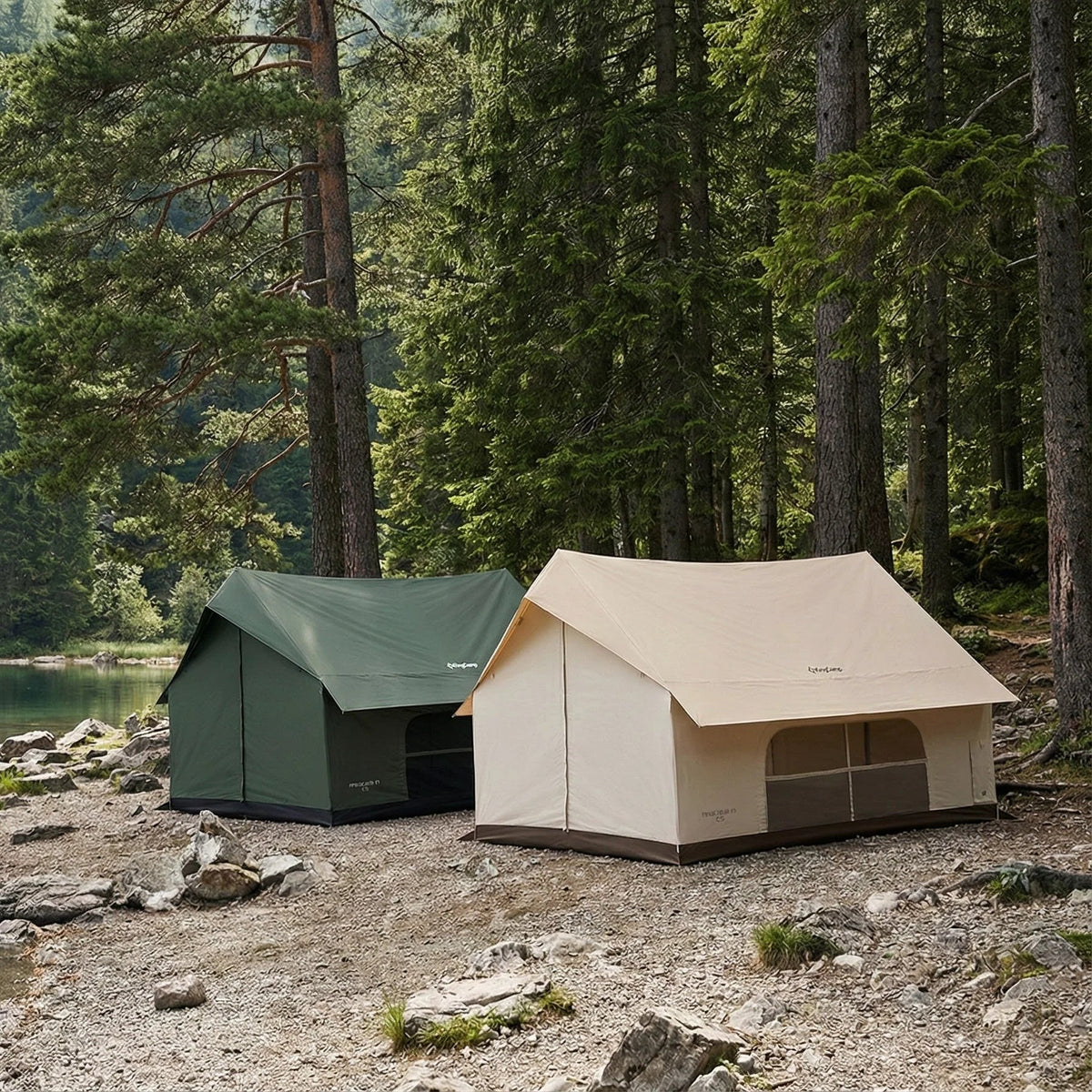
Short answer: For warm, rainy family car camping, choose the tent that can keep rain out and move humid air through the shelter while its doors are usable. The KingCamp MOUNTAIN IN C5 is a compact cabin-style candidate with a published 340 × 240 × 210 cm outline, two doors and four windows; the KingCamp KHAN VILLA trades compactness for two side sleeping zones and a 1.5 × 3 m central living area; the KingCamp KHAN 400/500 offers an open bell-tent choice in two nominal size classes. None should be called the best rainy-weather tent from material alone. The exact rainproofing, ventilation configuration, ground drainage and drying plan all matter.
Which family tents are worth considering for car camping in warm, rainy weather?
A useful shortlist starts with how the family will live during a wet afternoon: the MOUNTAIN IN C5 lists two doors, four windows and a center-free ridge structure within its 340 × 240 cm floor outline; the KHAN VILLA lists two side bedrooms and a 1.5 × 3 m shared middle; the KHAN 400/500 offers open bell layouts in roughly 4 m and 5 m classes. Those published features address different needs. They do not, by themselves, prove identical rain performance or that four beds and wet gear will fit comfortably.
For a short trip with frequent in-and-out traffic, look first at MOUNTAIN IN C5 if two entrances and a straighter-wall cabin layout serve the group. For a multi-day stay in which children may sleep while adults remain inside, compare KHAN VILLA. For an open shared room and a classic bell-tent arrangement, compare the exact KHAN 400/500 variant you would buy. A 500-class body is larger, but it also needs a bigger fully anchored campsite.

C5's published two-door, four-window layout is relevant to access and airflow; check the current closure and rain configuration before purchase.
Is a polyester or polycotton tent better for camping in warm, rainy weather?
Neither fabric name settles the question: MOUNTAIN IN C5 combines a listed 210 g polycotton roof with 210T ripstop polyester side fabric and a 210D Oxford floor, so even this one model cannot be reduced to “polyester versus polycotton.” For warm rain, compare the whole construction: fabric treatment, seam and zipper protection, roof shape, floor edges, closable openings and the way ventilation remains available when rain is blowing sideways.
Polycotton can feel less clammy in some conditions because cotton-blend fabric can exchange moisture differently from coated synthetics, but that does not eliminate condensation or remove the need to dry a wet tent. Polyester fabric generally sheds less absorbed water and can be easier to handle after a shower, but a coated polyester shelter can still collect condensation if occupants close every opening. The KHAN VILLA and KHAN 400/500 should be evaluated by their exact listed materials and ventilation features, not by assuming every “canvas” tent behaves identically.
| Model and verified layout fact | Possible fit for warm rain | Check before buying |
|---|---|---|
|
MOUNTAIN IN C5 340 × 240 × 210 cm; two doors, four windows; mixed roof/side fabrics |
Cabin access and multiple openings for a smaller family setup | Which openings can remain protected in rain; floor and seam details; actual bed fit |
|
KHAN VILLA About 460 × 300 cm; side sleeping zones and 1.5 × 3 m center |
Separate sleeping and indoor shared space during a wet afternoon | Current inner-room package, door protection, ventilation and fully pitched footprint |
|
KHAN 400/500 Nominal 4 m and 5 m bell classes |
Open family room; choose size by beds and wet-gear plan | Exact variant, stake-to-stake space, wall-side headroom and rainy-door use |
These are product-description facts and planning questions, not a hands-on waterproofness ranking or controlled fabric test.

KHAN VILLA's divided layout is useful to evaluate for longer wet stays; verify current inner-room inclusions separately.
Think in three water paths, not one “waterproof” label
The C5's 210D Oxford floor, the VILLA's multi-zone plan and the KHAN 400/500's bell profile each create different places to check for water. First is rain from above: roof panels, seams, vents and the door when opened. Second is wind-driven rain from the side: zippers, flaps and any mesh opening that cannot stay covered in a storm. Third is water from below: runoff, splashback and pooled water at the floor edge. A fabric hydrostatic-head number, if listed, cannot answer all three paths by itself.
For MOUNTAIN IN C5, ask whether the door you expect to use in a downpour has enough external coverage and whether a second door can stay closed while the first handles traffic. For KHAN VILLA, trace the route from outer entrance through the shared center to both sleeping zones: a dry bed is of limited comfort if every entry brings water across the center. For KHAN 400/500, check what happens when the main entrance opens and where wet shoes can be placed without blocking the central route.
Pitch on a naturally draining site above visible low spots; avoid runoff channels even if the pad looks level. Keep a footprint, if used, tucked beneath the tent edge so it does not collect water and direct it under the floor. Follow the manufacturer’s groundsheet and floor instructions for the exact model.
Ventilation that still works while it is raining
The C5's four listed windows create potential airflow, but warm-rain comfort depends on whether those openings can be operated without admitting driven rain. Before buying, examine the covers, rain-protected vents and door positions. A tent can have several windows yet be stuffy when all must be sealed for a storm. Conversely, opening everything on the windward side can wet bedding. The useful question is: which protected openings can remain open under the expected rain direction?
The KHAN VILLA's two sleeping zones add another airflow question: can air circulate into each sleeping area when the family closes partitions for privacy? Check the exact current configuration, because optional inner-room components must not be assumed included. In the KHAN 400/500, one large open room may let air mix more freely, but humid air from four sleepers can still condense on cooler surfaces overnight.
Condensation and leakage can look similar in the morning. Moisture spread broadly on the inner roof or walls after a humid night can be condensation; a localized track from a seam or opening during rain may indicate ingress. Document the location and weather before deciding what failed. Reduce indoor moisture where practical: leave wet outerwear outside sleeping areas, avoid cooking in the tent, and ventilate within the conditions allowed by the shelter’s design.
Will four beds, bags and wet shoes still leave a usable route?
Published capacity is not a furnished plan: the C5 lists a 340 × 240 cm footprint, the VILLA roughly 460 × 300 cm overall, and the KHAN 400/500 nominal circular size classes. Draw the actual mattresses or cots, four luggage pieces and a dry route to the exit at one scale. Add a place for wet shoes and rain jackets. Do not count the whole footprint as fully usable rectangular space, especially near a bell tent’s sloped edge.
For a one- or two-night trip, a compact C5 plan may be enough if meals and wet gear can stay under a separate approved shelter or in the vehicle. For several rainy days, KHAN VILLA's central 1.5 × 3 m zone may be valuable if it remains clear after beds are placed in the side zones. A larger KHAN 500 can offer more open floor than a 400-class model, but it does not create separate rooms and it demands more campsite space.
Simple layout test: With all sleeping gear in place, can one adult enter carrying wet coats, close the door, reach every bed and store shoes without stepping on bedding? If the answer is no, either enlarge the shelter, reduce furniture or move some gear to a separate dry storage area.
What changes when the rain lasts all weekend?
A single shower tests closure details; a wet weekend tests the daily routine. With MOUNTAIN IN C5, decide which door will carry traffic and where people can remove rainwear before entering the sleep area. With KHAN VILLA, decide whether the center is a clean living zone or a gear corridor; trying to use it as both can make the layout feel smaller than its measurements suggest. With KHAN 400/500, organize the shared room so bags and damp clothes do not migrate into the walk path.
Plan an external place to cook and a realistic way to keep meals dry. Do not assume a stove jack, large doorway or covered-looking photo authorizes cooking inside a closed tent. Fuel-burning appliances carry fire and carbon-monoxide risks and require their own manufacturer-approved setup. For warm weather, the simplest plan is usually to keep cooking outside the sleeping shelter and protect it with a separate, properly secured canopy where permitted.
At departure, a wet KHAN tent may need temporary transport while damp, but not damp long-term storage. Unpack, clean and dry the fabric, floor, seams, lines and storage bag as soon as practical under the product-care instructions. Do not promise a universal “24-hour” deadline; climate, material and access to drying space vary. The actual goal is to store every component fully dry.
A booking and setup checklist for a rainy car-camping site
The KHAN 400/500 bell forms require stake and guyline space beyond their nominal diameter; KHAN VILLA and C5 likewise need their complete specified pitch, not just the published body outline. Before booking, ask for the usable level tent pad, stake rules, ground type, drainage and whether the campsite is exposed to the prevailing storm direction. A large lot can still have a small usable pad after the picnic table, fire ring and parking area are excluded.
On arrival, choose high, draining ground rather than a depression, check for overhead hazards, pitch and tension all required components, and keep the entrance approach clear. Inspect rain covers and floor edges before bedding goes in. If severe thunderstorms or strong wind are expected, do not treat any family glamping tent as a substitute for a substantial building or enclosed hard-top vehicle.
Which of the three should you shortlist?
Shortlist MOUNTAIN IN C5 when the family values two doors, four windows and a compact cabin-style body, and a scale drawing shows the actual beds and bags fit. Shortlist KHAN VILLA when separate sleeping and a shared interior middle are important during several wet days, and the site can hold its complete pitch. Shortlist KHAN 400/500 when an open bell room suits the family, then select the 4 m or 5 m class from furniture needs and full guyline clearance.
There is no honest blanket winner for “warm and rainy.” A good match depends on the exact product variant, the site’s drainage and anchors, the way doors and vents work in wind-driven rain, and whether you can dry the tent after the trip. Compare those conditions before comparing aesthetic or nominal capacity.
FAQ
Does polycotton prevent condensation?
No. C5's polycotton roof does not remove humidity from four occupants or eliminate moisture on cooler surfaces. Protected ventilation and moisture management still matter.
Is polyester automatically more waterproof than canvas?
No. For C5, KHAN VILLA or KHAN 400/500, compare the complete fabric treatment, seams, roof, doors and floor. Material family alone is not a controlled rain test.
Should I choose KHAN 500 simply because it is bigger?
Only if the furniture plan benefits and the campsite accommodates its full anchored footprint. The KHAN 500 is a larger nominal size class than KHAN 400, not a substitute for measuring beds or guyline clearance.
What if the tent is wet when the family leaves?
Transport it according to the product-care guidance, then fully dry the fabric, floor and lines before storage. None of these KingCamp models should be stored damp.
Product sources: KingCamp MOUNTAIN IN C5 · KingCamp KHAN VILLA · KingCamp KHAN 400/500. General guidance: REI tent setup and REI condensation guide. Verify current product details and weather instructions before purchase.
Share:
When Is a Separate Sleeping Area Worth It for a Family of Four?
Floor Cutout, Groundsheet or Fire Mat? What Each Means for a Winter Tent Stove