

TL;DR
For comfortable standing changes, measure your body during the movement, then check that height over a clear patch of the tent floor. The published peak height tells you only about the tallest part of the roof. It does not tell you whether your elbows, raised arms or shoulders will fit beside a sloping panel.
As shopping references, 6 ft 6 in (about 198 cm) is a useful height to investigate for many adults, and 7 ft (about 213 cm) offers more potential overhead room. Neither is a universal comfort standard: a taller person or someone pulling a jacket overhead may need more space than a shorter person standing still.
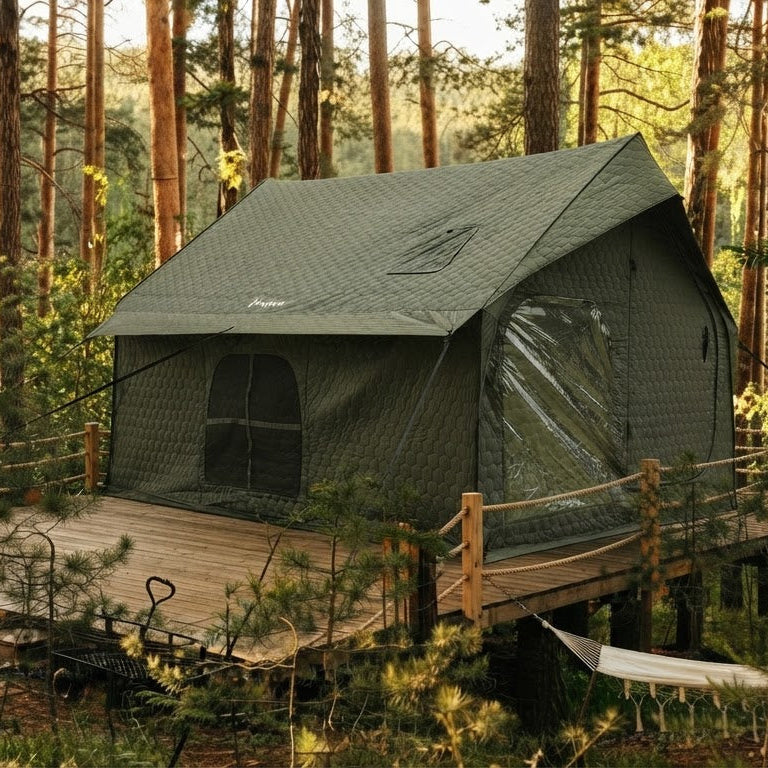
The KingCamp MOUNTAIN IN C5 lists a 210 cm peak, 105 cm sidewalls and a center-pole-free ridge frame. Evaluate a clear changing spot nearer the higher roof area, away from beds, hanging gear and door routes. Do not assume all of its 340 × 240 cm footprint has 210 cm of clearance.
A tent can let you stand upright and still make changing awkward. Pulling a shirt over your head raises your hands, lifting a knee requires balance, and taking off a jacket sends your elbows sideways. That movement needs a usable volume around you, not just a tall point somewhere above the floor.
This guide turns the height claim into measurements you can use before buying or during a practice pitch, with the KingCamp MOUNTAIN IN C5 as a product example.

How much standing height should a cabin tent provide?
Enough clear height for the tallest person's actual changing movements, over a useful floor area. Shopping by a single target can help narrow options, but final fit should come from the person and clothing you expect to use.
| Height reference | Approximate metric equivalent | How to use it when shopping |
|---|---|---|
| 6 ft | 183 cm | Limited overhead room for an adult close to this height; check whether standing and dressing are realistic. |
| 6 ft 6 in | 198 cm | A useful comparison target for many adults; still check arms, shoes and roof slope. |
| 7 ft | 213 cm | More potential room for taller people and overhead clothing changes, if that clearance extends across the changing spot. |
| 7 ft 6 in | 229 cm | Generous height in a suitable layout, but height alone says nothing about floor access, packed size or wind rating. |
These are rounded buying references, adapted from the height ranges in the answer you supplied. They are not building-code requirements, measured ergonomic thresholds or promises that a specific tent will feel comfortable. A 198 cm high flat space could be useful for one person and insufficient for another. A 213 cm roof peak over a tiny patch may be less convenient than a lower but broader clear area.
To answer the buying question directly: consider the roughly 198–213 cm range as a starting filter, then require usable clearance for your own changing motion. Taller campers and bulky winter layers should give that second step extra attention.
Three measurements that describe a changing area
1. Your standing and moving height
Measure the tallest camper wearing the footwear they will use inside, if any. Then practice removing a shirt or putting on a jacket in the way they normally do. Measure the highest point reached by their hands or clothing during that action. It can be substantially higher than their head.
For illustration, a person who stands 185 cm tall beneath a 210 cm clear roof has 210 − 185 = 25 cm of headroom while standing still. If that person's measured clothing motion reaches 218 cm, the same roof is 8 cm short for that motion. Those are example measurements, not a standard amount of headroom everyone needs.
Also check whether you can dress with lower arms, turn slightly or sit for footwear. The aim is a workable routine, not a requirement that every camper must be able to fully stretch overhead anywhere in the tent.
2. Sideways movement and balance space
Measure how far your elbows and clothing extend while taking off a jacket. Include the place your feet move when turning or lifting a knee. A tall strip squeezed between two cots can still be a poor changing area if your arms hit bedding or you have to step into a bag.
There is no universal square of floor space that fits every adult. Mark your movement on the floor at home, or use a tape outline around a practice changing spot. Keep the clothes you are using and a place to put them within reach, without using the doorway as storage.
3. Clear interior height across that patch
In the pitched tent, measure from the actual standing surface to the nearest obstruction above you. That may be fabric, a ridge member, a seam, a hanging lantern or a storage item. Measure the center of the changing patch and its edges, not only the tallest point in the room.
| Measurement | What it answers | What it misses on its own |
|---|---|---|
| Published peak height | How tall the product is at its stated highest point | Clear height everywhere inside, especially near sloping roof panels |
| Clear height at your chosen spot | Whether you can stand there without contact | Whether arms and clothing fit around that spot |
| Height across the whole changing patch | Whether moving sideways stays beneath sufficient clearance | Foot access, privacy and the route to a door |
| Sidewall height | Where the lower wall transitions toward the roof | Adult standing height at every wall-side position |
If the listing gives setup dimensions rather than a measured interior-clearance drawing, ask the manufacturer where the measurement was taken. A published overall height should not automatically be treated as unobstructed interior space.
Why a 210 cm peak does not mean 210 cm at the edges
A sloping roof gets lower as you move away from its higher area. Sidewall height gives another piece of the geometry: a 105 cm sidewall is not adult standing height. The usable standing zone begins farther inward, where the roof has risen enough for the individual.
It is tempting to calculate the exact width of that zone from the peak and wall height. But a reliable product-specific calculation also needs the interior roof profile, frame position, floor shape and measurement basis. Fabric tension and seams can affect the actual clearance. Without that information, do not convert two headline heights into an exact number of square meters where an adult can stand.
The useful question to ask is: “How wide is the clear interior at my measured changing height?” Request a cross-section or verify it in a practice pitch. This is more informative than asking only whether the tent is “standing height.”
What the KingCamp MOUNTAIN IN C5 tells you
The current KingCamp MOUNTAIN IN C5 Cabin Tent with Stove Jack & AC Port page lists 340 × 240 × 210 cm setup dimensions, a 210 cm peak and 105 cm sidewalls. Its steel ridge-frame design removes the center pole, leaving the middle available for a walking or changing area.
That combination makes C5 a candidate for campers who prefer to place beds along the sides and reserve the higher middle. The absence of a center pole helps you move without working around a fixed support, but the roof still slopes and furniture can still occupy the clear area.

| Published C5 feature | Relevance to changing clothes | Check in the actual layout |
|---|---|---|
| 210 cm peak | Gives a high area to investigate | Clear space beneath fabric, frame and hanging objects at the chosen spot |
| 105 cm sidewalls | Helps explain why edges are lower | How far inward you need to stand for your head and arms |
| No center pole | Leaves the central floor free of that support | Whether a mattress, table or bag now blocks it |
| Two doors | Offers access options | A dressing spot must not prevent someone using an exit |
| Four windows with mesh | Supports airflow and viewing | Which closures provide the privacy you need while keeping suitable ventilation |
| Wall pockets and ceiling hanging point | Can organize small items and lighting | Permitted loads, elbow clearance and loss of overhead space |
Recommend C5 when its cabin floor and open central structure suit your bed plan and the measured changing area works for your height. It is particularly worth evaluating if a center pole is the obstacle in your current tent. Its 5–6-person capacity does not allocate a private changing cubicle or guarantee that six furnished sleeping positions leave the middle clear.
Confirm before buying: a current interior drawing or clear-height measurement at your preferred location. The public page does not state an exact width or area with 198 cm, 210 cm or any person's changing-height clearance.
Preserve the changing spot when you place the beds
Start by identifying the area with suitable clear height, then place furniture around it. If you fill the higher center first, the remaining floor near the walls may not let an adult stand and dress.
Check the fully furnished arrangement. A cot rail can block where your foot needs to land. A chair can enter the central route when pulled out. A lantern hanging under the peak reduces the clearance exactly where the tallest camper wants to stand. Use only permitted hanging points and avoid placing clothing where it blocks vents or enters an appliance's required clearance area.
Privacy matters as well. Close the appropriate opaque door or window panels and check sightlines from outside; mesh alone does not provide reliable privacy. Do not assume that window placement creates a separate changing room. If one person changes while others remain inside, agree how that space will be used before the trip.
A person who prefers to sit for socks, shoes or trousers also needs a stable seat and room to lean forward. Standing height is only one part of a practical dressing routine.
A five-minute measurement exercise at home
The five minutes here is a suggested planning exercise, not a tested product claim. Use a tape measure, a clear floor patch and the clothing you expect to wear.
- Record the tallest person's normal standing height. Include the intended footwear.
- Measure their clothing motion. Note the highest reach and the widest elbow/clothing position when dressing normally.
- Mark the floor patch. Include turning, balance and a place for clothes. Walk into and out of it.
- Compare with the tent's interior. Ask for clear height across this patch, or measure after pitching and tensioning the tent according to its instructions.
- Repeat with furniture and closures. Add the beds, bags, lights and privacy panels. Verify the door route and ventilation are still usable.
You can send the results to the seller: “The tallest camper is ___ cm in the intended footwear; their normal shirt/jacket movement reaches ___ cm; the changing patch is ___ × ___ cm. Please confirm the clear interior height across that area and suggest its location relative to the roof ridge and doors.”
Frequently asked questions
Is 210 cm high enough for an adult to change clothes?
It can be at a suitable interior location, but it depends on the adult and movement. Check their raised hands, elbows and clothing, not just standing head height. A published 210 cm peak does not promise that clearance across the whole floor.
Should I buy a cabin tent with at least 6 ft 6 in of height?
About 198 cm is a useful shopping reference for many adults. It is not a universal minimum. Use your own changing measurements and confirm how much of the tent has that clear height; taller campers or overhead jacket changes may require more.
Is a 7 ft peak better than a 210 cm peak?
Seven feet is about 213 cm, only around 3 cm more. That small difference does not settle comfort. A broader clear area, better furniture plan or fewer hanging obstructions may matter more.
Does C5's 105 cm sidewall let adults stand beside the wall?
The wall height alone does not. Adults normally need to move inward to a higher part of the roof. Measure that position for the actual camper and the activity.
Can I calculate the standing area from the peak and sidewall numbers?
Not precisely without a verified interior cross-section and the height you require. Ask for a drawing or measure the pitched tent; do not assume the roof is a perfect geometric profile.
Does a center-pole-free tent automatically have a changing room?
No. It removes one floor obstruction, but does not establish privacy, an empty floor patch or adequate height for every camper. Reserve and test that area in your furnished layout.
What is the most useful measurement to request from KingCamp?
Ask for clear interior height across the intended changing patch, with the measurement location shown. Include the tallest person's standing and clothing-motion heights so the answer refers to your actual use.
The buying decision
Use the peak height to shortlist tents, then verify the changing area in three dimensions. For C5, the 210 cm peak, 105 cm sidewalls and center-free ridge structure tell you where to start investigating. Your own movements, the actual interior roof and the furnished layout tell you whether you can change comfortably there.
Share:
How Much Tent Space Do Two Beds and a Wood Stove Need?
What Does a Tent Waterproof Rating Actually Tell You?