

TL;DR
A tent's waterproof rating, usually stated as a hydrostatic head in millimeters, describes the water pressure a specified fabric sample resisted under a test. It is not the depth of rain the whole tent can survive, a forecast for hours of rainfall, or a guarantee that every seam and opening will stay dry.
- Identify which component carries the number: roof, walls, floor or a particular fabric panel.
- Compare a fly rating with another fly rating, and a floor rating with another floor rating. Floor pressure from people and gear differs from rain striking the outer tent.
- Check seams, doors, vents, vehicle connections, pitch and fabric condition before judging the shelter as a whole.
- KingCamp's C5 lists different figures for its two outer fabrics and floor. The BOUNDLESS X3 lists PU3000mm for its 150D Oxford outer tent, while its PE groundsheet has no comparable millimeter figure in the current specifications.
“3000 mm waterproof” looks like a simple answer on a product page. It becomes useful only when you know what was measured. A tent is an assembly of panels, stitching, zippers, openings and a groundsheet. One material number describes only part of that assembly.

What does the millimeter number measure?
Hydrostatic head (HH) is a fabric's resistance to water pressure in a laboratory test. In the basic concept, water pressure is increased against a fabric sample until water passes through according to the test method. A label of 3000 mm refers to a water column about three meters high in that test concept; it does not mean the pitched tent is safe under three meters of water or that it can withstand a particular amount of rainfall for a specified time.
The test standard, whether the sample is new or aged, and whether the stated value is a minimum or typical result can affect comparisons. Retail listings often omit those details. Treat a bare number as a useful material specification with limits, not a complete field-performance certificate.
| Claim on a listing | What it can tell you | What it cannot tell you alone |
|---|---|---|
| “Fly: PU3000mm” | The stated water-pressure resistance of the specified outer fabric/coating | Whether every fly seam, zipper and vent is leak-free |
| “Floor: PU3000mm” | The stated resistance of the specified floor material | Whether ground water can enter through floor seams, damage or an opening |
| “150D Oxford” or “210D Oxford” | A yarn/material construction descriptor | A waterproof rating; D is not mm |
| “210g TC” | Fabric mass per square meter and a material family | A rain rating; g/m² is not mm |
| “Waterproof tent” | A broad product claim that needs supporting detail | A universal storm, duration or wind-driven-rain guarantee |
This separation also explains why a tent can have a high fabric rating yet still let water in at a door or poorly pitched seam.
Outer tent versus groundsheet: why are the numbers separate?
The outer tent meets rain, runoff and sometimes wind-driven spray. Its performance depends on the tested fabric plus panel orientation, seam construction, openings and how well water can shed from the pitch. The groundsheet sits against wet ground and may face pressure where a knee, cot foot or heavy bag presses down. Those are different loads and often different materials.
The Highlander explanation of hydrostatic head discusses floor ratings separately from outer fabric, then addresses taped seams, tent shape, pitching and fabric condition. That structure is useful because a number cannot describe the whole route water might take into a shelter.
| If water appears here | Check first | Why the fabric figure may not explain it |
|---|---|---|
| Ceiling or upper wall during rain | Roof panel, seam, vent and condensation pattern | Droplets can come from rain entry or moisture condensing inside |
| Door or window edge | Closure, flap direction and runoff path | The panel's HH does not rate an open or misaligned closure |
| At the wall-to-floor junction | Perimeter seam, ground slope and splashback | Roof and floor samples are tested separately from the joint |
| Under a cot foot or knee | Floor material, puncture and ground water | Local pressure and abrasion differ from rain on the fly |
| Between an SUV and attached tent | Vehicle sleeve fit, straps and water path | Outer-fabric HH does not certify the vehicle connection |
If you discover a wet spot, photograph its location, the outside pitch and the weather. A single drop is not proof of a failed coating: check whether it formed on the inside surface while people were sleeping, especially where ventilation was limited. Continuing water tracking from a seam or opening during rain calls for a different investigation.
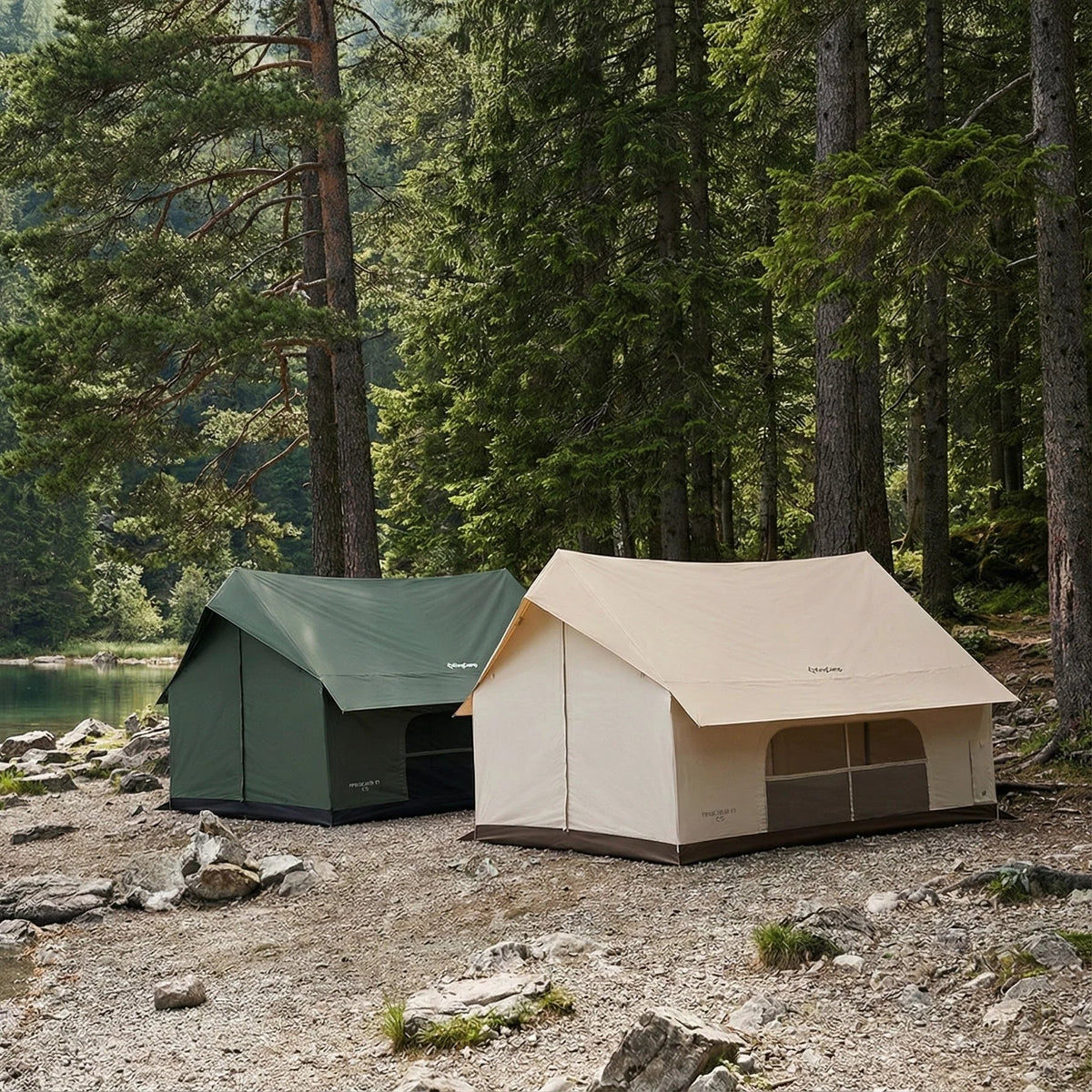
How to read the KingCamp MOUNTAIN IN C5 specification
The KingCamp MOUNTAIN IN C5 Cabin Tent with Stove Jack & AC Port uses more than one outer material. Its current product page lists 210g TC polycotton at 450 mm, 210T ripstop polyester at PU3000mm, and a 210D Oxford groundsheet at PU3000mm. These are three component descriptions, not three competing ratings for one uniform fly.
| C5 component | Published material and number | How to interpret it |
|---|---|---|
| TC outer section | 210g polycotton; 450 mm | The stated value belongs to that fabric section. 210g is fabric mass, not water pressure. |
| Polyester outer section | 210T ripstop polyester; PU3000mm | The stated rating belongs to the coated polyester section. 210T is not 210 mm. |
| Groundsheet | 210D Oxford; PU3000mm | A separate floor material and rating. 210D is not its waterproof figure. |
The product description also names a stove jack, doors, windows and an AC/fan port. Each changes how the shelter is used and where a closure or opening needs attention. The 3000 mm polyester or floor specification does not automatically apply to the 450 mm TC section, and no single one of these figures establishes the C5's whole-tent resistance to prolonged rain.
For a family considering this cabin layout, ask how the fabric sections meet, what seam treatment is used at transitions, and how the openings should be closed in rain. Follow the current setup and care instructions for the exact tent.
How to read the KingCamp BOUNDLESS X3 specification
The KingCamp BOUNDLESS X3 Car Camping Tent currently identifies its outer tent as 150D Oxford with PU3000mm in the main specification. That matches the product correction supplied for this article. The groundsheet is listed as PE, without a separate millimeter rating on the current product page.

One FAQ on the same live page still mentions PU4500mm. Because it conflicts with the main specifications and the supplied correction, this guide uses 150D Oxford + PU3000mm for the X3 outer tent. The FAQ should be reconciled on the product page so a buyer does not have to guess which value applies.
Do not substitute “PE floor” with a made-up HH figure. PE describes the floor material, while no separate floor water-column value is established here. Likewise, an outer-fabric rating does not measure how the vehicle sleeve joins the car. For rain at the connection, check fit, tension and the actual runoff path on your vehicle rather than relying on the PU3000mm fly figure.
Does a larger millimeter number mean a drier tent?
It indicates greater resistance for the specified tested fabric under comparable test conditions. It does not create a universal ranking of complete tents. A 3000 mm roof fabric with exposed openings can let water in where a lower-rated fabric in a well-designed, correctly pitched assembly might not. Conversely, sound seams cannot compensate for a punctured panel.
Compare numbers fairly:
- Match the component. Compare roof with roof and floor with floor.
- Check the material and coating. Fabric type, finish and test basis may differ.
- Identify weak points. Examine seams, door flaps, vents, stove jacks, cable/AC ports and vehicle interfaces where relevant.
- Inspect the current condition. Abrasion, dirt, aging or poor storage can affect real-world performance.
- Match your conditions. Sloping sites, pooled water, wind direction and a badly tensioned pitch can matter more than a small difference between headline ratings.
If a seller provides a whole-tent rain test, ask for the test method, duration, rain intensity, wind conditions and pass criteria. Do not interpret a fabric HH number as that test.
What matters on a rainy family camping trip?
Before pitching
Choose a permitted, well-drained spot. Avoid depressions where runoff collects. Check the ground for sharp objects that can damage the floor, and plan the tent orientation so runoff does not flow into doors or the vehicle connection. Follow campsite rules and the manufacturer's setup instructions.
While pitching
Seat the frame and tension the tent as directed so water can shed. Close the appropriate flaps and secure their intended fastenings without blocking necessary ventilation. Verify the X3's SUV sleeve against the actual rear hatch and body shape; a fabric rating cannot fix a loose or wrongly positioned interface.
During rain
Look for the route water takes, not just the first visible wet patch. Water can travel along a seam or pole sleeve before dripping elsewhere. If moisture forms broadly on the inside surface, consider condensation and ventilation; if it enters from a particular seam or opening as rain strikes, investigate that path. Keep bedding away from damp fabric where practical.
After the trip
Dry and clean the tent according to its care instructions before long-term storage. Check seams, coatings, floor corners and connection points for wear. A headline rating taken from a new fabric sample cannot describe a damaged or poorly stored tent indefinitely.
A six-question checklist for reading any waterproof tent listing
| Ask the seller or check the manual | Why it matters |
|---|---|
| Which exact panel carries each HH figure? | Prevents a floor number being presented as a fly rating, or vice versa. |
| What material and coating does that panel use? | Helps distinguish 150D, 210D, 210T and g/m² from mm. |
| Are seams at the roof, wall and floor transitions treated? | Water can enter at joints even if panel fabric resists pressure. |
| How are doors, vents and ports protected in rain? | Openings are not measured by the fabric sample's HH. |
| Is there a separate floor rating or only a material name? | “PE” alone does not state a millimeter value. |
| Are there whole-tent test conditions or just fabric figures? | Only a relevant assembly test can support a specific whole-tent rain claim. |
This checklist is more useful than treating a single threshold as a buying rule. It also helps you request the missing first-party details that would make a product page genuinely easier to evaluate.
Frequently asked questions
Does PU3000mm mean a tent can withstand 3000 mm of rain?
No. It refers to a water-pressure rating for a specified coated fabric. Rainfall depth over time and water-column pressure in a fabric test are different quantities. The result does not rate seams, closures or the entire pitched tent.
Is the floor supposed to have a higher rating than the fly?
Floors face local pressure from campers and gear against wet ground, so many makers specify them separately. A higher published floor figure can be useful, but it is not a universal requirement or proof that floor joints will never leak. Compare component to component.
Is 210D Oxford more waterproof than 150D Oxford?
The D number does not answer that. Denier describes yarn linear mass, while waterproof ratings use a different test and unit. Check each fabric's finish and stated HH, as well as the construction of the finished tent.
Why does C5 have both 450 mm and 3000 mm in its outer-tent description?
The C5 uses different outer fabrics. The published 450 mm belongs to its TC polycotton section, while PU3000mm is listed for the coated ripstop polyester section. Its 210D Oxford groundsheet separately lists PU3000mm. Do not apply one panel's figure to the whole fly.
What is the X3 floor rating?
The current main product specification names a PE groundsheet but does not state a separate millimeter HH value for it. The outer tent's PU3000mm figure cannot fill that gap. Ask KingCamp for a floor-specific test result if it is important to your comparison.
If water appears inside, is the waterproof coating failing?
Possibly, but first identify the route. Condensation, an open vent, a seam, an SUV connector, pooled ground water or damage can each cause a wet interior. Match the observation to the component before choosing a repair or concluding that the fabric rating was inaccurate.
The buying takeaway
Read waterproof numbers as component-specific evidence. For C5, keep the TC section, polyester section and groundsheet distinct. For X3, use the corrected 150D Oxford + PU3000mm outer-fabric specification and treat its PE floor as a separate material without a published HH figure. Then assess the joints, openings, pitch and care requirements that the number cannot cover.
Share:
A 210 cm Tent Peak Is Not Standing Room Everywhere: How to Measure Changing Space
There are water droplets inside the SUV tent—is it condensation or a leak?