

TL;DR
For a family staying several days, treat the tent wall as a daily operating system, not a set-it-once feature. Use open panels for maximum daytime connection to the campsite when conditions allow, mesh for airflow and insects, and the opaque outer wall for nighttime sightline privacy and more weather protection. Mesh is not a privacy wall, especially when a lamp is on inside.
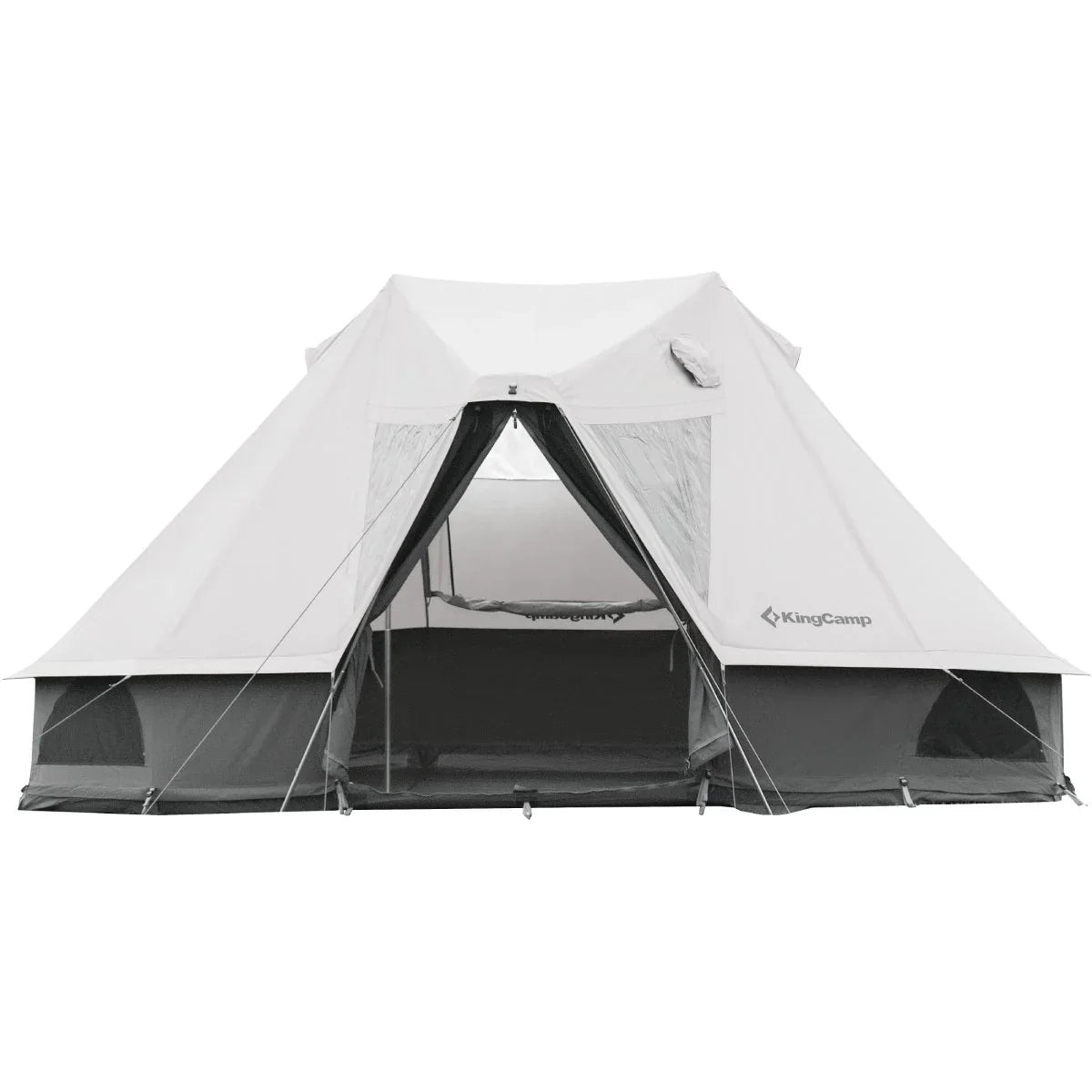
KingCamp's KHAN VILLA page describes a wall system that can be fully open for ventilation or fully closed, plus three-sided mesh windows and a mesh-and-PVC back window. KHAN PALACE explicitly describes three perimeter-wall modes: fully closed, mesh only and fully open. The public pages do not provide a complete fastener-by-fastener switching sequence or wind threshold, so follow the instructions supplied with the exact model and secure every panel as designed.
For families that want sleep separated from living space, VILLA is the more proportionate starting point: its current description specifies two side bedrooms and a 1.5 x 3 m central living room. PALACE provides a much larger 2.5 x 4 m central area between side sleeping quarters, but its clip-in inner sleeping tents are described as optional and must be confirmed separately.
A glamping tent may be pitched once but adjusted many times. Morning cooking, afternoon heat, evening insects and bedtime privacy create different wall needs. The useful question is not simply whether a tent “has mesh.” It is whether the family can move between ventilation, bug protection and visual privacy without losing the room layout or forgetting weather exposure.
This guide gives KHAN VILLA and KHAN PALACE owners a decision routine. It does not replace the setup and use instructions for the exact tent.

Which glamping tent features matter most for a family staying at the same campsite for several days?
The most valuable features are the ones the family uses repeatedly after setup: a workable furnished floor plan, adjustable ventilation and insect protection, reliable visual privacy, clear movement routes, usable entrances, weather-ready closure and a practical way to organize wet and dry gear.
| Multi-day need | Feature to inspect | Why it matters after the first night |
|---|---|---|
| Daytime airflow | Mesh openings and outer panels that can be opened or secured | Four people add heat and moisture; the family needs controllable airflow, not only a tall roof. |
| Insect separation | Intact mesh and closable mesh entry/openings | Fully open walls provide the most access, but not an insect barrier. |
| Night sightline privacy | Opaque outer panels and closable room boundaries | Mesh may remain visibly transparent, especially with interior lighting. |
| Different bedtimes | Sleeping zones separated from the shared area | Adults can use the middle without entering a child's bed zone. |
| Rain-day living | A furnished common area with a clear exit | Advertised capacity does not show whether four people, chairs and bags can coexist. |
| Daily entry | Door route that stays clear in every wall mode | Rolled panels, chairs and luggage should not obstruct the way out. |
| Changing weather | A closure routine the adults can complete promptly | A loose or forgotten panel is not useful protection. |
| Longer occupancy | Storage and a wet-gear plan | Clutter can block vents, bedroom openings and escape paths over several days. |
Once a family stays in one place, a few extra setup minutes often matter less than how the tent works as a temporary room. That does not mean “more features” always delivers more value. Every panel, room or optional inner needs a real job in the family's day.
Before the trip, practice the complete open-to-closed transition in daylight. Identify which sections are mesh, which are opaque outer fabric, where opened material is retained and which openings must remain available for safe ventilation under the supplied instructions. A feature is only useful if the adults can operate it correctly before weather or darkness arrives.
Which tent layout works best for separating sleeping space from a family living area?
A bedroom | shared living area | bedroom layout provides the clearest separation for a family that needs distinct sleep zones and a common middle. It is more direct than dividing one open room into only two halves because each sleeping side can connect to the shared zone without becoming the shared zone.
| Layout | Sleeping/living relationship | Best for | Main limitation |
|---|---|---|---|
| Open bell-tent room | Beds and living furniture share one volume | Family with similar bedtimes that values an open glamping atmosphere | Light, conversation and movement remain in the same room. |
| Open cabin room | Rectangular floor makes beds and furniture easier to align | Family wanting one efficient common room | Straight walls do not create private bedrooms by themselves. |
| Bed | living | bed | Sleep zones flank a common movement and activity area |
KHAN VILLA's current description names two side bedrooms and a 1.5 x 3 m central living room. KHAN PALACE describes side sleeping quarters around a larger 2.5 x 4 m central living area. Those are relevant starting points, but a room name is not a furnished fit test. Draw each bed, the closed room openings, chairs and the main exit route.
The layout and wall mode solve different problems. Bedroom zoning separates activities inside the tent. Mesh and opaque outer walls change airflow, insects, views and sightlines between the interior and campsite. A family that needs both must test both systems together.
The four wall states a family should plan for
The KHAN PALACE page names three perimeter modes: fully open, mesh only and fully closed. For family use, it is helpful to add a fourth planning state: a mixed or transitional configuration allowed by the exact product instructions. Do not assume every panel can be independently arranged unless the model documentation shows it.
| State | Primary purpose | What it provides | What it does not prove |
|---|---|---|---|
| Fully open | Daytime access and an open-air pavilion feel | Maximum connection to the site when conditions allow | Insect exclusion, privacy or rain protection |
| Mesh only | Airflow with an insect barrier | Views and ventilation through intact mesh | Visual privacy, darkness or rain protection |
| Mixed / transitional | Respond to sun direction, activity or changing conditions | Potential balance when supported by the exact panel design | That every wall can be positioned independently or left that way in wind |
| Fully closed | Night sightline control and greater enclosure | Opaque boundary and the model's closed-weather configuration | Soundproofing, complete blackout or permission to block required ventilation |
“Fully closed” must not be interpreted as airtight. Continue to use ventilation as the manufacturer directs. Four sleepers produce moisture overnight, and cooking or combustion equipment introduces separate safety requirements. Never close or alter required vents merely to improve privacy.
A day-to-night KHAN wall routine
Use this as a decision checklist, not a substitute for the model's mechanical instructions.
Morning: inspect before opening
Check the forecast and the actual sky, wind and campsite exposure. Look at the outer fabric for dew or rain, inspect mesh for damage and make sure no chair, bed or storage bin blocks the panels or exit. If a panel is wet, avoid rolling or storing it in a way that traps moisture; follow the care instructions for drying and securing it.
Decide which daytime state serves the next activity. Fully open may suit supervised social use in mild conditions. Mesh-only mode is the more relevant choice when insects are active or children will move in and out less frequently. Keep the main entry clear and close the intended insect barrier after passage.
Midday: manage views, heat and access
Reassess as sun direction and wind change. A bright campsite can become warmer or more exposed later in the day. Use only configurations supported by the exact model, and fasten opened material at its intended retention points so loose fabric does not enter doors, mesh or walking routes.
Mesh supports airflow and views, but it is still a physical panel that can be damaged by furniture, children or gear. Keep cot corners, chair backs and sharp storage items away from it. Do not use a rolled wall or mesh seam as a hanging rail unless the instructions specifically provide an attachment point.
Before dusk: switch before privacy becomes urgent
Do not wait until the family is changing clothes or insects have entered. While there is still daylight, clear the wall edges, locate closures and confirm that each family member's route to the door remains open. Change from fully open to mesh as insects increase, then close opaque outer sections needed for visual privacy and expected weather.
Perform an outside sightline check with the interior lights on. A panel that looks private from inside may show silhouettes from the campsite. Check bedroom entrances, main doors, windows and any PVC viewing panel separately. Close the intended opaque covering where the product provides one.
Night: preserve ventilation and exits
Use the opaque outer configuration for sightline privacy, but keep all required ventilation operating. Dim and aim lamps away from mesh or bedroom openings. Confirm that shoes, chairs and bags have not moved into the exit path.
If wind or rain changes, follow the tent's instructions and campground requirements. The public product pages reviewed for this article do not publish a numeric wind threshold for changing wall modes. A large open or loose surface can respond differently to weather, so do not invent a personal limit from pole diameter or tent weight.
Mesh is for insects and airflow, not nighttime privacy
Mesh can feel private during a bright day because the outside is more strongly lit than the tent interior. At night, the relationship reverses: a lamp behind mesh can make occupants and furniture easier to see from outside.
Use a simple practice test:
- Pitch the tent as instructed and choose the intended mesh-only state.
- Put the normal nighttime lights in their planned positions.
- Have one adult stand, sit and move where changing or sleeping will occur.
- Have another adult check sightlines from the paths and neighboring directions around the site.
- Close the opaque panels and repeat.
This is a visual check, not a fabric-performance test. It establishes what the family's actual lamps, distance and campsite angles reveal. Do not photograph or observe neighboring sites while conducting it.
Opaque fabric can reduce direct visibility, but it does not establish blackout. Seams, gaps, door edges and transmitted light may remain visible. Likewise, neither mesh nor an opaque textile wall is soundproof. Quiet hours and family routines do more for acoustic privacy than a wall-mode label.
KHAN VILLA: a compact bedroom-living-bedroom routine
The KingCamp KHAN VILLA 4-Season 4-6 Person Bell Tent currently describes a center-free structure, two side bedrooms, a 1.5 x 3 m central living room and raised 70 cm walls. Its published setup dimensions are about 460 x 300 cm.
For wall control, the page states that its multi-season wall design can be fully open for sunshade and ventilation or fully closed for warmth and wind protection. It also lists three-side mesh windows, a top ventilation window and a mesh + PVC double-layer back window.
Those facts make VILLA relevant for a family that wants the middle to work differently across the day: an open or ventilated family area while awake, then a more enclosed shared route between two sleep sides at night. Its center-free structure avoids a central pole in that routine.
What the page does not establish: a complete panel-by-panel switching order, the visual opacity of every bedroom closure, an acoustic rating or a wind speed at which walls must be changed. Request the current manual and interior photos if any of those details decides the purchase.
For a multi-day stay, assign one side room to adults and one to children, then keep the central route free when the outer wall is closed. Store the next day's clothes inside the appropriate sleep zone so no one searches through the living area after lights-out.
KHAN PALACE: three published wall modes around a larger family room
The KingCamp KHAN PALACE 10-12 Person Glamping Tent publishes a 670 x 420 x 270 cm setup size and a central 2.5 x 4 m living area between side sleeping quarters. Its 75 cm vertical perimeter walls use the page's stated three-mode double-layer system:
- Fully Closed: outer walls form the enclosed configuration;
- Mesh Only: mesh supports cross-ventilation with other mesh openings; and
- Fully Open: the wall system can be rolled and stored for an open-air pavilion configuration.
This explicit three-state description makes PALACE the clearer product example for a household that expects to reconfigure a very large shared space over several days. It also creates more wall area to inspect, operate, secure and dry.

PALACE's current FAQ describes clip-in inner sleeping tents as optional, and the base included-items list does not clearly name them. The outer wall's closed mode provides an exterior sightline boundary; it does not automatically create two enclosed bedrooms inside. Confirm inner-tent availability, quantity, closures and price if sleeping separation drives the purchase.
PALACE is most appropriate when the family or group will use its large shared area, can obtain a suitably large full-stake campsite and has enough adults for setup and repeated wall management. For a family of four, VILLA may be the more proportionate privacy layout unless the extra indoor common space has a recurring purpose.
VILLA or PALACE for several days at one campsite?
| Decision | KHAN VILLA | KHAN PALACE |
|---|---|---|
| Published family layout | Two side bedrooms and 1.5 x 3 m central living room | Side sleeping quarters and 2.5 x 4 m central living area |
| Published setup size | About 460 x 300 cm | 670 x 420 cm |
| Wall/opening description | Wall system fully open or fully closed; three-side mesh windows; mesh + PVC back window | Perimeter walls explicitly described as fully closed, mesh only or fully open |
| Stronger use case | Family wants separate sleeping sides in a more compact plan | Larger family/group repeatedly uses a substantial indoor common room |
| Privacy confirmation | Bedroom closures and their opacity/inclusion | Optional inner sleeping tents and their exact package/price |
| Operational burden | Smaller shell, but still needs daily inspection and drying | More wall area, stakes, guy lines and fabric to manage |
Choose from the repeated routine, not the most impressive open photo. If the family will use two sleep sides and a modest central room each day, VILLA is the clearer starting point. If several people need a large all-day indoor living area and the site can support it, PALACE's three published wall modes are more relevant.
Neither product should be chosen solely because its outer wall closes. Confirm how the sleeping rooms, door, windows and required ventilation behave in the fully furnished nighttime configuration.
A seven-point changeover check
Use this every afternoon before privacy and weather conditions change:
- Forecast: check rain, temperature and wind before choosing the evening state.
- Fabric condition: note dew, rain or dirt before rolling, folding or securing a panel.
- Wall perimeter: move furniture and sharp gear away from mesh, fabric and closures.
- Fasteners: use the model's intended zippers, ties, loops or retention points without forcing them.
- Sightlines: test from outside with the real interior lights on.
- Air and exit: preserve required ventilation and a clear route from every bed to the door.
- Final walk-around: confirm no panel, guy line or entry component is loose, misplaced or obstructed.
If the supplied instructions conflict with this general checklist, follow the product instructions. Stop if a zipper, panel or retention point does not move as expected; forcing hardware can damage the system and still fail to produce the intended wall state.
Keep several-day occupancy from blocking the wall system
The first-night layout rarely survives unchanged. Towels appear, chairs move, shoes collect near the door and bags migrate toward the walls. Set a daily reset time before dusk.
Give each person a storage zone that does not touch the mesh. Reserve one dry location for outerwear and one place for wet items that does not obstruct ventilation. Keep lighting away from sleep-zone sightlines. Use only designated hanging points and respect their documented load limits; wall toggles and mesh attachments should not be treated as general storage hooks.
Keep children involved at the decision level—“mesh for bugs, outer wall for privacy”—but assign closure inspection to an adult. A panel may look closed while a lower edge, zipper or retention point remains incomplete.
At departure, the fully closed nighttime position is not automatically the correct packing condition. Clean and dry the tent as its care instructions require before storage. A multi-day tent can collect moisture even without obvious rain.
Frequently asked questions
Does mesh provide privacy during the day?
It may reduce visibility under some lighting conditions, but it should not be relied on for privacy. Sightlines change with sun direction, distance and interior brightness. Use the opaque outer panel and test from outside when visual privacy matters.
Why can people see through mesh more easily at night?
When the tent interior is brighter than the campsite, illuminated people and objects behind mesh can become more visible. Close the intended opaque layer and position lights away from exposed mesh.
Should every outer wall be closed as soon as the sun sets?
Choose the configuration from privacy, insects, weather and the exact model instructions. Preserve required ventilation and do not block exits. Complete the transition before darkness makes inspection difficult.
Does closing the outer wall stop sound?
No sound isolation should be assumed. Textile walls, mesh, zippers and shared roof space transmit voices and movement. Use quiet routines and campground quiet hours.
Can KHAN VILLA switch to mesh-only perimeter walls like KHAN PALACE?
The VILLA page states fully open or fully closed wall use and lists three-side mesh windows plus a mesh-and-PVC back window. It does not publish the same explicit three-mode perimeter description as PALACE. Do not assume identical operation; follow the VILLA documentation.
Are KHAN PALACE inner bedrooms included?
Its current FAQ calls the clip-in sleeping tents optional, while the base package list does not clearly name them. Confirm the exact inner rooms and price before relying on them for parent-child separation.
Which tent is better for a family of four?
VILLA is the more proportionate starting point when two sleeping sides and a shared middle are the goal. PALACE makes more sense when the family repeatedly needs its much larger living area and can manage the larger site and structure.
Can panels stay rolled up in wind or rain?
Use the model's instructions and respond conservatively to changing conditions. The public pages reviewed here do not provide a numeric wall-mode wind threshold or a universal permission to leave every panel rolled in rain.
Should we close ventilation openings for more privacy?
No. Do not defeat required ventilation. Use the intended opaque privacy layers and manage light placement while keeping the ventilation specified for the tent and any equipment in use.
The day-to-night decision
For several days at one campsite, plan a repeatable progression: inspect in the morning, choose open or mesh mode for daytime conditions, move toward insect protection before dusk, then use the opaque outer configuration for nighttime sightlines while preserving ventilation and exits.
KHAN VILLA combines a stated bedroom-living-bedroom plan with walls that can open or close and several mesh openings. KHAN PALACE adds an explicitly described fully open, mesh-only and fully closed perimeter around a much larger central room. Choose the scale and layout the family will actually operate every day, verify all optional inner rooms and learn the exact hardware sequence from the supplied model instructions before the first trip.
Share:
Six Adults in KHAN PALACE: Will One Measured Set of Cots Actually Fit?
Is KHAN PALACE Practical for Six Adults with Cots and Luggage?