

TL;DR
No. Steel poles can add stiffness, and a high roof can add standing room, but neither feature by itself proves wind resistance. A tall cabin also places more projected surface in the wind. The useful question is whether the complete system transfers load from fabric to frame, reinforced guy points, correctly tensioned ropes, suitable stakes and firm ground.
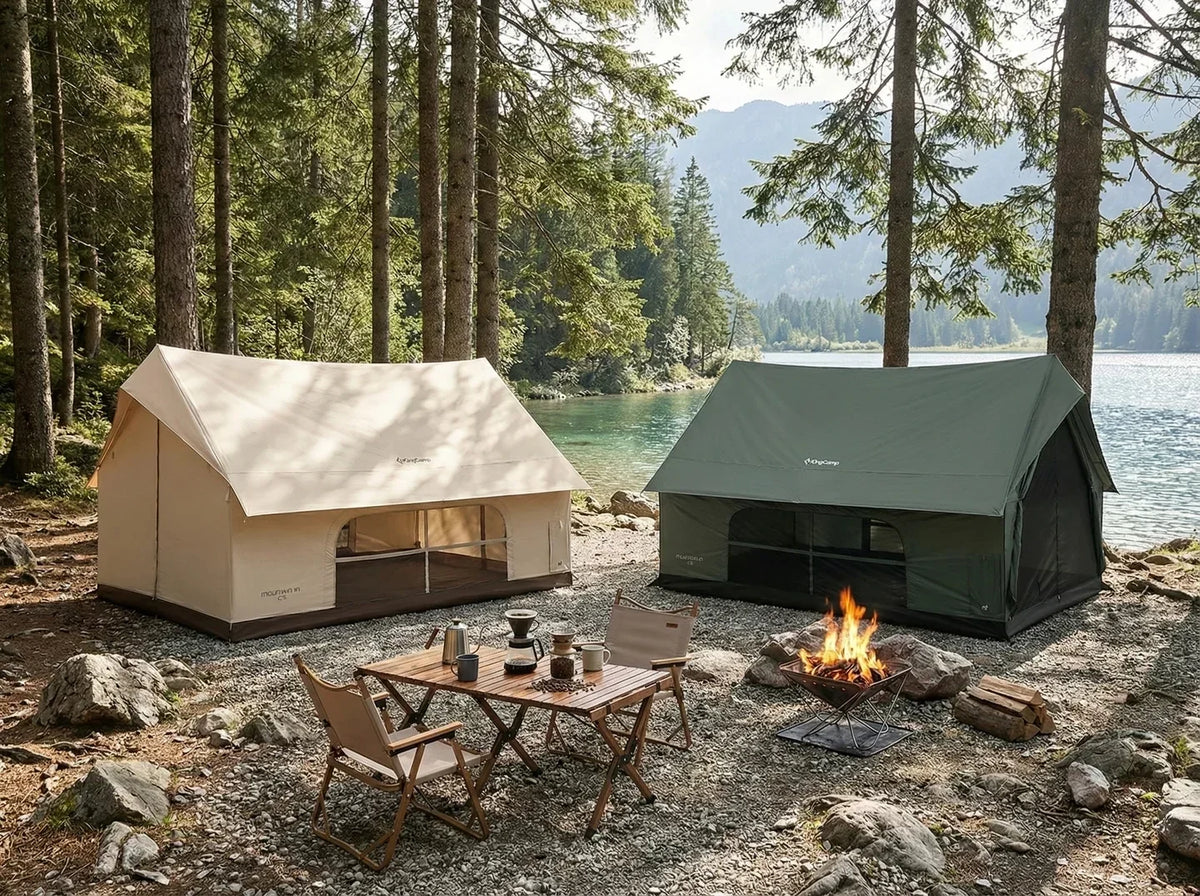
KingCamp currently lists the MOUNTAIN IN C5 with a 210 cm peak, 16 mm steel poles, 12 guy ropes and 16 steel stakes. It lists the KHAN 340GSM in 4 m and 5 m versions with a tapered bell profile, an aluminum-alloy center-pole system, 11 guy ropes and 9 mm steel stakes. These are relevant construction facts, not numeric wind ratings. Neither current product page publishes the wind speed, gust pattern, soil, anchoring setup, test duration and pass/fail standard needed to turn those specifications into a verified wind limit.
For an exposed site, choose from documented wind guidance rather than pole material or peak height. If that evidence is unavailable, move to a sheltered pitch or postpone when conditions are uncertain.
“Steel frame” sounds reassuring. So does a substantial, high-roofed tent. Yet wind does not test one specification at a time: it pushes and lifts the whole shelter, then sends those loads through seams, corners, joints, ropes, stakes and ground.
This guide separates what the specifications can tell you from what they cannot. It uses two different KingCamp layouts—the cabin-style MOUNTAIN IN C5 and the bell-shaped KHAN 340GSM—to show why material, height and pole diameter should never be treated as a wind rating.

Is a tall cabin tent with steel poles a good choice for a windy campsite?
It can be a reasonable choice only when the entire structure, anchoring system and published operating guidance match the site. Height and steel poles alone are not enough.
Steel can make a frame stiff and strong, but material is only one input. Pole diameter, wall thickness, span, joints, bends, corrosion, frame geometry and connections determine how that material works in the assembled tent. A weak connector or poorly supported roof can remain the limiting point.
A high cabin roof creates comfortable standing room and efficient furniture placement. The tradeoff is a larger face presented to the wind, especially when walls are near vertical. Compared with a lower profile of otherwise similar construction, a tall box-like shape generally receives more wind load.
Before selecting a tall cabin for a windy site, verify:
- a manufacturer-published wind rating or test with stated conditions;
- reinforced and well-distributed guy-out points;
- a complete frame with robust joints and attachment points;
- stakes or anchors appropriate to the actual soil;
- a pitch that can be fully tensioned without omitting ropes; and
- guidance for doors, windows, awnings and stove equipment during wind.
If those details are absent, “steel poles” should be read as a material specification—not a promise that the tent is suitable for an exposed ridge, coast or open plain.
How can I tell whether a large family tent can handle an exposed, windy campsite?
Look for documented performance first, then inspect the complete load path from the roof to the ground. Marketing phrases such as “heavy-duty,” “all-season” or “wind resistant” are less useful than a test that states wind speed, gusts, duration, pitch configuration, anchor type and ground conditions.
Use this evidence hierarchy:
| Evidence | What it can tell you | What it cannot tell you alone |
|---|---|---|
| Published test or rating with conditions | Performance in the stated setup and test conditions | Performance outside those conditions |
| Full pitch instructions and anchor specification | How loads are intended to reach the ground | A maximum safe wind speed |
| Pole, rope, stake and fabric specifications | Components used in the system | How the complete tent performs in wind |
| Product photos and marketing claims | General shape and intended positioning | Structural capacity or a survival threshold |
Then check the physical system. Are roof loads transferred into continuous poles or a stable frame? Are joints positively secured? Are guy points reinforced and distributed around the roof and walls? Can every required rope pull in a useful direction? Will the stakes hold in this particular soil? Is the fabric taut enough to avoid repeated flapping?
Finally, check the forecast and the campsite itself. Exposure, gustiness, slope, nearby trees, saturated soil and wind direction can make two sites with the same forecast behave very differently. A large family tent should not be the place to discover that the product's operating limit was never documented.
Why a high roof increases the wind question
Wind load depends partly on the area and shape facing the flow. A 210 cm cabin roof may make dressing and furnishing easier, but tall, near-vertical walls create a broad projected surface. A tapered bell tent reaches a higher peak while reducing its cross-section toward the top; that geometric difference matters, though it still does not prove a rating.
Wind pressure also rises quickly with speed. As a simplified physics illustration, dynamic pressure is proportional to velocity squared:
30² / 20² = 2.25
All else equal, 30 mph wind has about 2.25 times the idealized dynamic pressure of 20 mph wind. Real tents face gusts, turbulence, uplift, changing direction and flexible movement, so this calculation does not predict whether either tent will survive a given speed. It explains why a small-looking increase in the forecast should not be dismissed.
Peak height must also be interpreted correctly. C5's listed 210 cm peak and KHAN's listed 270 or 300 cm peak do not mean that every part of either interior has that height. Nor does a taller peak automatically mean greater wind exposure than every shorter tent; wall angle, total dimensions and orientation also matter.
What steel poles do—and do not—prove
Steel is typically valued for stiffness and strength, but “steel pole” is not a structural calculation. Two steel frames can behave very differently because of pole diameter, wall thickness, unsupported span, joint design and geometry.
C5's current page specifies 16 mm steel poles in a center-free ridge structure. That fact helps identify its construction. It does not publish pole wall thickness, a complete structural model or a numeric wind test.
KHAN uses a different system: a central aluminum-alloy pole with listed diameters of 52 / 47.5 / 43 / 36 mm and 2 mm wall thickness. Comparing 52 mm with 16 mm and declaring one stronger would be misleading. The materials, pole functions, spans, geometry and load paths are different.
Use pole specifications to understand how a tent is built. Use documented whole-tent testing to understand verified wind performance.
Follow the load path from roof to ground
A useful inspection starts where wind presses or lifts the fabric and follows every connection to the soil:
- Roof and walls: fabric should be correctly oriented and evenly tensioned, with no avoidable loose panels.
- Reinforcements: seams, corners and guy attachments should spread force rather than concentrate it at one stitch line.
- Frame: poles and roof members must be fully seated and locked as instructed.
- Guy geometry: ropes need useful outward angles and clear directions, not a cluster pulling the same way.
- Tensioners: each line must hold tension without slipping while still allowing adjustment.
- Stakes or anchors: hardware must suit soil type and be installed at the specified angle and depth.
- Ground: the final connection is only as reliable as the soil holding it.
One weak stage can limit the system. More guy ropes do not help if several are omitted, attached to weak ground or positioned where they cannot oppose the wind load. Larger stakes do not guarantee holding power in loose sand. Strong canvas does not compensate for an open door catching wind.
MOUNTAIN IN C5: a tall steel-frame cabin without a published wind rating
The current KingCamp MOUNTAIN IN C5 Cabin Tent with Stove Jack & AC Port page lists these relevant facts:
| C5 specification | Published value |
|---|---|
| Setup dimensions | 340 x 240 x 210 cm |
| Sidewall height | 105 cm |
| Frame | Center-free ridge structure; 16 mm steel poles |
| Included frame poles | 3 |
| Guy ropes | 12 total: two 4 m and ten 2 m |
| Rope specification | 3 mm solid reflective rope |
| Stakes | 16 steel stakes, 6 mm x 18 cm |
The cabin geometry offers standing room and an unobstructed central area. Its steel ridge frame, multiple guys and stakes are all relevant parts of the system. However, the current page does not publish a numeric wind rating, maximum gust, test duration, soil type or exact anchoring configuration for a wind test.
That means C5 should not be labeled “safe at X mph” from these specifications. For a campsite with routine exposure, the conservative use case is a sheltered pitch with every structural part and guy line installed according to the manual, subject to current manufacturer guidance and the forecast.
KHAN 340GSM: tapered geometry and substantial anchoring hardware
The KingCamp KHAN 340GSM TC Canvas 4-Season Bell Tent has a different form and structure:
| KHAN specification | 4 m version | 5 m version |
|---|---|---|
| Setup dimensions | 400 x 400 x 270 cm | 500 x 500 x 300 cm |
| Sidewall height | 65 cm | 65 cm |
| Main support | Aluminum-alloy center-pole system | Aluminum-alloy center-pole system |
| Guy ropes | 11 | 11 |
| Stakes | 22 short, 20 cm; 11 long, 30 cm | Same published set |
| Stake diameter/material | 9 mm steel | 9 mm steel |
Its sloping bell profile is less box-like than a cabin, and the longer 9 mm stakes are meaningful anchoring hardware. The page also lists 340 g/m² TC canvas. None of these facts, separately or together, establishes a tested maximum wind speed.
The current product page does not state the wind speed, gust profile, ground conditions, test duration or independent test method behind its weather-oriented marketing language. Treat KHAN as another system that must be correctly pitched and anchored—not as “wind-proof” because its canvas and stakes are substantial.

C5 or KHAN for a windy campsite?
Choose by campsite, living needs and documented operating guidance—not by a simple steel-versus-aluminum comparison.
| Decision factor | MOUNTAIN IN C5 | KHAN 340GSM |
|---|---|---|
| Interior character | Rectangular cabin; center-free ridge layout | Open circular bell layout; center pole |
| Wind-facing shape | Tall, boxier walls and roof | Tapered upper profile with low sidewalls |
| Published anchoring hardware | 12 guys; 16 steel stakes | 11 guys; 33 listed steel stakes in two lengths |
| Published numeric wind rating | Not found on current page | Not found on current page |
| Best-supported conclusion | Efficient cabin space; use cautiously without a verified wind limit | Different aerodynamic form and heavier anchoring kit; still no verified wind limit |
Neither row establishes a winner. The C5 may better suit a family prioritizing rectangular furniture placement and no center pole. KHAN may suit a group that accepts a circular open plan and center pole. For an exposed campsite, a documented test matching the intended size and setup would be the deciding evidence. Without it, shelter and forecast discipline matter more than declaring one design wind-proof.
How ground type changes the anchoring decision
The stake is only half of an anchor. The other half is the ground around it.
- Firm mineral soil: the supplied stake may hold well when fully seated, but rocks can prevent correct depth.
- Soft or saturated soil: standard stakes may loosen as the hole enlarges under repeated loading.
- Sand: broader or longer sand-specific anchors may be necessary; a narrow steel pin can pull through loose material.
- Gravel or rocky ground: penetration may be limited, and improvised shallow placement reduces holding power.
- Frozen ground: installation and removal require suitable equipment and product guidance.
Use only anchoring methods permitted by the campsite and compatible with the tent instructions. Do not attach guy lines to vehicles, trees or campground fixtures unless the manufacturer and site rules explicitly allow that configuration. Do not omit a guy because the supplied stake will not enter the ground; change the site or use an approved anchor suitable for that terrain.
A pre-trip wind checklist
Before taking a large tent to an exposed campground:
- Read the current tent manual and any published weather limitations.
- Check whether a numeric wind rating includes gusts, anchoring, soil and test duration.
- Inspect poles, joints, webbing, seams, guy points, ropes, tensioners and stakes for damage.
- Match anchors to the expected ground and confirm the campground allows them.
- Practice the full pitch before travel; install every required guy line.
- Compare the complete guyed footprint with the campsite, not just the floor dimensions.
- Choose the most sheltered legal position, away from dead limbs, runoff and obvious wind funnels.
- Keep doors, windows, awnings and stove components in the configuration required for the conditions.
- Re-tension after the fabric settles and after meaningful weather changes.
- Have a plan to leave or take the tent down before conditions exceed documented guidance.
Frequently asked questions
Are steel tent poles always stronger than aluminum poles?
No. Material matters, but so do alloy or grade, diameter, wall thickness, length, joints, shape and the role of each pole. Whole-tent design and testing are more useful than material alone.
Is a lower tent always better in wind?
Not automatically. A lower profile generally reduces exposed area, but construction, orientation, guying and anchoring still determine the load path. A poorly anchored low tent is not proven safer than a correctly engineered taller one.
Can I calculate a wind rating from pole diameter and tent height?
No. Those values omit material properties, wall thickness, joints, fabric loads, reinforcements, anchor behavior and dynamic gusts. A wind rating requires stated whole-system testing or engineering evidence.
Do more stakes mean better wind resistance?
Only when the stakes are appropriate for the ground, correctly positioned and connected to reinforced load points. Count alone is not a performance rating.
Does “4-season” mean a tent is safe in any storm?
No. Season labels describe intended positioning, not unlimited weather performance. Follow the manufacturer's specific limits and current weather guidance.
Should I use a stove during high wind?
Only within all stove, tent and local fire-safety instructions. Wind can affect draft, sparks and fabric movement. If conditions fall outside documented guidance, discontinue use and move to a safer plan.
Final decision: buy the evidence, not the shorthand
A steel pole is a component. A high roof is a space feature. Neither is a wind certificate.
The C5 and KHAN publish useful details about frames, ropes and stakes, but their current pages do not provide the complete numeric wind-test conditions needed for an exposed-site recommendation. Choose between them first by the layout your family can use, then by whether the complete pitch fits the site and whether verified guidance covers the forecast.
When the campsite is genuinely exposed and evidence is missing, the responsible decision is simple: select a more sheltered location, change the trip plan or wait for better conditions.
Share:
Why Are Glamping Tents Expensive? Calculate the Cost Per Night Before You Buy
Six Adults in KHAN PALACE: Will One Measured Set of Cots Actually Fit?