

TL;DR
Measure your vehicle with its rear hatch in the position you will use at camp. Record the cargo-opening width and height, the outer path a tent sleeve must wrap around, the hatch's highest and farthest points when open, and the locations available for straps. Then check spoilers, spare tires, racks, lights and the slope of the parked vehicle's rear. Compare those measurements with the connection opening and adjustment range of the exact tent, not with the size of its sleeping room.
- A fit claim for “SUVs” does not confirm fit on every SUV, crossover, hatchback or small van.
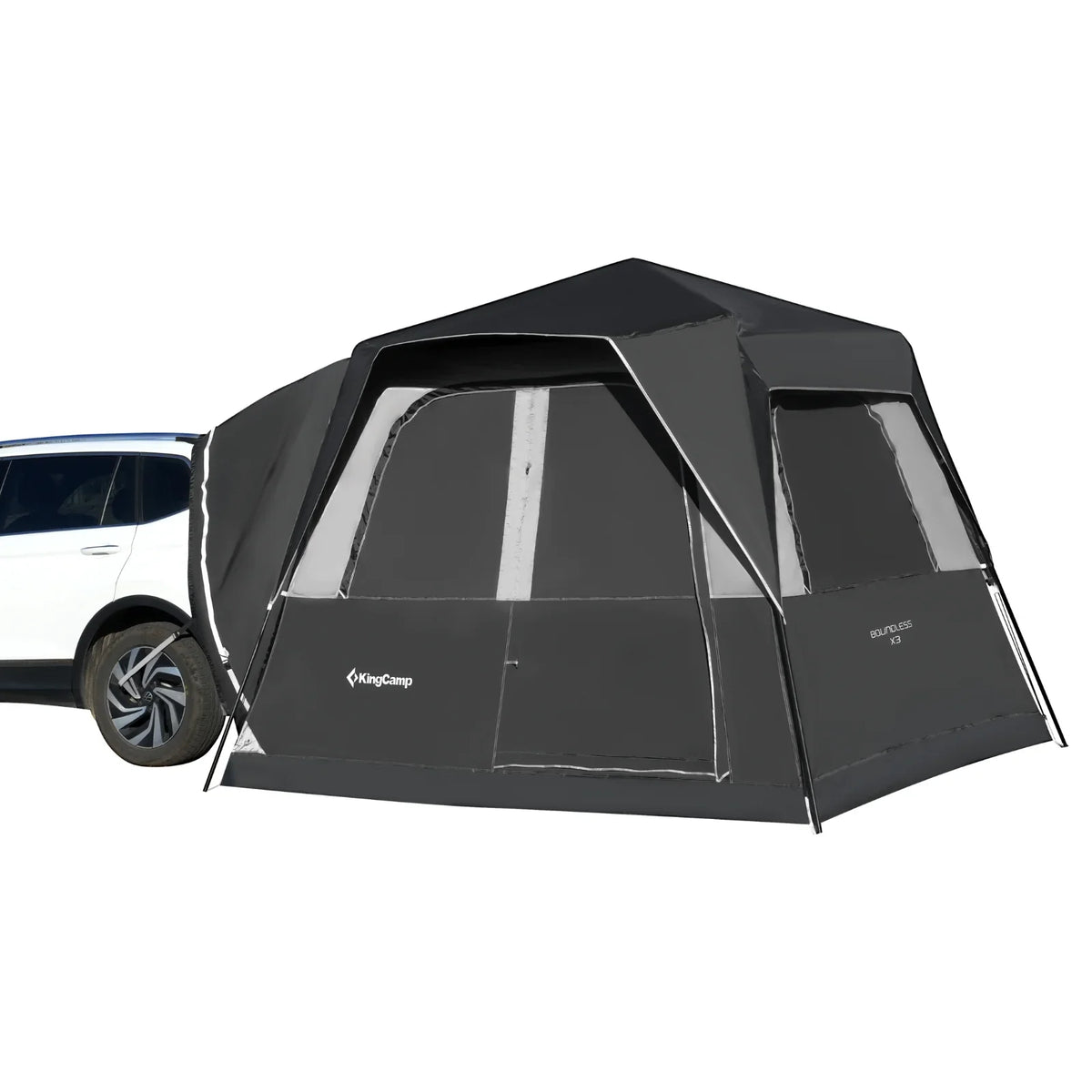
- KingCamp's BOUNDLESS X3 has a corrected connection-circumference figure of 700 cm, but that number alone does not establish a usable fit range for every rear shape.
- The BOUNDLESS AIR3 page describes a removable rear connection cloth, but does not publish a full vehicle-opening range or a verified vehicle list.
- Before ordering, send the seller your measurements and photos of the open hatch, including any rear accessories. Ask for written confirmation for the exact vehicle and tent model.
The most common measurement mistake is checking the vehicle's cargo opening while the tailgate is closed. An SUV tent connects around the open rear of the vehicle. The raised hatch, body corners and points where straps can reach all affect whether the fabric can sit evenly against the car.
This guide shows exactly what to record, how to identify likely gaps, and how to use those notes to assess the KingCamp BOUNDLESS X3 Car Camping Tent and KingCamp BOUNDLESS AIR3 Inflatable SUV Tent.

First, identify the type of rear door you have
The door's movement changes the shape that the tent must cover. Open it fully and identify whether it is a top-hinged liftgate, a pair of side-hinged doors, a split tailgate, or a hatch with separately opening glass. If your camping plan uses the glass open but the main door closed, describe that exact arrangement when asking about fit.
For most rear-sleeve tents, the simplest starting point is a top-hinged liftgate that rises over the cargo opening. Side-hinged or split doors may leave different corners exposed or place hardware where fabric and straps need to sit. A small hatchback can be a candidate, but its short body, spoiler and lower hatch height may change the sleeve angle. A small camper van may have enough width but use tall side-opening doors or accessories that prevent the same attachment method.
The Tenplay car-rear-tent guide organizes compatibility around door type, rear opening and vehicle shape. Use that as a question framework; its generic examples do not establish a KingCamp fit range.
| Rear configuration | What to inspect before buying | Why it matters |
|---|---|---|
| Top-hinged liftgate | Open-hatch height, spoiler, hatch edge and body perimeter | The sleeve must pass around the raised hatch and seal below it. |
| Compact hatchback | Low roof, short hatch projection and narrow/angled rear corners | Fabric may bunch or leave side gaps even when the opening width seems suitable. |
| Small van with rear liftgate | Width, roof height, hatch reach and strap paths | A broader or taller rear can exceed the available sleeve adjustment. |
| Side-hinged van doors | Door swing, exposed hinges and closing path | A liftgate-oriented sleeve may not seal or allow normal door movement. |
| Split tailgate or spare tire on rear | Upper/lower door position, spare-tire depth and access | The obstruction can prevent an even seal or safe operation. |
Do not infer compatibility solely from vehicle category. Even two vehicles sold as compact SUVs can have different spoilers, liftgate travel and rear-body tapers.
The measurements to take with the hatch open
Use a flexible tape measure and have another person hold it where needed. Park on level ground, open the hatch to the normal camping position, and measure the actual vehicle with its usual accessories installed. Record centimeters and inches if you plan to compare products that use different units.
| Record this measurement | Where to measure | The fit question it answers |
|---|---|---|
| Clear cargo-opening width | Narrowest useful width between the inner opening edges | Can people and gear move between car and tent without the sleeve blocking the passage? |
| Clear cargo-opening height | Opening sill to the lowest overhead edge | Is the pass-through usable once connected? |
| Outer rear width | Vehicle body across the area where the sleeve will sit | Does the tent connection have enough width and adjustment? |
| Outer rear height | Ground or relevant lower attachment point to the intended upper contact line | Can the sleeve reach around the rear without lifting its lower edge? |
| Wrap path / rear perimeter | Along the exact route the elastic or fabric edge would follow around the open hatch and rear body | Is the connection edge likely to reach and retain adjustment? |
| Hatch-open highest point | Ground to the top of the fully raised hatch or spoiler | Will the hatch fit below the tent connection and any nearby canopy? |
| Hatch-open rear projection | From the rear bumper plane to the farthest hatch edge | Is there enough space for the hatch and sleeve without pushing against the tent? |
| Lower attachment locations | Wheel arches, wheel area, permitted lower body points and their spacing | Can the specified straps be secured without crossing a hot, sharp or moving part? |
| Vehicle-to-tent ground relationship | Rear bumper and cargo-sill heights, plus ground slope | Will the passage and fabric skirt meet without a persistent low gap? |
Measure the wrap path around the actual contact line, not a rectangle calculated from width and height. Curved corners, roof rails, an extended spoiler and a liftgate that projects backward can make the real path longer than a simple 2 × (width + height) estimate. Mark the route in a photo so customer support knows what your number represents.
For example, “rear perimeter 610 cm” is incomplete. “610 cm around the outer contact path with the liftgate fully raised, from the lower left attachment point over the hatch to the lower right point” is much more useful. Keep the endpoints consistent with the tent maker's measuring instructions; a published circumference might use a different path.
Check shape and obstructions, not just numbers
After measuring, stand behind the vehicle and look for places where the connection fabric cannot lie flat. Take one straight-on photo and one photo from each rear corner with the hatch open.
- Spoiler or roof rack: Does it lift the sleeve away from the body or block the upper route?
- Rear-mounted spare tire, bike rack or cargo box: Does it project through the intended fabric contact area?
- Antenna, lights, badges or sharp trim: Could a tensioned strap rub or snag them?
- Deeply tapered rear corners: Will elastic contact the body continuously, or bridge across empty space?
- Tailgate struts and hinges: Can the hatch remain open without fabric pinching or loading a moving part?
- Exhaust outlet: Is the connection away from exhaust exposure? Never run the engine while the tent is attached and occupied.
The XQTent explanation of sleeve, strap and overlap connections is useful here because it treats the rear interface as a separate fit problem. Its generic sleeve dimensions and overlap suggestions are not KingCamp specifications, so check the actual model's instructions before using any numerical allowance.
How should the connection seal gaps around different tailgates?
A good fit is continuous contact that stays in place after the tent is tensioned. A stretchy edge alone cannot eliminate every gap if the vehicle shape forces the fabric to bridge over a spoiler, hinge or rear corner. Straps can improve tension, but their reach and safe anchoring points must be confirmed for that vehicle.
During a test setup, work around the perimeter in order: upper hatch edge, roof corners, both sides, lower corners and the vehicle-to-ground transition. Check from inside and outside for daylight. Recheck after the tent has been staked and its lines tensioned; pulling the shelter away from the vehicle can reopen a gap that looked closed during loose fitting.
| Gap you see | Likely cause to investigate | Appropriate next check |
|---|---|---|
| At the top beside the spoiler | Raised hatch shape holds the sleeve off the roof | Confirm approved fabric path and available adjustment. |
| At a rear corner | Tapered body or uneven tension | Follow the attachment sequence and check both sides. |
| At the bottom near the bumper | Sleeve skirt too high, sloping site or strap geometry | Check the model's lower attachment and ground setup. |
| Along a side after staking | Tent is pitched too far from the vehicle or off-center | Reposition the tent within the maker's setup instructions. |
| Around side-hinged doors | Connection designed for a different door movement | Ask for model-specific fit confirmation; do not force the doors. |
Avoid making permanent changes to the vehicle or tent to close an unverified fit. Do not cover tail lamps, block required ventilation, trap the exhaust outlet, or attach straps to hot or moving components. A fabric sleeve can help reduce insects and rain entry when correctly installed, but no universal sleeve guarantees an airtight, watertight seal on every body shape. Napier's SUV tent fit FAQ also describes its sleeve as fitting a range of vehicles while acknowledging that fabric connections do not create a perfectly airtight seal on every vehicle; its published fit limits belong to Napier products only.

What does KingCamp publish for the BOUNDLESS X3?
The current KingCamp BOUNDLESS X3 Car Camping Tent page describes a detachable vehicle connector and adjustable rear attachment. The supplied product correction sets the connection circumference at 700 cm. Its tent body is listed as 280 × 280 × 220 cm when set up; those are tent dimensions, not the size of the opening that wraps around your vehicle.
The 700 cm figure deserves careful reading. A circumference is a length around a route. Without the exact measuring route, the elastic adjustment range and an approved vehicle-fit chart, it cannot prove that every vehicle whose measured perimeter is below 700 cm will fit. A much smaller hatch might leave excess material; a spoiler can consume reach even when a simple perimeter appears acceptable.
Use X3 as a candidate if its detachable connector and quick-pitch ground shelter suit your trip. Send your open-hatch measurements, rear photos and exact vehicle year/model to KingCamp for fit confirmation, especially for hatchbacks, small vans or modified rear ends. The product page's broad SUV/minivan language is not a vehicle-specific guarantee.
What does KingCamp publish for the BOUNDLESS AIR3?
The KingCamp BOUNDLESS AIR3 Inflatable SUV Tent uses external crossed TPU inflatable columns and lists a removable rear connection cloth. The product describes a bedroom and living-room arrangement, plus an overall set-up size of 440 × 270 × 240 cm. That large tent-body size does not establish a larger or smaller vehicle connector than the X3.
Its public listing reviewed for this guide does not give a precise vehicle opening or circumference range, a measured upper and lower adjustment limit, or a verified list of compatible model years. The rear connection should be assessed from its own dimensions and attachment instructions, independently of how spacious the pitched tent is. Confirm the pump and operating instructions for the air structure separately; vehicle fit and inflatable-frame operation are different decisions.

X3 or AIR3: which fit question changes?
Both products are ground tents that connect to a vehicle at the rear. Their different support structures affect setup and equipment, but neither tent's floor dimensions answer vehicle compatibility.
| Buying question | BOUNDLESS X3 | BOUNDLESS AIR3 |
|---|---|---|
| Rear connection | Detachable connector; corrected 700 cm connection circumference | Removable rear connection cloth; exact usable fit range not published on current page |
| Tent support | Quick-open iron frame and fiberglass components | External crossed TPU inflatable columns |
| Published overall size | 280 × 280 × 220 cm | 440 × 270 × 240 cm |
| What to ask before ordering | How is the 700 cm path measured, and what is the permitted adjustment range for my hatch? | What are the rear cloth's usable dimensions and attachment limits for my hatch? |
| Special trip planning | Check connector straps and packed length | Check connection plus pump, pressure instructions and air-column preparation |
These figures describe different things. Do not compare X3's connection circumference with AIR3's tent-body length. For either product, the decisive pre-purchase answer is whether the actual sleeve or rear cloth can attach to your actual open hatch without a persistent gap or unsafe strap route.
Can a compact van or hatchback use an SUV tent?
Possibly, but the vehicle class name is not the fit test. A compact van with a top-hinged liftgate may be closer in connection geometry to an SUV than a full-size SUV with a large spare tire or split rear door. A hatchback may fit if the sleeve can reach and tighten around its lower, shorter rear without bunching or blocking the hatch.
The Napier Backroadz SUV Tent product page specifically discusses SUV and minivan liftgates, showing that rear tent designs can cover more than one vehicle category. That is a Napier product claim, not a KingCamp compatibility list. Likewise, roof-top-tent fit advice concerns roof racks and roof loads; it does not determine whether a ground tent's rear sleeve fits a tailgate.
If your vehicle has side-opening van doors, a roof ladder, spoiler extension or rear-mounted rack, ask for confirmation using photos. If the answer depends on removing a safety-relevant or permanently installed accessory, regard that as a different setup and verify it separately.
A fit request you can send before ordering
Copy these fields into a message to the seller. A complete request is more likely to produce a useful answer than “Will it fit my SUV?”
Vehicle: make, model, model year and body style. Rear door: top liftgate / split / side doors; hatch fully open in photos. Cargo opening: narrowest clear width × clear height. Outer contact path: measured perimeter with endpoints shown in a photo. Open hatch: maximum height from ground and rear projection past bumper. Accessories: spoiler, roof rack, spare tire, bike rack or other rear hardware. Lower attachment points: photos and spacing. Tent: BOUNDLESS X3 or BOUNDLESS AIR3. Please confirm the approved connection method and usable adjustment range for this exact vehicle, including where straps should attach and whether any gaps are expected.
Include rear, left-corner and right-corner photos. If the vehicle has a powered liftgate, ask whether its parked position can be held as required without the sleeve interfering with closing or sensor operation. Request the current installation manual or a model-specific fit diagram when available.
Check the fit at home before the first trip
Once you have the tent, do a dry setup on level ground before leaving for a campsite. Park with the engine off and exhaust away from the connection area. Open the hatch to the intended position, assemble the tent as instructed and center its rear opening on the vehicle. Fit and tension the connector in the manufacturer's sequence, then stake and tension the tent. Check again for gaps, trapped fabric, strap rubbing and hatch interference.
Look for clearance around doors and access to the vehicle's cargo area. If you intend to detach the vehicle for daytime driving, practice the specific disconnect and reconnect procedure and check how the tent opening is secured while the car is away. Do not assume every rear tent can remain fully weather-protected when disconnected; confirm the exact model's instructions.
Frequently asked questions
Do I measure the cargo opening or the outside of the hatch?
Both. The clear cargo opening tells you whether the passage is usable. The outer contact path and raised-hatch geometry tell you whether the tent connection can wrap around and seal. One measurement cannot stand in for the other.
Is the X3's 700 cm connection circumference a maximum vehicle perimeter?
It is the corrected connection-circumference figure supplied for X3. Without the maker's measurement route and adjustment limits, do not treat it as a guaranteed maximum or a universal fit threshold. Send your actual perimeter measurement and photos for confirmation.
Will a hatchback fit if it is smaller than an SUV?
Possibly. Smaller does not automatically mean easier: the sleeve may have excess fabric, an angled rear or spoiler can create gaps, and attachment straps still need suitable points. Check the exact hatch geometry and connection range.
Will a compact camper van fit?
It depends on whether it has a compatible liftgate or rear-door arrangement and whether the connector reaches around its width and height. A van with side-hinged doors needs specific confirmation; a broad “minivan compatible” statement does not settle every door type.
How do I close gaps at the sides of a tailgate?
First center and attach the connector in the required order, then tension the tent and recheck the corners. If a spoiler or body taper keeps fabric off the vehicle, ask the manufacturer for an approved setup or different connector. Avoid an improvised seal that blocks lights, ventilation or the exhaust area.
Are tent-body dimensions enough to compare X3 and AIR3 fit?
No. They describe living space. Ask for the separate rear connection dimensions and adjustment range for each model, plus the approved attachment points for your vehicle.
Can I run the engine while the SUV tent is attached?
No. An attached tent may trap exhaust gases near occupants. Keep the engine off while the tent is connected and people are using it. Follow the vehicle and tent instructions when disconnecting before driving.
The decision before checkout
Bring together four pieces of evidence: the open-hatch measurements, a clear photo set, the tent connector's actual adjustment limits, and an approved attachment path for your vehicle. With those, you can choose between X3 and AIR3 for their different living-space and setup features. Without them, a broad “SUV compatible” label is only a starting point.
Share:
How Do You Know Whether a Tent Stove Jack Fits Your Chimney Pipe?
Will a Large Tent Fit in Your Car Trunk After It Is Packed?