

TL;DR
Match the exact outside diameter and type of pipe at the point where it passes through the tent, not merely the stove model name. Then verify the approved stove-jack opening or pass-through assembly, pipe route and height, supports, floor arrangement, ventilation and the required clearances from every combustible surface. A stove jack on a product page is not proof that a particular stove and pipe can be installed safely.
KingCamp's Surefire Camping Wood Tent Stove (Size L) lists a 70 mm (2.75 in) chimney pipe and six sections. The current MOUNTAIN IN C5 and Snowhouse 5 listings show stove-jack features, but do not publish enough opening and clearance details to certify either as a match to this stove. Obtain the current instructions or a written model-specific compatibility answer before cutting, modifying or firing the assembly.
The tempting shortcut is to compare two labels: “stove jack” on a tent and “tent stove” on a heater. The safer and more useful comparison is physical. Which pipe section passes through which protected opening? What keeps hot metal away from fabric? Where do the pipe and stove sit after the tent is fully pitched and tensioned?
This guide gives a buyer's measurement checklist and a pre-use inspection sequence for the three KingCamp products listed here. It deliberately leaves an exact clearance number open where the relevant product instructions do not supply one.

What needs to match at the stove jack?
Measure the pipe's outside diameter at the actual pass-through location. Pipe listings can describe a nominal size, the inner diameter, the outer diameter, or a connection fitting. An adapter, spark-arrestor section, heat shield or double-wall pass-through section can have a different outer diameter from the ordinary pipe below it.
| Check | What you need from the exact products | Why it matters |
|---|---|---|
| Pipe outside diameter | Actual diameter of the section that crosses the tent plane | The stove-jack opening or approved fitting must accept this part, not just the bare lower pipe. |
| Stove-jack usable opening | Manufacturer's approved size or adjustable range, measured as instructed | A photo of a round ring does not establish the working opening or required overlap. |
| Pass-through construction | Approved jack, sleeve, thimble or insulated transition for this pipe type | The protected exit has to keep hot components from contacting tent fabric. |
| Pipe route and height | Stove position, jack location, roof slope, number and length of sections | A nominal pipe length does not confirm that the assembled chimney reaches or clears the exit correctly. |
| Supports and restraints | Approved pipe bracing and tent anchoring instructions | The pipe must remain in its intended position as wind, fabric tension and heat change. |
| Stove and floor location | Approved footprint, groundsheet opening and noncombustible base | A heat-resistant mat does not establish clearance to walls or guarantee floor protection. |
The Kodiak Canvas guide to stove jacks organizes the decision around jack function, pipe diameter and field checks. That is the right order of questions, but its sizing and model examples belong to Kodiak equipment. The CanvasCamp Exit 1 product page likewise separates technical properties, included parts and installation instructions for a specific exit. Its dimensions cannot be assigned to a KingCamp jack.
Do not cut the opening to make a pipe fit
Some stove-jack systems are designed for an approved, carefully prepared opening; others rely on a fixed ring or a specified replacement part. Do not enlarge a KingCamp jack, remove its ring or substitute a household chimney component based on a generic tutorial. Confirm the exact manufacturer's approved method and whether modifying the supplied jack affects the protection it provides.
What KingCamp currently publishes for these three products
| Product | Published information relevant to this decision | Information still needed to approve a pairing |
|---|---|---|
| KingCamp MOUNTAIN IN C5 Cabin Tent with Stove Jack & AC Port | Built-in stove jack; product page lists a 74 × 40 cm fire-resistant ground cloth | Usable jack/transition diameter, approved pipe type, stove and pipe clearances, exact stove placement and compatible models |
| KingCamp Snowhouse 5 Insulated Quilted Cabin Tent with Stove Jack | Stove-jack feature with a metal ring; removable/openable groundsheet area; included protective cloth | Ring opening and protected pass-through dimensions, approved pipe and stove setup, clearances to insulated walls/roof, floor instructions |
| KingCamp Surefire Camping Wood Tent Stove (Size L) | 70 mm / 2.75 in chimney pipe; six sections; approximately 2.7 m assembled total height; 80 × 125 cm silicone-fiberglass ground mat included | Required stove-body and pipe clearances for each installation, approved tent exits/transition pieces, supported pipe configuration and operating instructions |
These product-page facts make a candidate comparison, not a compatibility certificate. They do not state that Surefire Size L is approved for either tent. The C5's listed protective cloth and the Surefire mat also differ in dimensions; neither size is a manufacturer-issued distance to nearby fabric.
MOUNTAIN IN C5: check the position, not just the label
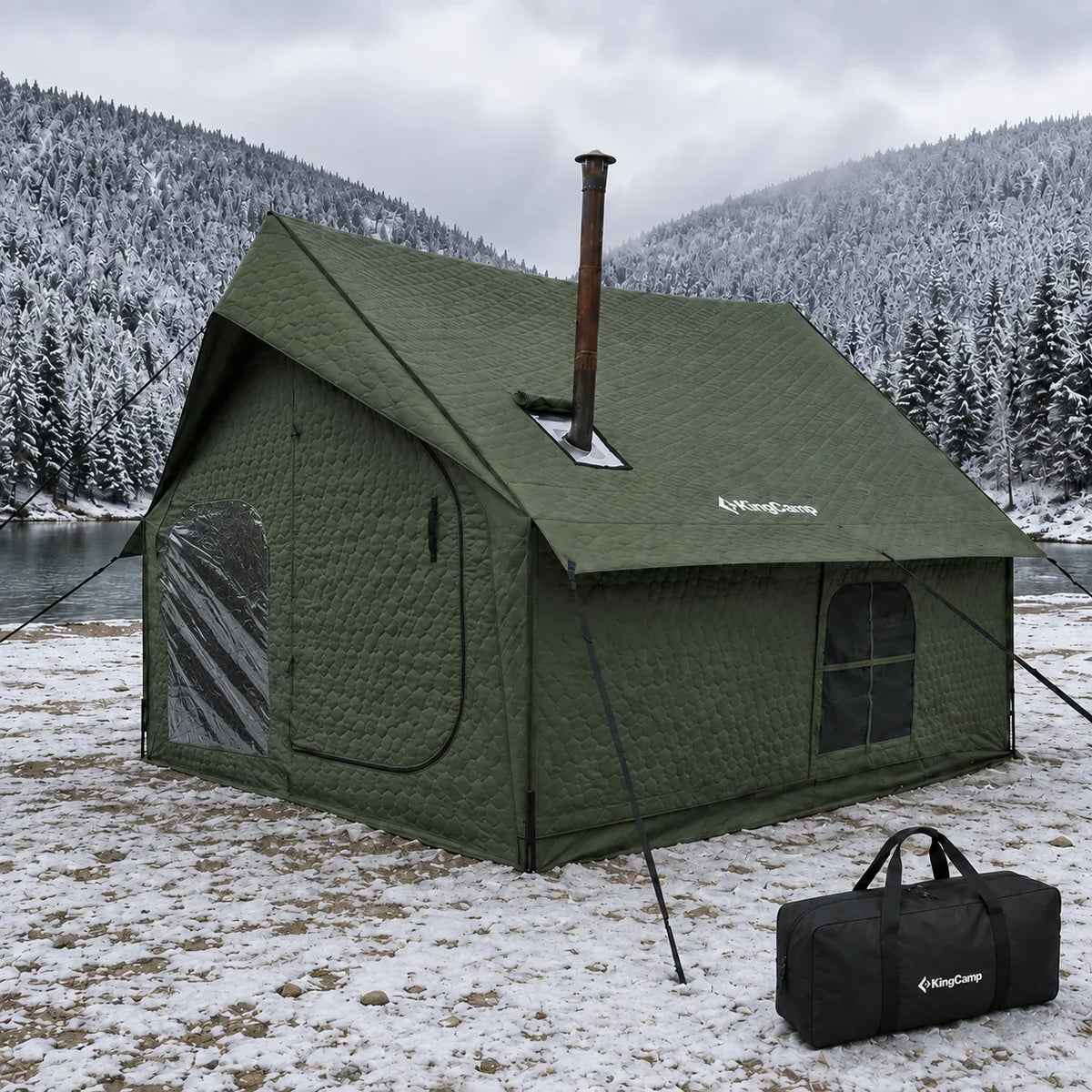
The KingCamp MOUNTAIN IN C5 Cabin Tent with Stove Jack & AC Port has a built-in stove jack and a ridge-frame cabin shape. Its page includes a 74 × 40 cm protective ground cloth. It does not specify the jack's usable pipe diameter or a model-specific stove-body and chimney clearance in the public details reviewed for this guide.

Snowhouse 5: confirm the ring and insulated-wall clearances
The KingCamp Snowhouse 5 Insulated Quilted Cabin Tent with Stove Jack lists a metal-ring stove-jack design and a groundsheet section that can be removed or opened in the stove area. Its page also mentions a fire-resistant protective cloth and ventilation openings. It does not publish the ring's working diameter or the clearance specification needed to approve a 70 mm Surefire pipe.

For an insulated tent, ask specifically about distance from the stove body and every pipe section to the inner lining, outer wall, roof and any hanging item. An open floor section does not make adjacent fabric or the ground beneath automatically suitable. Confirm the approved floor treatment and the jack's instructions for the exact Snowhouse 5 variant.
Surefire Size L: a stated pipe diameter is only the starting point
The KingCamp Surefire Camping Wood Tent Stove (Size L) lists 70 mm (2.75 in) chimney pipe sections, six sections and approximately 2.7 m assembled total height. Its package also lists an 80 × 125 cm silicone-fiberglass ground mat, gloves and other accessories. These are useful first-party facts about the stove package.
They do not say that a bare 70 mm pipe may pass directly through either tent's fabric, that all six sections are correct for an off-center jack, or that the included mat replaces the required air space around the stove. A connector, shield or other approved exit component may alter the diameter at the tent. Obtain the current stove instructions and the tent's approved jack configuration before purchasing them as a pair.
How much clearance should there be around the stove and chimney?
Use the clearance specified for the exact tent, stove, pipe and approved pass-through assembly. There is no defensible single centimeter or inch value in the three current product pages that can be applied to every side of this installation. Different components can require different distances: stove body to wall, unprotected pipe to fabric, protected pass-through to the roof, and stove base to the floor.
The Shasta Vent clearance article distinguishes chimney pipe, connector pipe, stove body and wall penetrations. That distinction helps avoid treating every hot surface as the same part. Its numerical examples concern specified residential chimney systems and are not KingCamp tent clearance values. The Tiny Wood Stove wall-exit guide similarly shows that a wall exit is a designed assembly with parts and an installation process, not just a hole; its yurt/wall instructions cannot authorize a KingCamp roof-jack installation.
If the manual for any component gives a minimum distance, measure it from the component and surface it names. If the tent and stove manuals specify different requirements for the same relationship, obtain a manufacturer-approved resolution and use the more restrictive applicable instruction. If you cannot establish the required distances for the proposed arrangement, do not light the stove inside that tent.
Why a heat-resistant mat is not a clearance rule
A mat can protect the area beneath a stove from some heat or embers within its stated use. It does not establish wall clearance, pipe clearance, jack compatibility, or protection for the entire floor. The C5 cloth is listed at 74 × 40 cm and the Surefire mat at 80 × 125 cm; neither dimension states how far the stove must be from combustible material. Do not stack or substitute them as a guessed solution to missing instructions.
A first-time hot-tent pre-use check
Do this at home in a dry, unoccupied practice setup before relying on heat at camp. Follow the current instructions for every component. The Wood Stove Works beginner safety guide frames the task around suitable equipment, chimney assembly, ventilation and checks before operation; the POMOLY hot-tent guide similarly distinguishes stove choice, tent compatibility and chimney routing. Their generic distances or installation claims do not replace KingCamp documentation.
- Identify exact models and revisions. Record the tent variant, stove variant, jack and any transition or shield part numbers. Obtain the current setup and operating manuals.
- Verify the fit on paper. Confirm the outside diameter at the exit, approved jack opening/assembly, roof path, required pipe height and support method. Do not cut fabric to force a fit.
- Pitch the tent completely. Stake and tension it as directed before locating the stove. Check how wind and fabric movement could change the available space.
- Check floor and clearances. Use the specified base and floor opening. Measure the required distances to walls, roof, inner lining, doors, gear and sleeping positions.
- Assemble and inspect the chimney. Check section joints, support, exit alignment and spark-control components required by the stove instructions. No pipe should rest against tent fabric.
- Plan ventilation and detection. Keep the required openings clear and use a carbon-monoxide alarm appropriate for the camping setting according to its instructions. An alarm is an additional safeguard, not permission to reduce ventilation or clearance.
- Operate only as instructed. Use approved fuel, keep combustible items out of the required clearance zones, watch the stove while it is operating, and extinguish it before leaving or sleeping if that is required for safe operation by the applicable instructions.
- Recheck during and after use. Watch for fabric movement, changing pipe position, smoke leakage, damaged components and hot surfaces. Let the stove and chimney cool fully before dismantling.
If instructions are missing, a photo or a general blog cannot fill the gap. Request written compatibility and clearance guidance from KingCamp for the exact tent, stove and jack configuration.
Frequently asked questions
If the pipe is 70 mm, does any 70 mm stove jack fit?
No. Confirm whether both measurements are outside diameter versus usable opening, and whether the section at the tent is a protected transition with a larger outer diameter. Also verify the jack design and approved clearance, not just a nominal number.
Can I use the C5 or Snowhouse 5 with Surefire Size L?
The public pages establish stove-jack features and a 70 mm Surefire pipe, but do not provide enough matching opening, pass-through and clearance data to confirm the complete combination. Obtain model-specific written guidance before use.
Can I trim the stove-jack opening myself?
Only if the instructions for the exact jack explicitly authorize that method and specify how to keep its protective design intact. Do not infer permission from a generic installation video or another brand's product.
How far should a chimney pipe be from the tent wall?
Use the stated clearance for the exact pipe section and tent material. Unprotected pipe, protected pass-through and stove body can have different limits. The current KingCamp product pages reviewed here do not establish a universal distance for these combinations.
Does a fire-resistant floor mat make the setup safe?
No single mat verifies the entire installation. Check its intended use and coverage, the approved floor opening or base, and all wall, roof, pipe and stove clearances separately.
Is a stove jack enough ventilation for a wood stove?
No. The chimney exit is not a substitute for the ventilation required by the stove and tent instructions. Keep specified air openings unobstructed and use an appropriate carbon-monoxide alarm as an added safeguard.
Can I leave the stove burning while my family sleeps?
Follow the exact appliance and tent instructions. Never leave a lit stove unattended; a first-time user should not assume that an installed pipe or alarm makes overnight unattended operation safe. Plan bedding and clothing for the weather without depending on an unverified overnight burn.
The decision before lighting the stove
A workable hot-tent setup is a documented system, not a match between two product labels. For these KingCamp products, confirm the 70 mm pipe's actual pass-through configuration, the C5 or Snowhouse 5 jack's approved opening, the stove location, chimney support, floor treatment, ventilation and every required clearance. When those facts are confirmed for the exact models, follow the supplied assembly and operating instructions. Until then, leave the stove unlit inside the tent.
Share:
How to Fit Camping Cots in a Tent—and Leave Room to Walk
What Should You Measure at the Back of Your Vehicle Before Buying an SUV Tent?